

Finding good candidates is one of the hardest parts of the hiring process. Job ads still matter, but they often bring too many random applications and not enough people who truly fit the role.
That’s why many recruiters use candidate sourcing platforms. The best sourcing tools help you search for qualified talent, find contact details, build candidate lists, manage outreach, and keep your hiring pipeline active. Some focus on LinkedIn and public profiles. Others search across job boards, niche communities, databases, or AI-based talent pools.
Good talent sourcing software can save time and improve hiring quality. It helps recruiters move faster, reach passive candidates, and spend less time on manual searches. Instead of switching between tabs, copying profiles, and tracking messages by hand, you can focus more on starting real conversations.
But sourcing isn’t always the best answer. Sometimes it’s faster and cheaper to outsource the work to an independent specialist or freelancer, especially for short-term projects or one-off tasks. We’ll cover that option too.
In this guide, you’ll find 12 top candidate sourcing platforms worth checking in 2026:
- SeekOut
- Fetcher
- LinkedIn Recruiter
- AmazingHiring
- Gem
- HireEZ
- Manatal
- Dice
- Indeed
- Juicebox
- Workable
- Useme
The shortlist was built by comparing widely used sourcing tools across core criteria like sourcing capabilities, candidate data quality, outreach features, integrations, ease of use, and overall fit for modern recruiting workflows.
Top candidate sourcing tools and platforms – at a glance
| Platform | Type | Best For | Pricing |
| SeekOut | AI sourcing and outreach platform | Enterprise healthcare and tech talent, high-compliance US and Canada roles, autonomously automated outreach | From $833/mo for SeekOut Recruit for enterprise teams or $1,788/yr for individual recruiters |
| Fetcher | AI sourcing and outreach platform | Outbound knowledge workers, lean in-house teams, automated email sequences | From $115/mo to $649/mo or custom |
| LinkedIn Recruiter | Professional network sourcing tool | Direct network engagement, fresh user-updated records, standard candidate pipelining | ~$1,680/yr for Recruiter Lite, ~ $10,800/yr per seat for Recruiter Corporate |
| AmazingHiring | Professional network sourcing tool | Deep engineering hiring, evaluating developer code contributions, complementing LinkedIn | Custom |
| Gem | AI sourcing and outreach platform | Mid-to-large in-house teams, multi-channel sequencing, end-to-end pipeline tracking | $135–$405/mo for startups, custom pricing for enterprise |
| HireEZ | AI sourcing and outreach platform | Enterprise outbound pipelines, replacing manual Boolean queries, multi-channel automation | Custom |
| Manatal | Recruitment CRM and pipeline management tool | Small-to-mid-sized agencies, affordable setup workflows, ranking internal candidates | $15–$55/mo per user or custom pricing |
| Dice | Resume database and job board | US-based tech roles, active or semi-passive developers, skill and location filtering | $399/mo for a single job slot, from $649 for monthly subscriptions |
| Indeed | Resume database and job board | Active applicant generation, rapid inbound screening, scale-driven job sourcing | From $5/day or $150/mo for sponsored jobs, from $96/mo for Smart Sourcing |
| Juicebox | AI sourcing and outreach platform | Startup and SMB teams, avoiding complex syntax, plain-English discovery | From $139/mo per seat or custom for Business plan |
| Social and community-based sourcing platform | Grassroots talent discovery, hyper-niche specialists, low inbox competition | No standard recruiting-platform pricing | |
| Workable | Recruitment CRM and pipeline management tool | SMB all-in-one hiring, unified tracking and workflows, connecting recruiting to HRIS | From $299/mo for Standard, from $719/mo for Enterprise |
| Useme | Freelancer and outsourcing platform | Independent contractor bases, flexible external pools, compliant billing | 4.99% of invoice value per job or custom volume pricing |
Pricing information is based on publicly available sources as of May 2026. Prices may change over time, so always check the provider’s website for the latest details.
Overview of best candidate sourcing tools for recruiters
1. SeekOut
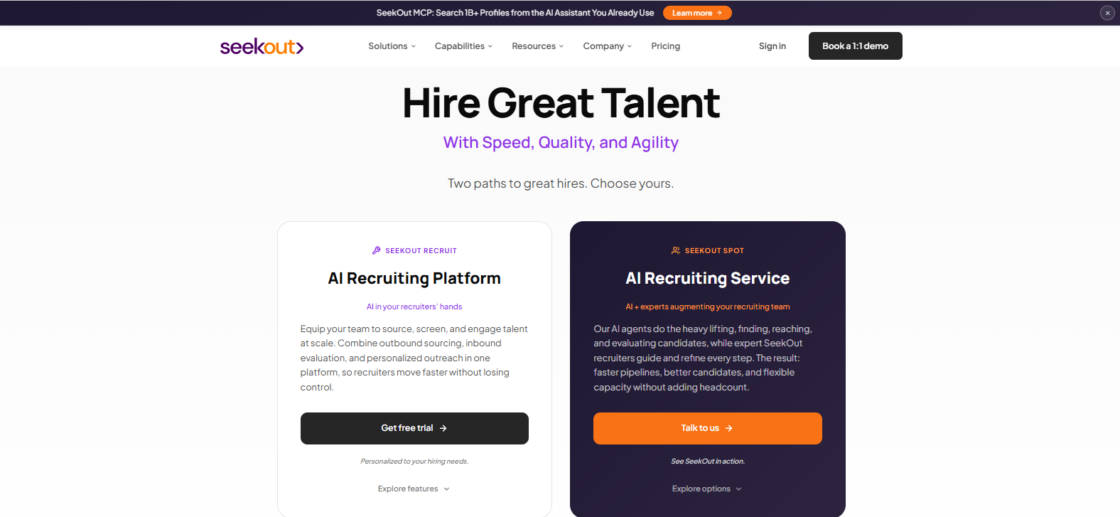
SeekOut is an agentic AI talent search engine built for specialized and technical hiring. It searches across over one billion profiles, pulling data from LinkedIn, GitHub, academic publications, patents, and internal ATS databases. The platform includes over 300 search filters and dedicated datasets for technical talent, healthcare professionals, and security-cleared candidates.
Its agentic AI feature takes a job description and builds search criteria, finds matching candidates, and runs multi-step personalized outreach without manual input at each stage. Recruiters can also use it to rediscover past qualified candidates already in their ATS. Supported integrations include Workday, Greenhouse, iCIMS, Lever, and Bullhorn, with bidirectional sync on major platforms.
SeekOut works best for mid-to-large in-house teams hiring for technical, healthcare, or government-adjacent roles in the US and Canada. Coverage outside North America is limited, and candidate profiles are built from public data rather than self-submitted resumes. This means they can be incomplete or out of date.
2. Fetcher
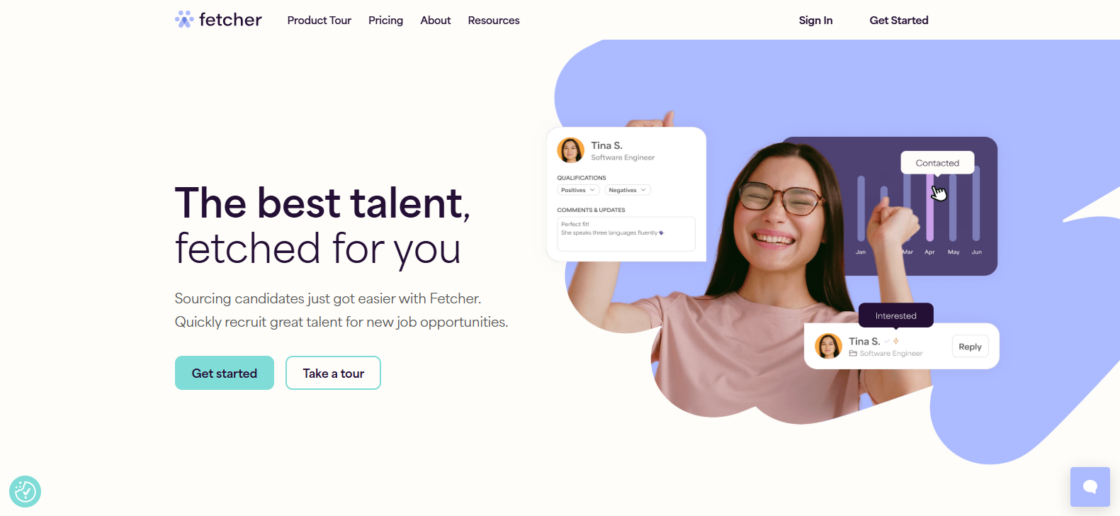
Fetcher is a recruiting automation platform that combines AI candidate sourcing with human review. Rather than relying solely on automation, Fetcher pairs AI candidate identification with human sourcers who review and quality-check candidate batches before they reach the recruiter. The platform searches a database of over 500 million profiles and supports both outbound sourcing of passive candidates and inbound applicant screening.
Key features include:
- automated email outreach sequences,
- AI-generated personalized templates,
- a DEI analytics dashboard,
- a Chrome extension.
Fetcher integrates with over 20 ATS platforms including Greenhouse, Lever, SmartRecruiters, BambooHR, and Jobvite, using Merge’s Unified API for bidirectional sync. Personalized outreach is email-only – there is no native LinkedIn or SMS channel.
The platform stops at sourcing and initial outreach. There is no built-in screening, assessment, or interview scheduling, so teams need separate tools to cover the rest of the hiring funnel. Fetcher suits in-house recruiting teams with consistent hiring volume across knowledge worker roles – less so for high-volume, technical, or agency use cases.
3. LinkedIn Recruiter
LinkedIn Recruiter is LinkedIn’s dedicated sourcing product for hiring teams. It gives recruiters access to LinkedIn’s member network – more than 1B global members – along with advanced search filters, InMail messaging, candidate pipeline management, and team collaboration tools. Because members maintain their own profiles, candidate information is often more current than in many third-party databases.
The platform supports searches based on skills, experience, location, education, industry, current employer, and other professional attributes. Recruiters can save searches, build talent pools, track candidate activity, and collaborate with hiring teams from a shared workspace. LinkedIn Recruiter also surfaces candidate recommendations based on search behavior and hiring requirements.
Newer AI features include AI-assisted search, InMail drafting, automated follow-ups, and LinkedIn’s Hiring Assistant, available as a paid add-on to Corporate plans.
LinkedIn Recruiter is widely used by in-house teams and agencies. It works well for reaching passive candidates, building professional networks, and supporting long-term hiring needs.
4. AmazingHiring
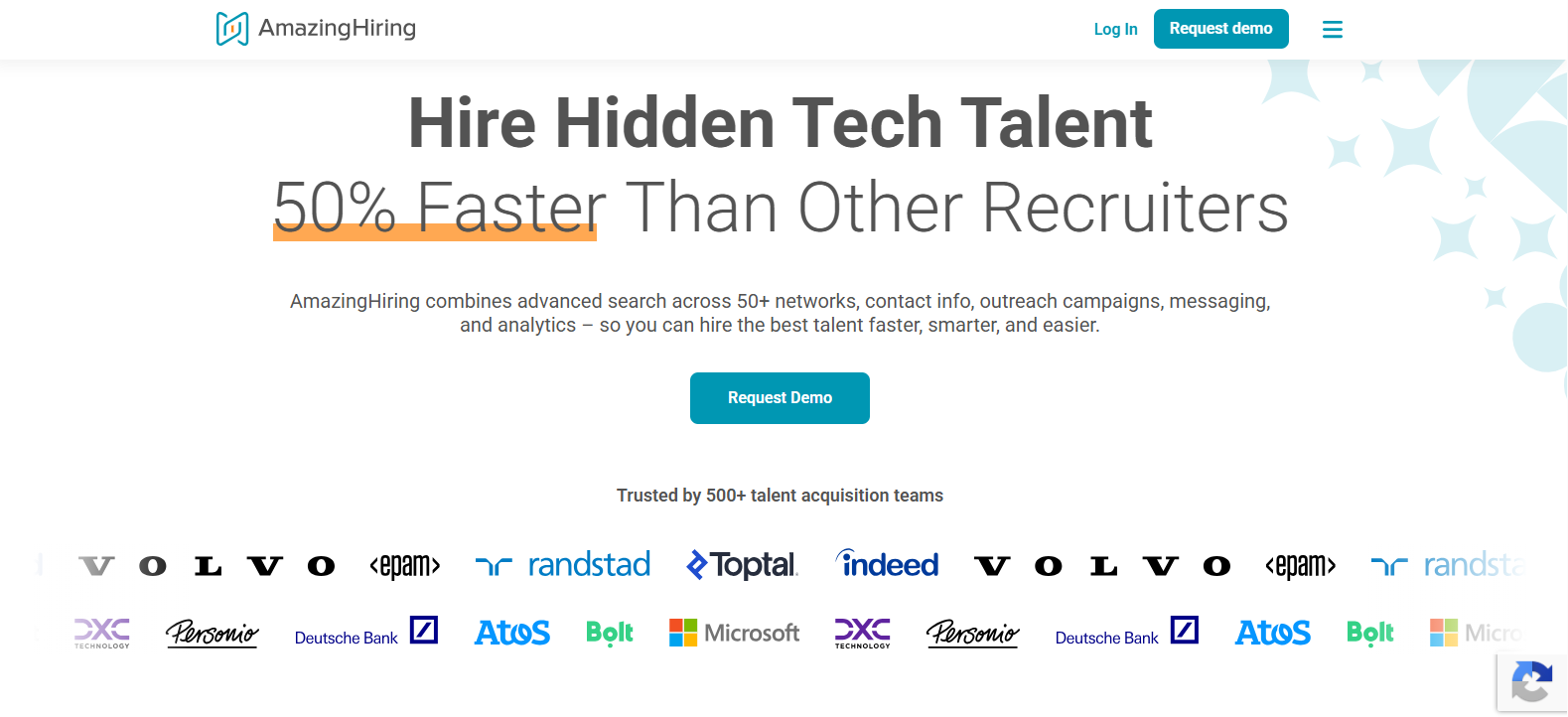
AmazingHiring is a sourcing platform built specifically for technical recruiting and evaluating technical expertise. It aggregates over 600 million profiles from 50+ sources, including GitHub, Stack Overflow, Kaggle, and LinkedIn, and consolidates publicly available data into a single candidate profile. This makes it possible to evaluate engineers based on code contributions, community activity, and technical signals that don’t appear on a standard resume or LinkedIn profile.
Core features include:
- AI-powered candidate search and ranking,
- Boolean filters,
- bulk personalized email outreach with follow-up sequences,
- engagement tracking,
- a Chrome extension for one-click profile import,
- ATS data enrichment.
ATS integrations include Greenhouse, Lever, SmartRecruiters, Jobvite, Bullhorn, and Workable. Email outreach connects to Outlook and Gmail.
AmazingHiring works best as a complement to LinkedIn Recruiter for tech-heavy hiring. Users describe it as adding depth and efficiency to outbound tech recruiting rather than replacing existing workflows.
5. Gem
Gem started as a LinkedIn sourcing Chrome extension and has since expanded into an all-in-one talent acquisition platform. It now combines ATS, CRM, sourcing, outreach automation, interview scheduling, and analytics in a single product, with a sourcing database of over 800 million profiles. Interview scheduling is built on the ModernLoop technology Gem acquired. The platform can be used as a full replacement for separate ATS and CRM tools, or layered on top of an existing ATS via integrations.
Key features include:
- AI-powered candidate sourcing with natural language search,
- multi-step outreach sequences with A/B testing,
- candidate rediscovery from existing ATS data,
- pipeline management,
- diversity tracking,
- reporting.
AI agents on higher-tier plans handle sourcing, application review, rediscovery, profile summaries, and bias detection. Personalized outreach covers email, LinkedIn InMail, and SMS.
Gem is primarily used by mid-to-large in-house recruiting teams and less suited to staffing agencies or small teams without consistent high-volume hiring needs.
6. HireEZ
HireEZ is an AI recruiting platform built around outbound candidate sourcing and outreach automation. It searches over 750 million profiles from 45+ sources, including LinkedIn, GitHub, job boards, and other public platforms. The platform features agentic AI that automates multi-step workflows from search and shortlisting through outreach and follow-up without manual input at each stage.
Core features include:
- open-web AI sourcing,
- outreach across email,
- LinkedIn InMail,
- SMS,
- ATS candidate rediscovery,
- automated applicant screening and scoring,
- a recruiting CRM,
- pipeline analytics,
- a Chrome extension.
ATS integrations include Workday, Greenhouse, Lever, SAP SuccessFactors, iCIMS, Bullhorn, SmartRecruiters, Jobvite, and Workable, with over 100 connections total. The platform is designed for mid-market and enterprise recruiting teams. Users consistently flag a steep learning curve and a feature-dense interface as the main drawbacks.
7. Manatal

Manatal is a cloud-based ATS and recruitment CRM built for small to mid-sized teams and staffing agencies.
Key features include:
- AI candidate scoring and matching,
- drag-and-drop pipeline management,
- resume parsing,
- profile enrichment from social media,
- job posting to multiple job boards,
- a Chrome extension for candidate sourcing.
Recent additions include an AI Interviewer for automated video screening, an AI Notetaker, and direct integrations with ChatGPT, Claude, and Gemini.
Manatal’s AI works primarily as a recommendation and scoring engine on top of candidates already in the system – it surfaces and ranks existing profiles against job descriptions rather than sourcing new candidates from the open web.
The platform suits teams that prioritize affordability and quick setup over deep integrations or complex automation.
8. Dice
Dice is a tech-focused hiring platform. It combines a job board with a searchable candidate database aimed specifically at technology professionals – software engineers, IT specialists, developers, and related roles. The platform’s candidate database covers millions of registered tech professionals, with search filters for skills, location, experience, and role type, plus AI-powered match scoring that highlights the closest candidates for each posting.
Core recruiter features include:
- job postings,
- database access with candidate profile views,
- employer branding pages,
- basic outreach tools.
It integrates with ATS platforms to reduce manual data entry, though integration depth is more limited than dedicated sourcing platforms.
Dice is primarily useful for US-based tech hiring. It works best as a complementary channel alongside LinkedIn or a dedicated sourcing tool, rather than a standalone sourcing solution.
9. Indeed

Indeed is a global job board and hiring platform, attracting millions of monthly visits.
Employers can:
- post jobs for free,
- search a resume database,
- sponsor listings for paid visibility,
- manage applicants through a built-in workflow with screening questions, assessments, and interview scheduling.
Indeed is strongest for active job seekers and inbound hiring at scale. It integrates with major ATS platforms via Indeed Apply. The platform has no meaningful outreach automation or passive candidate discovery. Teams looking to source candidates who aren’t actively applying need a separate tool.
10. Juicebox

Juicebox is an AI-native talent sourcing platform, used by seed-stage startups as well as enterprises. The platform’s core feature is natural language candidate search: recruiters describe who they are looking for in plain English rather than building Boolean strings, and the AI queries the database accordingly. Filters include career growth signals and funding-stage targeting alongside standard criteria like skills, location, and experience.
The platform searches 800M+ profiles from 30+ data sources and integrates with ATS platforms including Greenhouse, Lever, Ashby, Workday, BambooHR, and Personio, plus Gmail and Outlook for outreach. Additional features include:
- email outreach sequences,
- a lightweight CRM,
- an AI Agents add-on that runs searches and outreach autonomously.
Juicebox suits teams that prioritize fast outbound sourcing without Boolean expertise, particularly at the SMB and startup end of the market.
11. Reddit
Reddit is a community platform recruiters can use to research niche industries, follow professional conversations, and identify potential talent — but it has no native recruiting tools. The practical workflow is manual: find relevant subreddits, identify consistent contributors, and reach out via direct message. Some technical communities also have dedicated hiring threads.
Reddit hosts large, topic-specific communities where sustained participation often signals genuine professional expertise in a way a résumé cannot. The channel also sees significantly less recruiter activity than LinkedIn, which reduces inbox competition when reaching out to candidates.
The tradeoff is time. Reddit requires more manual effort, community judgment, and relationship-building than any dedicated sourcing tool. It works best as a supplementary channel for hard-to-fill technical or specialist roles, not as a primary sourcing method.
12. Workable
Workable is a cloud-based ATS and HR platform used primarily by SMBs and mid-market companies. Core features include:
- job posting to 200+ job boards,
- resume parsing,
- AI-assisted screening,
- candidate sourcing via a 400M+ profile database,
- customizable hiring workflows,
- interview scheduling,
- one-way video interviews,
- candidate scorecards,
- offer management.
The platform also covers HR functions including onboarding, time tracking, and payroll integrations, making it usable as a combined ATS and HRIS rather than a standalone recruiting tool.
The built-in People Search database is functional for passive candidate discovery but smaller and less specialized than dedicated sourcing platforms. Outreach is email-only with no LinkedIn or SMS automation outside of add-ons. Workable fits teams that want applicant tracking and basic sourcing in one place, not teams whose primary need is high-volume outbound sourcing.
13. Useme
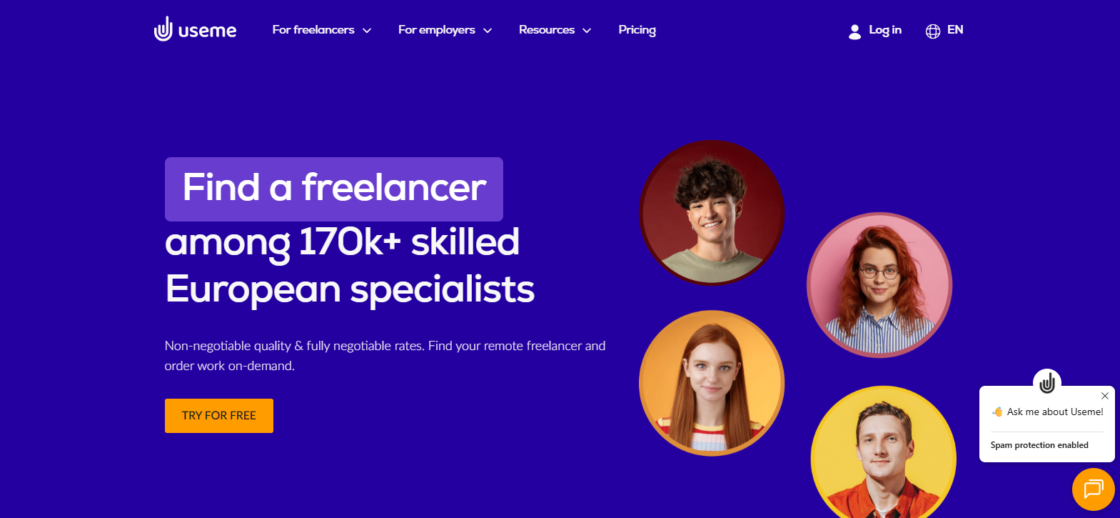
Useme is different from the other 12 sourcing platforms because it focuses on outsourcing work to freelancers rather than hiring permanent staff. It features a large pool of remote professionals across dozens of industries, with a strong focus on digital and creative fields like programming, IT, marketing, graphic design, UX, writing, and translation.
The platform is built on three main pillars that simplify the outsourcing workflow: a job board, a freelancer base, and a built-in payment tool. Once you post a job and find candidates, you can pay them compliantly on the same platform. You can also build your own freelancer base and delegate tasks when needed, without any long-term employment commitments.
Useme is especially efficient for managing global talent. The candidate pool is primarily European – a practical advantage for US-based employers looking for western-standard professionals at eastern European rates. The platform standardizes the cross-border payment process and combines multiple freelancer transactions into a single, consolidated invoice to cut down on company paperwork.
Types of candidate sourcing platforms
Not every sourcing platform works the same way. Some tools focus on AI automation, while others help recruiters search resumes or manage outreach. The best option depends on how your recruiting process works. Many companies use several types of tools together instead of relying on one platform.
Here are the most common types of candidate sourcing tools and platforms:
AI sourcing and outreach platforms
AI sourcing tools for recruiters help them find potential candidates faster and automate repetitive work. Platforms like SeekOut, Fetcher, HireEZ, Gem, and Juicebox can suggest profiles, enrich candidate data, and automate outreach campaigns. These tools are useful for outbound recruiting and large hiring pipelines. They also help recruiters spend less time on admin tasks and more time speaking with candidates.
Professional network sourcing tools
Professional network sourcing tools focus on candidate profiles and career data. LinkedIn Recruiter is the best-known example, while AmazingHiring is popular in tech recruiting. These platforms help recruiters search by skills, experience, company background, or location. They work especially well for passive candidates and specialized roles.
Resume databases and job boards
Job boards and resume databases remain one of the most common sourcing methods. Platforms like Indeed or Dice combine job postings with searchable candidate profiles. Recruiters can publish openings, search resumes, and contact candidates directly from one system. These platforms usually work best for active job seekers and high-volume hiring.
Social and community-based sourcing platforms
Some recruiters now source talent directly from online communities and discussion platforms. Reddit is one of the best-known examples because many professionals actively share knowledge there. This approach helps recruiters find niche specialists and learn more about candidate interests before reaching out. However, community sourcing usually takes more manual work and relationship building.
Recruitment CRM and pipeline management tools
Some platforms focus more on organizing hiring pipelines than sourcing candidates directly. Sourcing tools for recruiters like Manatal and Workable help teams track applicants, manage communication, and organize recruiting workflows. They combine sourcing, applicant tracking, and relationship management in one place. These platforms are especially useful for agencies and companies hiring across multiple roles at the same time.
Freelancer and outsourcing platforms
Sometimes sourcing candidates internally is not the fastest or most cost-effective option. Instead of building a hiring pipeline, companies may outsource projects to freelancers or independent specialists. Platforms like Useme help businesses manage contracts, payments, and legal paperwork in one place. This model often works well for short-term work, specialized projects, and urgent business needs.
Why candidate sourcing platforms matter in 2026
Candidate sourcing platforms have become a standard part of modern recruiting because companies can’t rely only on job ads anymore. Many skilled professionals already have jobs and never apply publicly, so recruiters need better ways to find and reach potential candidates directly.
Recruiters need access to larger talent pools
Modern sourcing tools for recruiters help them search candidates across LinkedIn, job boards, online communities, company websites, and resume databases at the same time. Instead of manually checking multiple platforms and spreadsheets, recruiters can manage more of the sourcing process from one place. This saves time and gives companies access to larger and more diverse talent pools.
Recruiting teams spend less time on manual work
They also reduce repetitive recruiting work. Recruiters spend less time searching for contact details, reviewing profiles manually, tracking follow-ups, or updating disconnected systems. That leaves more time for conversations, relationship-building, and hiring decisions.
AI changed how recruiters discover candidates
AI has also changed candidate sourcing significantly. Modern platforms can identify relevant candidates faster, improve candidate matching, and surface people recruiters may not find through standard keyword searches alone. This is especially useful for technical, niche, and hard-to-fill roles.
Hiring workflows become easier to manage
Candidate sourcing platforms also help companies stay more organized during hiring. Recruiters can manage outreach, communication history, candidate activity, and follow-ups in one system instead of switching between separate tools. This reduces the risk of missed messages and helps teams collaborate more easily.
Companies can plan hiring more strategically
Some sourcing platforms also support long-term hiring strategy. Recruiters can monitor talent market trends, understand where specific skills are concentrated, and stay connected with candidates before new roles officially open. This helps companies prepare for future hiring needs instead of starting every search from zero.
Relying on one platform alone has risks
Still, relying too heavily on one sourcing platform has risks. Recruiters may end up competing for the same candidates using the same databases and outreach channels as other companies. That’s why many teams combine several sourcing methods instead of depending fully on a single tool.
How AI tools are changing candidate sourcing
Artificial intelligence has changed how recruiters find and engage candidates. Instead of relying only on job boards, Boolean searches, and manual profile reviews, recruiters can now use AI to speed up many sourcing tasks and focus more on candidate relationships.
The shift is happening quickly. AI adoption across HR hit 43% in 2025, with 32% of organizations automating candidate searches, making automated candidate sourcing the fastest-growing use case in talent acquisition.
One of the biggest changes is candidate discovery. AI-powered sourcing tools can analyze skills, experience, and career history to surface relevant candidates beyond exact keyword matches. This helps recruiters find talent that may be missed through traditional searches.
AI also reduces the time spent reviewing profiles manually. Many platforms can automatically highlight potential matches, helping recruiters build shortlists faster. Teams using AI sourcing tools report five to ten times greater efficiency than manual candidate searches, as AI can continuously identify and engage candidates with less recruiter involvement.
Many sourcing tools now use AI for outreach as well. Automated follow-ups, personalized messaging, and communication tracking help recruiters engage more candidates without increasing administrative work. Some best sourcing tools also provide talent market insights, helping recruiters understand skill demand, talent availability, and hiring trends.
However, AI tools should support, not replace recruiters. Human judgment is still needed to evaluate candidates, build relationships, and make hiring decisions. The most effective recruiting teams combine AI-powered efficiency with human expertise.
How to choose the best candidate sourcing tool
Not every sourcing platform solves the same problem. Before choosing a platform, define what slows your recruiting team down most today. The best candidate sourcing tool depends on your (and your team’s) needs.
Start by identifying your biggest hiring challenge. Some companies need access to passive candidates, while others struggle more with outreach, organization, or scaling recruiting across multiple roles. The best talent sourcing platform should solve a specific operational problem instead of adding another disconnected tool to your workflow.
You should also evaluate how well the platform fits your existing recruiting stack. Strong integrations with ATS, CRM, email, and calendar tools reduce manual work and help recruiters avoid duplicate data entry. Ease of use matters too, especially for teams without time for long onboarding or technical setup.
The quality of AI-powered search is another major factor. Best sourcing tools understand skills, seniority, industry context, and hiring intent instead of relying only on keyword matching. It’s also important to check database freshness, profile accuracy, outreach capabilities, compliance standards, and of course the total cost before making a decision.
What to look for in a candidate sourcing platform
| If your team needs… | Look for these features |
| Access to passive candidates | Large and regularly updated candidate databases, multi-platform search, AI-powered discovery |
| Faster candidate search | Contextual AI matching, natural language search, advanced filtering |
| Better outreach response rates | Multi-channel outreach, automated follow-ups, personalization tools, A/B testing |
| Less manual admin work | ATS and CRM integrations, workflow automation, centralized candidate tracking |
| Better candidate data | Profile enrichment, verified contact details, updated work history |
| Easier collaboration between recruiters | Shared notes, communication history, pipeline visibility, role-based access |
| Hiring across multiple regions | GDPR and CCPA compliance, regional database coverage, localization support |
| More predictable recruiting costs | Transparent pricing, unlimited outreach, low add-on fees |
| Easier onboarding for recruiters | Simple interface, low-code workflows, fast implementation, strong support resources |
| Technical or niche hiring | Deep talent search, GitHub and Stack Overflow data, specialized sourcing filters |
| Diversity hiring initiatives | Diversity sourcing filters, talent pool analytics, bias-reduction tools, diversity reporting and benchmarks |
FAQ on top candidate sourcing platforms for recruiters
What are candidate sourcing platforms?
Candidate sourcing tools help recruiters identify, engage, and qualify potential candidates, often before they even apply. Depending on the platform, recruiters can search candidate databases, find contact information, automate outreach, and track recruiting activity from one place.
What are the best sourcing tools for recruiters?
Some of the most widely used sourcing tools include SeekOut, HireEZ, LinkedIn Recruiter, Gem, Fetcher, AmazingHiring, Juicebox, and Indeed. Each platform focuses on different recruiting needs. Some are stronger in AI-powered candidate discovery, while others focus on outreach automation, technical recruiting, or attracting active job seekers.
What is the difference between sourcing and recruiting?
Candidate sourcing is usually the first stage of recruiting. It’s the process of finding and contacting potential candidates. Recruiting covers the entire hiring process, including screening, interviews, offers, and onboarding.
Are AI sourcing tools worth it?
For many recruiting teams, yes. AI sourcing tools help recruiters surface relevant candidates, automate parts of the sourcing process, and reduce manual profile review. They are especially useful for technical and hard-to-fill roles. However, recruiters still need to evaluate candidates, build relationships, and make final hiring decisions.
Which sourcing platforms are best for technical hiring?
Platforms such as SeekOut, AmazingHiring, HireEZ, and Dice are commonly used for technical recruiting. They provide access to engineering and IT talent and often include technical filters, developer data, or AI-powered matching features.
How much do candidate sourcing platforms cost?
Pricing varies widely. Some platforms offer plans starting below $100 per month, while enterprise solutions can cost thousands of dollars per year per recruiter. Costs often depend on the number of users, database access, outreach volume, and advanced features.
What features should I look for in a sourcing platform?
Look for features that match your recruiting challenges. Common priorities include AI-powered search, large candidate databases, outreach automation, ATS integrations, candidate enrichment, analytics, compliance features, and support for passive candidate sourcing.
How to source freelancers?
Candidate sourcing platforms are designed mainly for employee hiring. If you need help with a project or short-term work, a freelancer platform may be a better option. Platforms like Useme let companies find independent professionals and manage payments and paperwork in one place.
This article was created with the assistance of AI technology.