

As a business grows, so does the number of invoices it needs to handle. What starts as a manageable billing process can quickly turn into a stream of documents, approval requests, and payment deadlines. Whether working with vendors, service providers, freelancers, or contractors, managing many separate invoices takes up valuable time and increases the risk of errors.
For finance teams, the challenge goes beyond paperwork. Processing multiple invoices each month makes it harder to track spending, forecast cash flow, and keep accurate records. The more invoices a team reviews, approves, and verifies, the more resources get spent on admin work instead of strategic priorities. Left unchecked, this burden grows fast – especially when dealing with high transaction volumes.
One way businesses address this problem is through invoice consolidation. Instead of issuing or receiving multiple separate invoices for related transactions, charges are grouped into a single invoice for a specific billing period.
But consolidated invoicing isn’t the right solution in every situation. Its effectiveness depends on the billing model, current invoice volume, and the expectations of customers or contractors.
In this guide, you’ll learn what a consolidated invoice is, how it works, its advantages and limitations, and when it makes sense to use it. We’ll also look at how consolidated invoicing can help businesses that work with freelancers and independent contractors manage payments more efficiently as they grow.
Key takeaways
- A consolidated invoice combines multiple charges into one bill for a set billing period – reducing paperwork and admin time for businesses and their clients.
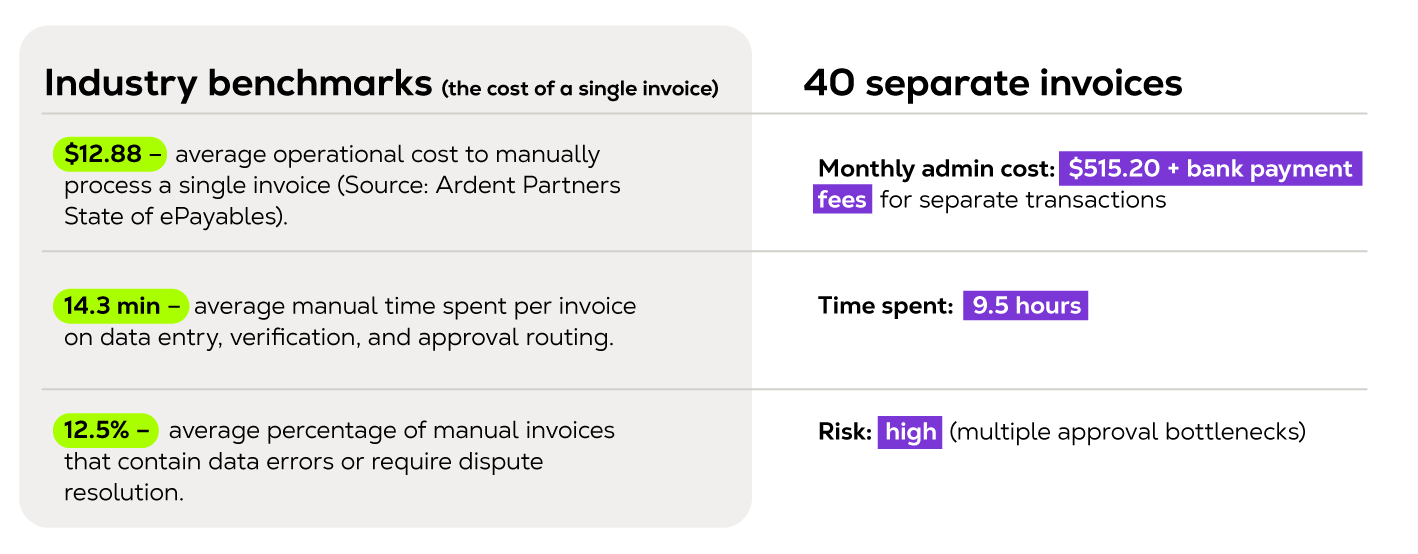
- Businesses without best-in-class AP automation spend an average of $12.88 per invoice, according to Ardent Partners’ 2024 State of ePayables report. Consolidation directly cuts that cost by reducing invoice volume.
- Consolidated invoicing works best for ongoing relationships, recurring services, and high transaction volumes – not for one-off or milestone-based projects.
- To implement it successfully, a clear billing schedule, consistent recordkeeping, and full itemization on every invoice are essential.
- Automation and AI are making consolidated invoicing faster and more accurate – especially for businesses working with global or distributed teams.
What is a consolidated invoice?
A consolidated invoice is a single invoice that combines multiple charges, transactions, or services into one bill. Instead of issuing a separate invoice every time work is completed or a purchase is made, related charges are grouped together into just one invoice at regular intervals.
The billing period can vary depending on the arrangement. Some businesses issue consolidated invoices weekly, while others prefer monthly or quarterly billing cycles. The goal is to reduce the number of invoices that need to be created, reviewed, approved, and paid.
For example, imagine a company working with the same freelance designer throughout the month. Instead of sending four separate invoices for four completed tasks, the designer includes all completed work on one invoice at the end of the month. The client receives a single bill, and both parties spend less time managing paperwork.
A consolidated invoice doesn’t mean losing visibility into individual charges. A well-prepared consolidated invoice should still provide a detailed breakdown of every service, product, or transaction included in the total amount due. This gives businesses a clearer picture of their financial activity while benefiting from a simpler invoicing process.
You may also see this referred to as consolidated billing. The terms are often used interchangeably. In a software or subscription context, consolidated billing usually refers to combining multiple subscription charges into one monthly bill. In a services or B2B context, consolidated invoicing process typically refers to grouping completed work or multiple purchases into one invoice per billing cycle. Both approaches share the same core goal: fewer documents, one payment, less administrative overhead.
When is consolidated invoicing commonly used?
Consolidated invoicing is most useful when multiple transactions occur between the same parties over a set period. Common examples include:
- ongoing freelance or contractor relationships,
- monthly retainers for marketing, consulting, or creative services,
- subscription-based products and services,
- long-term projects with multiple milestones,
- businesses that purchase from the same supplier regularly,
- organizations managing expenses across several departments or locations.
In each case, consolidation helps replace a series of individual invoices with one organized statement that’s easier to manage.
What does a consolidated invoice typically include?
While the format varies between businesses, most consolidated invoices contain:
- invoice number and issue date,
- billing period covered by the invoice,
- customer and vendor details,
- itemized list of products or services,
- quantities, rates, and individual charges,
- applicable taxes and fees,
- payment terms and due date,
- total amount due.
By bringing all relevant charges together in one document, consolidated invoicing creates a clearer overview of business activity. It also reduces admin overhead for both the sender and the recipient.
Consolidated invoice vs. standard invoice
Both consolidated and standard invoices serve the same purpose: requesting payment for products or services provided. The difference lies in how and when charges are billed.
A standard invoice is issued for a single transaction, project milestone, purchase, or completed service. Once the work is finished or the product is delivered, an invoice is created and sent to the customer.
A consolidated invoice takes a different approach. Instead of generating multiple invoices over time, related charges are collected and combined into one invoice at the end of a billing period.
Neither method is better by default. The right choice depends on the business model, transaction volume, and customer preferences.
Key differences at a glance
| Factor | Standard invoice | Consolidated invoice |
| Billing scope | One transaction or service | Multiple transactions or services |
| Invoice frequency | Issued whenever work is completed | Issued on a recurring schedule |
| Number of invoices | Multiple invoices over time | One invoice per billing period |
| Payment dates | Multiple due dates | One due date |
| Admin effort | Higher when transaction volume increases | Lower for recurring transactions |
| Best suited for | One-time projects and occasional work | Ongoing business relationships and recurring services |
When should a business use a standard invoice?
Standard invoicing is usually the better option when:
- projects are completed infrequently,
- each transaction requires separate approval,
- customers prefer individual billing records,
- services vary significantly from one project to another,
- payments are expected immediately after delivery.
Many freelancers, consultants, and service providers use standard invoices for project-based work.
When should a business use a consolidated invoice?
Consolidated invoicing is often a better fit when:
- a freelancer works with the same client repeatedly,
- multiple transactions occur within the same billing period,
- admin workload is becoming difficult to manage,
- both parties want to simplify approvals and the payment process,
- a predictable billing schedule works better for everyone involved.
This is particularly common among agencies, subscription-based businesses, and organizations managing multiple contractors or vendors.
The real difference: scale
The biggest distinction between the two methods isn’t the invoice itself – it’s the volume of activity behind it.
A standard invoice works well when transactions are occasional. As transaction volume grows, the number of invoices grows with it. Finance teams must review more documents, track more due dates, and process more payments.
Consolidated invoicing addresses this challenge by turning many smaller billing events into a single, structured process. For growing businesses, that can mean lower admin costs, faster approvals, and better visibility into overall spending.
Why businesses use consolidated invoices – key benefits
The real value of consolidated invoicing is fewer documents, better efficiency, stronger financial control, and a smoother experience for everyone involved in the payment process. As transaction volumes grow, so does the admin effort. Consolidated invoicing helps organizations handle that complexity without adding more manual work.
Reduced administrative overhead
Every invoice requires time and attention. Someone needs to create it, review it, approve it, send it, track it, and match it once payment arrives.
When dozens of invoices are generated for the same customer, vendor, or project, these tasks can quickly consume valuable resources. For finance leaders, reducing the time spent processing invoices is often a top priority.
Consolidated invoicing reduces the number of billing documents that need to be processed. Instead of managing multiple invoices throughout a billing period, a finance team can focus on a single invoice that captures all relevant activity.
This often leads to:
- less manual data entry,
- fewer approval workflows,
- reduced invoice tracking,
- faster month-end processes,
- more time for higher-value financial work.
For growing businesses, the savings from reduced admin overhead can become significant over time.
Improved financial visibility
It’s difficult to make informed decisions when financial information is scattered across numerous invoices, payment dates, and billing records.
By bringing related charges together, consolidated invoicing creates a clearer picture of spending and revenue. Everything is in one document rather than spread across disconnected systems.
This makes it easier to:
- monitor expenses,
- track project profitability,
- analyze purchasing patterns,
- review contractor costs,
- identify unusual spending trends.
Instead of piecing together information from multiple documents, decision-makers can access a more complete view of financial activity in one place.
Simplified recordkeeping
Matching invoices with payments becomes more challenging as transaction volume increases.
A consolidated invoice creates a central record of all charges in a billing period. This makes it easier to match payments, verify transactions, and maintain accurate financial records.
Benefits include:
- fewer documents to verify,
- easier audit preparation,
- reduced risk of duplicate payments,
- faster identification of errors,
- more organized accounting records.
For finance teams, this can significantly reduce the effort needed to close monthly or quarterly books.
Supported better cash flow planning
Predictable billing cycles create more predictable cash flow.
When invoices are consolidated into scheduled billing periods, both parties gain greater visibility into upcoming payments and expected revenue.This consistency makes cash flow management easier and helps reduce surprises.
Organizations can more effectively:
- forecast revenue,
- plan operating expenses,
- monitor outstanding balances,
- anticipate payment obligations,
- manage working capital.
The result is a more structured and reliable financial process – one that benefits both the business issuing the invoice and the client receiving it.
Reduced errors and missed payments
Every additional invoice introduces another opportunity for mistakes.
Duplicate charges, incorrect amounts, missed invoices, and late payments become more likely when billing activity is spread across numerous documents with different due dates.
Consolidated invoicing helps reduce these risks by centralizing billing information and creating a more standardized process. With just one invoice to review per billing period, it’s much easier to catch errors before they become disputes.
Created a better client experience
Consolidated invoicing doesn’t only benefit the organization issuing the invoice. It can also make life easier for customers, clients, and business partners.
Instead of tracking multiple invoices and due dates, recipients receive a single document – a single bill – that summarizes all charges for the billing period.
This creates a simpler payment experience by providing:
- one invoice to review,
- one approval process,
- one payment date,
- one record of transactions.
For long-term business relationships, this added convenience can boost trust and reduce admin friction on both sides.
Lowered operational costs
Processing invoices comes with both direct and indirect costs.
According to Ardent Partners’ 2024 State of ePayables report, companies without best-in-class AP processes and automation spend an average of $12.88 per invoice. For a business handling 100 invoices per month, that adds up to more than $15,000 per year in processing costs alone – before factoring in time spent on approvals, follow-ups, and disputes.
There may also be costs related to accounting software, document storage, and financial oversight. These costs multiply as invoice volume increases. By reducing invoice volume, consolidated invoicing can help lower overall operational expenses.
Scaled more easily as the business grows
One of the most overlooked advantages of consolidated invoicing is scalability.
A company working with five vendors may not feel overwhelmed by invoice management. A company working with fifty vendors, contractors, or freelancers often faces a very different reality.
Invoice consolidation allows businesses to increase transaction volume without a proportional increase in admin workload.
As an organization grows, this scalability can become just as valuable as the immediate time and cost savings.
For businesses working with freelancers, the benefits multiply
Companies increasingly rely on independent contractors, freelancers, and remote specialists to support growth.
Managing payments for multiple contributors can quickly become complex, especially when several people work on the same project or billing cycle. Each freelancer may submit invoices in different formats and on different schedules, which makes processing invoices time-consuming and error-prone.
Consolidated invoicing helps businesses:
- track contractor spending more easily,
- reduce accounts payable workload,
- maintain consistent payment schedules,
- improve budget visibility across projects,
- simplify financial reporting.
For organizations building flexible, project-based workforces, consolidated invoicing provides a practical framework for managing payments at scale – without sacrificing transparency or control.
Platforms like Useme support this directly. Useme offers grouped payments and consolidated invoices. Selected freelancer payments can be consolidated into one monthly payment. Learn more about how group payments work at Useme.
Managing multiple freelancers becomes complex quickly
Consider a marketing team that works with a copywriter, a graphic designer, an SEO specialist, a video editor, and a web developer – all during the same billing cycle.
Without consolidation, the finance team processes multiple separate invoices from each contributor every month. They often arrive on different days and in different formats. That’s a significant admin burden before any actual work gets reviewed.
With consolidated invoicing, all approved contractor costs are grouped into a single monthly invoice. The business gets a clearer picture of total workforce spend, and freelancers benefit from a clear, predictable payment schedule that removes the guesswork from their own cash flow planning.
Benefits for businesses:
- reduced accounts payable workload,
- easier contractor budgeting,
- better spending visibility,
- lower admin costs.
Benefits for freelancers:
- clear payment schedules,
- less admin friction,
- easier invoice tracking,
- fewer missed payments.
💡Learn how to issue an invoice as a contractor from our article – get to know the tips and tools to make the process smooth.
Common use cases for consolidated invoices
Consolidated invoicing is most valuable when multiple transactions occur between the same parties over a defined period. Instead of creating and processing a new invoice for every purchase, service, or milestone, related charges can be grouped into a single billing document.
While the exact setup varies by industry, several scenarios are particularly well-suited to consolidated invoicing.
Ongoing freelancer and contractor relationships
Businesses increasingly rely on freelancers and independent contractors for specialized work, from content creation and design to software development and consulting.
When contractors contribute to multiple tasks or projects throughout a month, individual invoices can quickly become difficult to manage. Consolidated invoicing allows businesses to group approved work into a single billing cycle, making payments easier to track and process.
This approach is especially useful for companies that:
- work with multiple freelancers at the same time,
- manage recurring contractor engagements,
- operate project-based teams,
- need better visibility into workforce spending.
Agencies serving long-term clients
Marketing agencies, creative studios, consulting firms, and professional service providers often deliver multiple services to the same client over an extended period.
Instead of issuing separate invoices for each service, the agency combines all charges into a single monthly invoice. This creates a simpler billing experience for both the agency and the client – one that reduces back-and-forth and supports a stronger long-term relationship.
Subscription-based businesses
Subscription-based businesses frequently offer multiple products, plans, or add-on services to the same customer.
Without consolidation, customers may receive several invoices with different billing dates. Consolidated invoicing combines these charges into one statement. This gives customers a clearer overview of recurring expenses and reduces the number of payments they need to process.
This model is common among:
- Software-as-a-Service (SaaS) providers,
- streaming services,
- membership organizations,
- cloud service providers.
Long-term projects with multiple deliveries
Projects that span several weeks or months often involve multiple deliverables, phases, or milestones.
Instead of invoicing after every completed task, agreed billing intervals can be set at regular points throughout the project. Examples include construction projects, consulting engagements, website development, and large-scale marketing campaigns.
This approach keeps billing organized while ensuring all completed work is clearly documented.
Businesses with multiple locations or departments
Large organizations often centralize purchasing while allowing individual departments, branches, or locations to make purchases independently.
Consolidated invoicing allows all charges to be combined into a single invoice while still maintaining a detailed breakdown by location, department, or cost center. This simplifies budget tracking, internal cost allocation, financial reporting, and approval workflows.
Organizations managing high transaction volumes
As businesses grow, invoice volume often increases faster than finance teams can comfortably manage.
Companies processing large numbers of transactions may adopt consolidated invoicing simply to maintain operational efficiency. Instead of expanding admin processes alongside transaction volume, invoice consolidation allows businesses to scale more effectively. It reduces the number of invoices that require review, approval, and reconciliation.
How to create a consolidated invoice
Creating a consolidated invoice involves more than combining several charges into a single document. To make the process effective, both parties need clear billing rules, accurate records, and a consistent workflow.
A good starting point is to assess the current invoice volume. So how many invoices the team creates, receives, and processes each month. This gives a concrete baseline – and a realistic sense of how much workload reduction consolidated invoicing could deliver.
Follow these steps to build a consolidated invoicing process that stays efficient as the transaction volume grows.
1. Define the billing cycle
The first step is deciding how often invoices will be issued.
The ideal billing cycle depends on the business model, cash flow needs, and customer expectations. Common options include weekly, biweekly, monthly, and quarterly billing.
Monthly billing is often the preferred choice. It provides a predictable payment schedule without creating excessive admin work.
Before implementing consolidated invoicing, make sure both parties agree on:
- billing frequency,
- payment terms,
- invoice delivery method,
- payment due dates.
This is also the right moment to configure the approval process and payment schedule so they align with the new billing rhythm. Make sure everyone involved – from accounts payable staff to project managers and contractors – understands their role in the consolidated invoicing process. Clear internal alignment at this stage prevents confusion and delays once the system goes live.
2. Decide what will be consolidated
Not every charge necessarily belongs on the same invoice.
Decide which transactions should be grouped together. Depending on the business, there may be consolidation of invoices by customer, project, department, location, contract, or billing period.
For example, a company working with multiple freelancers may consolidate all approved work completed during a month into a single invoice for each contractor.
3. Track transactions consistently
Accurate recordkeeping is the foundation of a successful consolidated invoicing process.
Throughout the billing period, maintain detailed records of all billable activities. This includes transaction dates, products or services provided, quantities or hours worked, rates and pricing, applicable taxes, and purchase order references.
The more transactions included in an invoice, the more important accurate tracking becomes. Many businesses use accounting software, project management tools, or time-tracking systems to collect this information automatically – reducing the risk that any billable activity slips through the cracks.
4. Organize and verify the invoice data
Before creating the invoice, review all recorded transactions.
Look for potential issues such as duplicate entries, missing charges, incorrect pricing, calculation errors, and unapproved expenses. A consolidated invoice often covers a larger total amount than a standard invoice, which makes accuracy especially important. Taking time to verify invoice data before sending can prevent disputes and payment delays.
5. Create an itemized invoice
Once the billing period ends, compile all approved transactions into a single invoice.
Even though the invoice is consolidated, it should still provide a detailed breakdown of every charge. Include the invoice number, billing period, client and vendor information, description of each charge, dates of service or delivery, quantities or hours, individual costs, applicable taxes and fees, total amount due, and payment terms.
Transparency helps recipients understand exactly what they’re paying for and makes internal approvals easier.
6. Attach supporting documentation when necessary
Depending on the nature of the work, supporting documents can add clarity and reduce questions. Examples include timesheets, expense reports, delivery confirmations, project summaries, and purchase orders.
This step is particularly valuable when working with large clients, enterprise customers, or long-term projects involving multiple stakeholders.
7. Send the invoice and monitor payment
After reviewing the invoice, send it according to the agreed billing schedule.
Consistent delivery dates help customers establish predictable payment routines and improve cash flow planning for both parties. Once the invoice is issued, track payment status, follow up on overdue payments, record received funds, and match the invoice with accounting records.
8. Refine the process over time
Consolidated invoicing should evolve alongside your business.
Regularly evaluate whether your current approach still makes sense by asking: Is the billing period appropriate? Are invoices easy for clients to review? Are payments arriving on time? Can any part of the process be automated to save time and reduce admin costs?
9. Run a full test cycle before going all-in
Before relying entirely on the consolidated invoicing process, run it in parallel with the existing workflow for at least one complete billing cycle.
Use this test period to verify that cost allocations are correct, payments are distributed accurately, and all stakeholders can navigate the new process without friction. A single full cycle is usually enough to surface any gaps in the setup – whether that’s a missing approval step, an unclear line-item description, or a timing issue with payment schedules.
Fixing these issues early is far easier than untangling them after several months of consolidated billing are already on the books.
Pro tip: don’t let consolidation reduce transparency
One of the biggest mistakes businesses make is assuming that a consolidated invoice should be shorter or less detailed than multiple individual invoices. In reality, the opposite is true. The most effective consolidated invoices combine admin simplicity with complete visibility. Recipients should be able to understand every charge included in the invoice without needing to ask for more details. A well-structured invoice saves time because it reduces paperwork – not because it hides important details.
Quick-start checklist: setting up consolidated invoicing
Use this checklist before you send your first consolidated invoice.
- Before you start:
- During the billing period:
- Before you send:
- After sending:
Best practices for consolidated invoicing
Consolidated invoicing can save time and reduce admin work, but those benefits only appear when the process is implemented thoughtfully.
Keep every charge fully itemized
Consolidating invoices should reduce paperwork – not visibility.
Recipients should be able to see exactly what products, services, hours, or expenses make up the total amount due. A lack of detail can create questions, slow approvals, and increase the likelihood of payment disputes. The easier an invoice is to understand, the faster it moves through approval and payment processes.
Establish a consistent billing schedule
Predictability is one of the biggest advantages of consolidated invoicing.
Whether invoices are issued weekly, monthly, or quarterly, maintaining the same schedule is important. Consistent billing cycles help customers plan payments and make internal budgeting easier. They also remove one of the most common causes of late payments: confusion over when a bill is due.
Use clear and specific descriptions
Invoice descriptions should work for the person reviewing them – not just the person who created them.
Avoid internal terminology, abbreviations, or project codes that may not be immediately recognizable to the recipient. For example, instead of writing “Development Support – Phase 2,” consider “Website Development Support – June 2026 Maintenance Updates.”
Standardize the invoice format
A consistent invoice structure makes invoices easier to review and process.
Using the same layout, categories, terminology, and formatting across billing periods helps recipients become familiar with the structure over time, which can speed up approvals and reduce admin friction. A standardized template should clearly display the billing period, itemized charges, applicable taxes, payment terms, and total amount due.
Automate data collection where possible
Manual processes become increasingly difficult to manage as transaction volumes grow.
Where possible, both parties should connect invoicing workflows with accounting software, time-tracking systems, project management platforms, and expense management tools. Automation reduces data-entry errors, improves accuracy, and helps ensure that no billable activity is overlooked.
Maintain supporting documentation
A consolidated invoice may contain dozens – or even hundreds – of individual transactions.
Keeping supporting records makes it easier to verify charges and resolve questions if they arise later. Maintaining an organized audit trail protects both parties and simplifies financial reviews, especially during high-volume billing periods.
Offer convenient payment options
Even a perfectly structured invoice can be delayed if paying it is inconvenient. Providing multiple payment methods – including bank transfers, credit cards, and online payment platforms – can help reduce friction and improve payment times.
Balance simplicity and transparency
The most successful consolidated invoicing systems strike a balance between convenience and clarity.
An invoice should be simple enough to reduce admin work, yet detailed enough to provide complete visibility into every charge. Businesses that achieve this balance often experience faster approvals, fewer disputes, stronger client relationships, and a more efficient billing process overall.
Invest in training and communication
Switching to consolidated invoicing isn’t just a technical change – it’s an operational one.
Teams that were used to processing individual invoices as they arrived will need to adapt to a new rhythm and set of responsibilities. Finance staff, project managers, and any contractors or vendors involved in the process all need to understand what’s changing and why.
Effective change management at this stage makes a real difference. Briefing teams before the switch, documenting the new workflow clearly, and ensuring everyone knows who to contact if questions arise all make a real difference. A smooth transition is far more likely when people feel informed and prepared.
Common challenges of consolidated invoicing (and how to avoid them)
Consolidated invoicing can streamline billing and reduce admin work, but it’s not without challenges.
Challenge #1: Invoices become too complex
As more transactions are added, invoices may become difficult to review and understand. Large invoices with dozens of line items can overwhelm recipients and slow down approvals.
How to avoid it: Organize charges in a logical structure – by project, department, service category, location, or contractor. Using clear headings and consistent formatting makes large invoices easier to navigate while preserving important details.
Challenge #2: Billing errors affect more transactions
With a consolidated invoice, one mistake can impact an entire billing period – rather than just a single transaction. Incorrect rates, duplicate entries, missing charges, or calculation errors can lead to disputes and delayed payments.
How to avoid it: Implement a review process before invoices are sent. Verify transaction records, check calculations, confirm approved work, and reconcile supporting documentation. The larger the invoice, the more important quality control becomes.
Challenge #3: Questions about historical charges
Because consolidated invoices often cover weeks or months of activity, clients may ask questions about transactions that occurred some time ago. If supporting information is difficult to locate, resolving those questions can become time-consuming.
How to avoid it: Maintain detailed records throughout the billing period, including contracts, timesheets, purchase orders, expense records, and project approvals.
Challenge #4: Complex pricing and discount structures
When multiple transactions are combined, determining how discounts or special pricing rules apply can become more complicated.
How to avoid it: Establish clear billing rules before implementing consolidated invoicing, and document when discounts apply, how usage is calculated, and which charges qualify for special pricing.
Challenge #5: Managing partial payments
Some customers may want to pay only part of a consolidated invoice while reviewing or disputing other charges. This can create additional accounting work, particularly when multiple projects or cost centers are involved.
How to avoid it: Define payment expectations upfront. If partial payments are allowed, establish clear procedures, track outstanding balances carefully, and communicate remaining obligations clearly.
Challenge #6: Cash flow management changes
Consolidated invoicing can change when money enters the business. A company that previously sent invoices throughout the month may receive payments in larger amounts but at fewer intervals. This can affect cash flow.
How to avoid it: Evaluate the financial impact before making the switch. Consider current payment cycles, operating expenses, and client payment habits. Some businesses choose shorter billing cycles or milestone-based invoicing to maintain a steadier flow of incoming payments.
Challenge #7: Compliance and tax requirements
Invoice requirements vary depending on jurisdiction, industry, and business structure. Applicable taxes, reporting obligations, and recordkeeping rules still apply regardless of whether invoices are consolidated.
How to avoid it: Work closely with accounting and tax professionals when designing the invoicing process. Make sure the invoices include all required information and meet local regulatory requirements.
One common concern is whether consolidating invoices changes how taxes are calculated. It doesn’t. Applicable taxes are calculated on each individual transaction, not on the invoice format. Consolidated invoices still need to itemize tax amounts per line item or service, just as individual invoices would. Businesses unsure how consolidation affects their reporting obligations should speak with a tax professional before switching.
Challenge #8: Losing transparency in the name of efficiency
Many businesses adopt consolidated invoicing to simplify billing, but some make the mistake of removing too much detail from invoices to keep them short. This creates confusion and ultimately undermines the efficiency gains consolidation is supposed to deliver.
How to avoid it: Remember that consolidation should reduce the number of invoices – not the quality of information they contain. A well-designed consolidated invoice should answer the recipient’s questions before they need to ask them.
The bottom line: Most challenges with consolidated invoicing stem from one issue: managing more information in a single document. Businesses that maintain accurate records, establish clear billing rules, and prioritize transparency can avoid most common problems – while still enjoying the efficiency benefits that make consolidated invoicing attractive in the first place.
When consolidated invoicing is not the best choice
Consolidated invoicing isn’t the right choice in every situation. Here’s when standard invoicing is the better fit.
One-off projects and occasional transactions
When a business only works with a party once or twice, there may be little value in waiting to combine charges into a single invoice. For a freelance designer completing a one-time branding project or a consultant delivering a single workshop, a standard invoice issued upon completion is often the simplest option.
Clients require separate billing for every purchase
Some organizations have strict procurement or budgeting procedures that require a separate invoice for each purchase order, individual invoices for each department, or transaction-specific approvals. When customer requirements conflict with consolidation, accommodating their process is usually the better choice.
Projects have distinct milestones and payment triggers
Many service-based businesses structure payments around project milestones – such as 30% upfront, 40% after a key deliverable, and 30% upon completion. In these situations, milestone invoicing often provides better alignment between completed work and payment collection. Waiting until the end of a billing cycle to issue a consolidated invoice could delay revenue and create cash flow challenges.
The business relies on frequent cash inflows
A business that currently invoices throughout the month may enjoy a steady stream of incoming payments. Switching to monthly consolidated billing could result in larger payments arriving less frequently. This may not be ideal for businesses with limited cash reserves or significant operating expenses.
Disputes and charge adjustments are common
When transactions frequently lead to pricing disputes, scope changes, or billing adjustments, combining everything into one invoice can complicate the dispute resolution process. A disagreement about a single charge may delay payment for the entire invoice. When disputes occur regularly, separate invoicing often provides greater flexibility.
The admin savings are minimal
If invoice volume is low, the efficiency gains may be negligible. Implementing a new invoicing process, updating workflows, and training teams may create more work than it eliminates. Consolidated invoicing tends to deliver the greatest value when invoice volume is high and recurring transactions are common.
A hybrid approach may work better
The choice isn’t always between consolidated invoicing and standard invoicing. Many businesses use a combination of both – invoicing project milestones separately while consolidating recurring monthly services, for example. This hybrid approach allows businesses to capture the efficiency benefits of consolidation while maintaining flexibility where individual invoicing makes more sense.
The key question to ask: Before adopting consolidated invoicing, ask yourself: does consolidation make billing simpler for both parties? If the answer is yes, it’s likely worth exploring. If consolidation introduces more complexity than it removes, traditional invoicing may remain the better option.
The future of consolidated invoicing: automation, AI, and global contractor payments
Consolidated invoicing is no longer just a way to reduce paperwork.
As businesses increasingly work with distributed teams, freelancers, and international contractors, invoicing is evolving from a manual accounting task into a technology-driven process that supports global operations.
Automation is becoming the standard
Many businesses still spend hours collecting transaction data, verifying charges, creating invoices, and reconciling payments. Automation is changing that.
Modern invoicing systems can automatically gather billing data from multiple sources, group transactions based on predefined rules, calculate applicable taxes and fees, generate invoices, send payment reminders, and update accounting records after payment.
Instead of manually compiling dozens of transactions at the end of each billing cycle, finance teams can focus on reviewing exceptions and resolving issues. As automation tools become more accessible, even small businesses can implement workflows that were once available only to large enterprises.
AI is improving invoice accuracy
Artificial intelligence is beginning to play a larger role in financial operations. For consolidated invoicing, AI-powered tools can help detect duplicate charges, flag unusual spending patterns, identify missing transaction data, predict late payments, suggest invoice categorization, and improve reconciliation processes.
For businesses managing large volumes of invoices, these capabilities can significantly reduce manual review time while improving accuracy.
Real-time billing data is replacing end-of-month surprises
New billing systems are moving toward real-time financial visibility. Instead of waiting for the end of a billing cycle, businesses can monitor ongoing project costs, contractor expenses, service usage, outstanding balances, and expected invoice totals throughout the month. This shift helps finance teams make better decisions in real time rather than after the fact.
Consolidated invoicing is becoming essential for global teams
Businesses today frequently work with contractors across multiple countries, currencies, and time zones – freelance designers in Europe, developers in Latin America, marketing specialists in Asia, and consultants in North America, all within the same billing period.
Without efficient invoicing processes, managing this kind of distributed workforce across disconnected systems can quickly become overwhelming. Consolidated invoicing helps centralize billing information, making it easier to manage payments, expenses, and financial reporting across a global workforce.
Contractor management and invoicing are converging
Historically, contractor management and invoicing were treated as separate processes – one system tracked work, another tracked payments. Today, those functions are becoming more closely connected. Take Useme for example: you can find freelancers, assign jobs, pay them, and collect a consolidated invoice – all with a single platform.
Businesses increasingly expect a single workflow that allows them to manage projects, track deliverables, run the approval workflow, generate invoices, process payments, and maintain compliance records. This integrated approach reduces admin overhead and provides greater visibility into contractor-related spending.
Data quality will become more important than invoice volume
As automation becomes more widespread, success will depend less on how many invoices a business processes and more on the quality of the invoice data behind them. Accurate transaction records, clear categorization, and consistent documentation will become increasingly valuable for financial reporting, budget forecasting, audit readiness, compliance, and strategic decision-making.
Conclusion on consolidated invoice
As businesses grow, so does the complexity of managing invoices, payments, and financial records. What starts as a manageable process can quickly become a time-consuming admin burden when multiple transactions, projects, subscriptions, or contractor engagements are involved.
Consolidated invoicing offers a practical solution by combining related charges into a single, organized invoice. The result is a more efficient billing process, improved financial visibility, and fewer admin tasks for both businesses and their clients.
When implemented correctly, the benefits of consolidated invoicing include:
- reduced invoice processing time,
- simplified payment tracking and reconciliation,
- improved cash flow forecasting,
- minimized billing errors,
- a better payment experience for customers and contractors,
- the ability to scale financial operations without proportionally increasing admin work.
That said, successful consolidation depends on maintaining transparency. A well-designed consolidated invoice should make billing easier to manage while still providing the detailed information needed for verification, reporting, and compliance.
As remote work, global hiring, and project-based collaboration continue to grow, businesses need invoicing processes that can keep pace. Consolidated invoicing is one way to create a more streamlined and scalable financial workflow without sacrificing clarity or control.
For companies working with freelancers and independent contractors, the benefits become even greater when invoicing is combined with efficient contract management and payment processing. Platforms like Useme help businesses simplify the entire collaboration lifecycle – from formalizing agreements and collecting invoices to making secure payments – allowing teams to spend less time on administration and more time focusing on productive work.
Ultimately, consolidated invoicing isn’t just about sending fewer invoices. It’s about creating a smarter, more organized system that supports sustainable business growth.
🚀 Ready to simplify your freelancer payments? Useme helps businesses consolidate contractor invoicing, manage agreements, and pay securely – all in one platform.
FAQs: invoice consolidation
What is a consolidated invoice?
A consolidated invoice is a single document that combines multiple charges, transactions, or services from a defined billing period into one bill. Instead of sending a separate invoice for every purchase or completed task, a party sends one invoice at regular intervals – weekly, monthly, or quarterly.
What is the difference between a consolidated invoice and a standard invoice?
A standard invoice covers one transaction or completed service. A consolidated invoice covers multiple transactions over a billing period. Standard invoices are better for one-off projects. Consolidated invoices are better for ongoing relationships with regular activity.
When should a business use a consolidated invoice?
Consolidated invoicing works best when there are multiple transactions with the same client or vendor over a short period. It’s especially useful for agencies, freelancer-heavy teams, subscription businesses, and any organization dealing with high invoice volumes.
Does consolidated invoicing affect taxes?
No. Applicable taxes are calculated on each individual transaction, regardless of whether they appear on a consolidated invoice or a separate one. The consolidated invoice should still itemize tax amounts per line item. Consult a tax professional if you have jurisdiction-specific questions.
How do I create a consolidated invoice?
The process starts with agreeing on a billing cycle and deciding which transactions to group together. All billable activity is tracked during the period, then compiled into one itemized invoice at the end. The invoice should include the billing period, a description of each charge, applicable taxes, and payment terms.
What are the main benefits of consolidated invoicing?
The key benefits include: reduced paperwork, lower administrative costs, better cash flow visibility, fewer errors, a simpler experience for clients, and the ability to scale without proportionally increasing workload.
Is consolidated invoicing the same as consolidated billing?
The terms are often used interchangeably. Consolidated billing is more common in software and subscription contexts. Consolidated invoicing is more common in B2B services. Both refer to grouping multiple charges into one payment document for a set period.
This article was written with the assistance of AI technology and is for informational purposes only. It does not constitute legal, financial, or tax advice. Always consult a qualified professional before changing your invoicing process.
| Author: Ela Binkowska |