

According to McKinsey’s “The state of AI in early 2024” report, 72% of respondents said their organizations had adopted AI in at least one business function – up from 55% the year before. And it’s not without a reason.
Market research used to mean hours of opening tabs, reading reports, and comparing sources manually. Today, AI tools can shorten that process dramatically. One of the most talked-about platforms in this space is Perplexity AI, an AI-powered research assistant that has gained significant attention since its launch in 2022.
Perplexity combines conversational AI with live web research. This is what makes Perplexity for market research such a practical choice – covering everything from early-stage analysis and competitor monitoring to customer research and strategic planning.
In this guide, we’ll cover:
- what Perplexity AI does well;
- where its limits appear;
- how you can use Perplexity for market research and competitor analysis;
- how to write prompts that produce better results;
- and how to combine AI speed with human judgment for smarter decisions.
Key takeaways on Perplexity for market research
- Perplexity AI searches the live web and returns sourced answers – making it faster than manual research for competitor analysis, trend tracking, and consumer insights.
- As with every other AI tool, the quality of your results depends on the quality of your questions. Specific, structured prompts produce far better output than vague ones.
- Follow-up questions are essential. Build research in layers rather than relying on a single query.
- Always verify key findings. AI tools can misinterpret sources or overstate certainty – especially for financial data and market size estimates.
- Perplexity Deep Research (available on Pro accounts) is suited for in-depth reports, market entry analysis, and investor materials.
What is Perplexity AI?
Perplexity AI is an AI-powered research tool. It helps you find, understand, and summarize information from the web. As opposed to Gemini or Claude, which are generative AI assistants, Perplexity is a research engine.
The platform ensures access to real-time, updated information, ensuring that handled data remains relevant and current for ongoing research. Instead of returning links like a traditional search engine, it generates direct answers based on multiple sources and presents them in a clear, structured way.
At its core, Perplexity uses natural language processing to interpret questions the way a person asks them. This includes complex, multi-part questions that could overwhelm a standard search engine. Perplexity AI’s ability to maintain conversation context allows for deeper exploration of specific topics, giving valuable insights for market research analysis.
As a result, you can explore complex business topics without needing advanced search skills or manually filtering results.
Don’t have time to run the research yourself? Find a Perplexity AI specialist on Useme who will handle the prompts, compile the findings, and deliver ready-to-use insights – so you can focus on decisions, not searches. Browse freelancers with Perplexity skills on Useme →

Perplexity for free vs. Perplexity Pro
The free plan gives you access to basic web search and AI-generated answers. It’s enough for occasional research tasks or testing the platform.
Perplexity Pro adds higher usage limits, access to more powerful models, and the Deep Research feature – check perplexity.ai for current pricing. For teams doing regular competitor monitoring or market analysis, the additional features may justify the cost – depending on how frequently the tool is used.
The benefits of Perplexity AI for businesses
In business, Perplexity for market research is especially useful when you need fast, reliable context, such as:
- analyzing a market before launching a product or service;
- reviewing competitors and their positioning;
- understanding customer needs and industry trends;
- supporting sales and outreach strategies with real data.
What sets apart Perplexity for market research is its ability to combine speed with context. Instead of giving isolated facts, it connects information into a coherent explanation backed by sources. It also maintains conversation context across a session. This lets you explore specific topics in more depth as the conversation develops. Early-stage research becomes much faster and easier to act on.
Perplexity AI vs. other AI platforms: a brief comparison
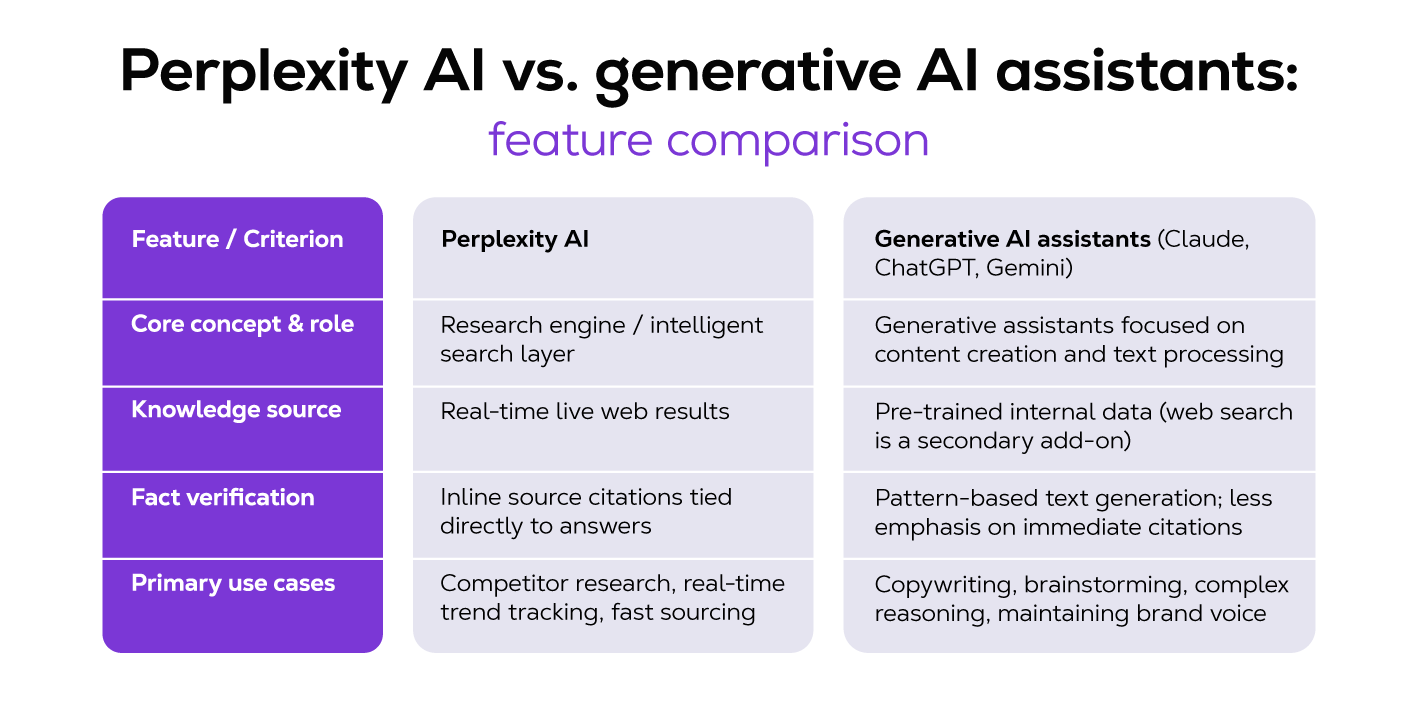
As we said before, Perplexity is a research engine. Tools like Claude are generative AI assistants. That distinction matters more than it might seem. ChatGPT, Gemini, and Claude are built around generating text – answering questions, writing content, summarizing ideas – based on their training data. They are powerful for copywriting, reasoning, and content creation. But their main purpose isn’t the web search feature.
Perplexity, on the other hand, was built from the ground up around search and sourcing. Every answer it gives is tied to live web results. It cites its sources inline, so you can verify what it found. The interface is closer to an intelligent search layer than a chatbot.
If you’re doing competitor research or tracking a trend in real time, Perplexity is the better fit. If you need to generate content, build on an idea, or maintain a consistent brand voice, a generative AI assistant may serve you better.
Curious how other AI tools stack up for business tasks? Check out our roundup of the 14 best AI tools for freelancers.
Step-by-step: how to use Perplexity for market research
AI tools can significantly improve how you approach market research. But only when used with intention.
The four sections below walk you through the most common research tasks. Each includes ready-to-use prompts and suggested follow-up questions. Copy them directly into Perplexity and adapt the bracketed fields to your context. This is how you use Perplexity for market research.
Step 1 – Competitor analysis
Using Perplexity AI for competitor analysis can help identify strengths and weaknesses. This allows businesses to make better strategic decisions based on detailed data about competitor strategies and products. Start by mapping who’s out there and how they communicate.
What to do with the output: Use the comparison to map where your offer is genuinely different. Look for gaps in competitor messaging – things customers care about that no one is addressing clearly.
Starter prompt:
“Give me a detailed overview of the main competitors in [your industry] in [geography]. For each, summarize their core product or service offering, key messaging, and any notable recent activity such as product launches, campaigns, or press coverage.”
Follow-up prompts:
“What are the most common customer complaints about [competitor name] based on public reviews and online discussions?”
“Where does [competitor name] appear weakest compared to others in this space? What gaps in their offer could a new entrant exploit?”
“How does [competitor name] position itself in terms of pricing – premium, mid-market, or budget – and what signals support that?”
Step 2 – Consumer insights and customer behavior
Understanding customer behavior is essential for meeting their needs. Using AI tools like Perplexity can help gather insights into consumer challenges and preferences. Before making product, pricing, or messaging decisions, you need to understand what your customers actually want – and what frustrates them.
What to do with the output: Use the language customers already use to shape your copy and messaging. Objections surfaced here are also useful for sales scripts and FAQ content.
Starter prompt:
“What are the main needs, frustrations, and priorities of [target audience] when it comes to [product or service category] in [geography]? Draw from public discussions, reviews, and any available research.”
Follow-up prompts:
“What language do people in this segment use to describe their problems? What specific words or phrases come up most often?”
“Are there differences in needs or priorities between [segment A] and [segment B] within this audience?”
“What objections do customers in this category most commonly raise before making a purchase decision?”
Step 3 – Trend analysis
Trend analysis in market research can identify emerging cultural shifts and notable industry trends. Spotting what’s changing in your market before competitors do is one of the clearest advantages AI research can give you.
What to do with the output: Prioritize trends by how directly they affect your customers and your offer. Use the leading-company examples as benchmarks – not to copy, but to understand the direction things are moving.
Starter prompt:
“What are the most significant trends shaping [industry] in [geography] in [current year]? Include both demand-side shifts in customer behavior and supply-side changes such as new entrants, technology, or regulation.”
Follow-up prompts:
“Which of these trends are early-stage and still developing, versus those that are already mainstream?”
“Which companies or brands are currently leading on [specific trend]? What are they doing differently?”
“How might [specific trend] affect businesses that serve [target audience] in the next 12 to 18 months?”
Step 4 – Market overview and sizing
Before entering a new market or pitching to investors, you need a clear picture of the landscape. As before, the rule is to go from general to follow-up prompts with Perplexity for market research.
What to do with the output: Treat Perplexity’s market size figures as directional, not definitive – always verify them against primary sources before including them in investor materials or strategic documents.
Starter prompt:
“Give me a structured overview of the [industry] market in [geography]. Include the key segments, the main players, rough indications of market size or growth rate if available, and any recent developments worth noting.”
Follow-up prompts:
“Who are the most active investors or acquirers in this space recently, and what does that signal about where the market is heading?”
“What barriers to entry exist in this market for a new company trying to compete with established players?”
“How fragmented or consolidated is this market? Is there room for a challenger, or is it dominated by a few large players?”
Perplexity for market research: how to structure a full research session
A single prompt rarely gives you the full picture. Think of each session as a conversation that builds in layers:
- Start broad – get an overview of the market or topic.
- Narrow down – ask follow-up questions about the most relevant findings.
- Go deep – drill into specific competitors, segments, or trends that matter most.
- Challenge the output – ask Perplexity to surface counterarguments or weaknesses in its own summary.
- Verify – check key figures and claims against the original sources it cites.
Common mistakes to avoid when using Perplexity for market research
Even experienced users run into the same problems. Here’s what to watch out for:
- Treating the first answer as final. AI responses are a starting point. Always follow up and verify.
- Asking vague questions. “Tell me about the market” produces generic results. Narrow your query before you start.
- Ignoring the sources. Perplexity cites its sources. Check if they’re legitimate – especially for financial or strategic data.
- Skipping follow-up questions. A single query rarely captures the full picture. Build your research in layers.
- Using AI output directly in reports. Always rewrite and verify AI-generated content before sharing it externally. This is especially important for SEO – learn more about proofreading after AI responsibly.
- Forgetting to add geography. Market conditions vary by region. Specify your geography in every relevant query.
Prompt checklist: before you start a research session
Use this checklist to write better prompts from the start, especially when it comes to Perplexity for market research:
☐ Have I defined the industry or niche?
☐ Have I specified the target audience or customer segment?
☐ Have I included a geographic context?
☐ Have I stated a clear goal – for example, competitor comparison, trend analysis, or pricing research?
☐ Am I ready to ask follow-up questions after the first response?
How to use Perplexity effectively (without misleading yourself)
Better inputs lead to better outputs
The quality of results depends heavily on how you write your questions.
Weak prompts produce broad summaries. Strong prompts produce usable insights.
A good business prompt should include:
- industry or niche;
- target audience;
- geography if relevant;
- specific goal – for example, pricing, competitors, or trends.
For example, instead of asking “Tell me about the IT market”, try this: “Analyze key trends in the EU IT outsourcing market for SMEs, focusing on pricing models and top competitors.”
Use iteration, not one-off queries
Market research is rarely solved in a single question.
A more effective approach when using Perplexity for market research is to build layers:
- Start with a general overview.
- Drill into competitors.
- Explore customer needs.
- Refine based on gaps or surprises.
This conversational process – including strategic follow-up questions at each stage – leads to deeper and more actionable insights. Follow-up questions play a crucial role in market research. They let you dive deeper into topics, gather additional information, broaden your perspective, and validate data before it informs a decision.
To create effective follow-up questions in Perplexity AI, keep these tips in mind:
- define the objective of each follow-up question clearly;
- use precise language;
- align new questions with what prior research has already surfaced.
This keeps the session focused and prevents it from drifting into areas that don’t serve your original goal.
Always validate key findings
AI tools can sometimes:
- misinterpret sources;
- present outdated information;
- overstate certainty.
This is why verification is essential, especially for:
- financial data;
- market size estimates;
- strategic business decisions.
AI should speed up research, not replace your judgment.
Perplexity Deep Research: when you need more
The Perplexity Deep Research feature is designed for complex topics where a simple summary isn’t enough.
It can:
- scan multiple sources automatically;
- compare and synthesize information;
- generate a structured draft – which still requires human review before use.
This is useful for:
- entering a new market;
- preparing investor materials;
- analyzing competitors in depth;
- validating business models.
It’s particularly well-suited for scenarios where depth and completeness matter more than speed. If you need a thorough analysis – not just a starting overview – this is the mode to use. That said, treat the output as a draft foundation rather than a final report. The strength lies in speed and structure, not guaranteed accuracy.
Tips for getting more out of Perplexity as a business tool
A few practical tips that consistently improve results:
- Treat every session as a process, not a single query. Build your research in layers and use follow-up questions to go deeper.
- Share your findings with your team in a structured format. Perplexity’s responses are easy to copy and organize into internal documents or strategy decks.
- Use it to generate consumer insights from public discussions and reviews – especially from sources like Reddit, where you can find candid customer opinions – though keep in mind that these communities don’t represent all customers equally.
- When exploring a new market or geography, start with a broad overview query, then optimize subsequent queries to go narrower.
- Always connect AI-generated insights to real business context before acting on them. The tool generates the raw material; your team provides the interpretation.
Extra tip 💡 Need market research done fast? Hire a freelancer on Useme. Instead of running Perplexity sessions yourself, you can hire freelancers with AI marketing skills directly. They handle the prompts, compile the findings, and send you an invoice – all in one place. No contracts, no back-and-forth.

Summary: Perplexity for market research
AI research tools like Perplexity are most powerful when you guide them properly.
The value doesn’t come from asking more questions – it comes from asking better ones. When used correctly, Perplexity can significantly speed up market research, improve decision-making, and help you understand your market with far less manual effort.
But the final responsibility always remains with you: to validate, interpret, and apply the insights with your business context in mind.
FAQs on Perplexity for market research
Is Perplexity AI free to use for market research?
Yes. Perplexity offers a free tier that gives you access to web search and AI-generated answers. For more advanced features – including Deep Research and higher usage limits – you’ll need a Pro account. Check perplexity.ai for current pricing.
How is Perplexity AI different from Google Search?
Google returns a list of links. Perplexity reads those sources and gives you a structured, cited summary. This saves time when you need to compare information across multiple sources quickly.
Can I trust Perplexity AI’s research output?
You can use it as a strong starting point. But always verify key data – especially financial figures, market size estimates, and statistics – against original sources before making decisions.
What about the data privacy of Perplexity AI?
If you’re using Perplexity for market research, it’s worth knowing how it handles your data.
Perplexity’s data practices are described in its privacy policy at perplexity.ai/privacy. Review it before using the platform for sensitive research, as policies may change over time.
Check your account settings and Perplexity’s privacy policy to understand your current data options – including any controls over how your queries are used. If privacy is important to your workflow, check this before you start.
For highly sensitive research, consider using a general summary query rather than sharing specific internal data in your prompts. AI tools work best when you feed them the question, not the confidential context.
What kinds of market research is Perplexity best suited for?
Perplexity works well for competitor analysis, consumer sentiment research, trend identification, and quick market overviews. It’s less suited for primary research – like surveys or interviews – which requires direct data collection.
What is Perplexity Deep Research?
Perplexity Deep Research is an advanced research mode available on Pro accounts. It scans multiple sources automatically, synthesizes the findings, and produces a structured draft. It’s best for in-depth tasks like market entry analysis or investor briefings – though the output always needs human review before use.
This article was created with the assistance of AI technology.
| Author: Ela Binkowska |