
Key takeaways on influencer payments
- Influencer payment platforms centralize onboarding, invoicing, tax documentation, and payouts, cutting the manual work that grows with every new creator.
- According to OnPay, as of 2026, US businesses only need to file a 1099-NEC once payments to a creator exceed 2,000 dollars a year, up from 600 dollars.
- The right platform depends on your creator volume, geographic reach, and compensation model – not the one with the longest feature list.
- Compare total cost, ndot just subscription price: transaction fees, FX costs, and fees charged to creators can add up fast.
As the creator economy keeps growing, more brands treat payment infrastructure as a core part of running influencer partnerships, not just an afterthought. Influencer marketing helps businesses reach new audiences, but paying creators can get complicated as campaigns grow. A brand may work with dozens of influencers at once. Each one has different rates, deliverables, payment schedules, and locations. Managing all these transactions by hand quickly creates extra work for marketing and finance teams.
This is where influencer payment platforms can help. These tools bring key parts of the payment process into one place – from creator onboarding and invoices to tax documentation, payment processing, and tracking. Many businesses now treat these creator payment platforms as core payment tools for their marketing campaigns, right alongside other vendor payments.
In this guide, we’ll explain how influencer payment platforms work, which features matter most, and what to consider when choosing one for your business. Whether you pay influencers weekly, monthly, or per campaign, a consistent process reduces friction for everyone involved.

What are influencer payment platforms?
Influencer payment platforms are software tools that help you manage the financial side of creator partnerships. Instead of handling each payout, invoice, and payment record separately, you can use one system to organize these tasks.
The exact features vary by provider, but many platforms support several stages of the payment process. A typical solution can help you onboard creators, collect payment and tax details, approve payouts, send funds, and keep a record of each transaction.
What can influencer payment platforms do?
Depending on the provider, an influencer payment platform may offer:
- Creator onboarding – collect payment details and other information before you pay a creator.
- Payment processing – send payouts through supported payment methods and track their status.
- Invoice management – collect, create, approve, and organize invoices.
- Tax documentation – help you collect and manage documents required for reporting.
- International payments – support creators in different countries and, in some cases, multiple currencies.
- Payment automation – reduce manual work with approval rules, recurring payouts, or payments tied to campaign milestones.
- Financial reporting – give you a clearer view of creator spending and payment history.
- Integrations – connect payment workflows with accounting, e-commerce, campaign management, or other business tools.
Together, these key capabilities cover the full payment structure a growing influencer program needs, from vendor onboarding through to final reconciliation.
Why do businesses use influencer payment platforms?
Paying a few influencers by hand can be manageable. The process gets much harder when you run several campaigns at once or work with creators across different countries. This is especially true for enterprise brands running large-scale marketing campaigns with dozens of creators at once.
Each partnership can involve separate contracts, payment details, invoices, tax forms, approvals, and deadlines. When this information spreads across email, spreadsheets, and different payment services, even simple payouts can take a lot of time to manage. Manual tracking of dozens of small payments across spreadsheets and inboxes often pushes marketing teams to look for a dedicated payment platform in the first place.
💡 See our complete guide to paying freelancers for a closer look at how the different payment methods and tax rules compare.
Common challenges with manual creator payments
Too much administrative work
Marketing and finance teams may need to collect creator information, check invoices, approve payments, and update records for every partnership. Repeating these tasks across a large creator roster adds up fast.
Payment delays
A payment may depend on several people confirming that the work is complete, checking documentation, and processing the transaction. Delays can frustrate creators and make them less interested in future collaborations.
Global payouts complications
Working with creators abroad can bring currency conversion, transfer fees, different payment methods, and extra documentation. A process that works well for US-based creators may not work as smoothly across borders.
Financial records: compliance and documentation risks
You need accurate records of who you paid and why. Missing tax information or poorly organized payment records can create problems for accounting and reporting. Tax compliance and regulatory compliance both depend on accurate records, so many businesses now add identity verification to their onboarding flow to reduce risk.
Limited financial visibility
When you handle payments manually, it can be hard to answer basic questions. How much has a campaign cost? Which creators have you paid? What payments are still outstanding?
More room for errors
Manually copying payment details, calculating commissions, or tracking multiple deadlines increases the chance of mistakes. Fixing those errors takes extra time for both you and the creator.
What features should should a platform for creator payouts have?
Not every influencer payment platform works the same way. Some focus mainly on payouts, while others combine payments with campaign management, affiliate tracking, invoicing, or compliance tools.
Creator onboarding
A platform should make it easy to collect the information you need before you pay a creator. This may include contact details, payment information, tax forms, and identity or business verification.
Self-service onboarding can cut down on email exchanges and stop marketing teams from manually entering the same information for every creator. A smooth onboarding flow should also confirm banking details early, since incorrect information is one of the most common causes of late payments.
Multiple payment methods and currencies
If you work with creators in different locations, payment flexibility becomes important. Depending on the platform, creators may receive money through bank transfers, ACH, PayPal, or local payment methods. Flexible payment options such as bank transfers, PayPal payouts, or direct deposit give creators more control over how they receive money. Whichever method you use, it helps to confirm the creator’s bank accounts or payout details are verified before you send the first payment, especially when working with international influencers.
Multi-currency support can also simplify international campaigns. Check which countries and currencies the platform actually supports before you choose a provider.
💡Most cross-border payments still move through the traditional correspondent banking model, though newer fintech rails are making transfers faster and cheaper – our guide on how cross-border payment systems power the global economy breaks down how the money actually moves.
Invoice management
Influencer campaigns can generate a lot of invoices and payment records. Platforms with built-in invoice tools can help you collect, review, approve, and organize this documentation in one place.
Some solutions also support consolidated billing, which can make reconciliation easier for finance teams.
Tax and compliance tools
Look for tools that help you collect and organize the tax information required for creator payments. Depending on the creator and payment arrangement, this may include W-9 or W-8 forms and support for relevant reporting.
💡 Read our article and check if you need w9 or w8 for international contractors.
Payment automation and approvals
A useful platform should reduce repetitive payment tasks without removing financial controls. Features may include approval workflows, scheduled payouts, recurring payments, or rules that trigger payment after specific campaign conditions are met.
Real-time payment tracking
Both you and your creators benefit from knowing where a payment stands. A platform may show whether a payout is awaiting approval, being processed, completed, or needs attention. Businesses juggling dozens of influencer payouts each month benefit most from having one dashboard for status updates.
Most creators simply want clarity: a clear payment schedule, a reliable method, and confirmation once you’ve sent the funds. Some platforms now aim to release payment within 1 to 3 days after you approve the work – Useme, for example, processes freelance payments in around 170 countries, with funds typically landing in the creator’s account within 24 hours after your payment clears.
Budget and spending controls
Some platforms let you assign budgets to individual campaigns, clients, or creator programs. This helps your team compare planned spending with actual payouts and catch overspending before a campaign ends.
Integrations
An influencer payment platform should fit into the systems you already use. Depending on the provider, integrations may be available for:
- accounting and ERP software,
- accounts payable systems,
- e-commerce platforms,
- influencer marketing tools,
- spreadsheets and productivity tools,
- automation services,
- custom applications through an API.
Security and access controls
Payment platforms handle financial and personal information, so security should be part of your buying decision. Look for features such as encryption, two-factor authentication, role-based permissions, fraud controls, and relevant security certifications or compliance standards. Strong access controls also protect financial records from unauthorized changes, which matters more as more people gain approval rights.
Reporting and reconciliation
Finally, you need a clear record of what you’ve paid. Reporting features can help your team review creator spending, payment history, outstanding payouts, and campaign-level costs.
The strongest solutions connect these records with the rest of your financial workflow, making it easier to reconcile transactions and maintain an audit trail.
How influencer payments work
An influencer payment usually involves more than sending money after a post goes live. You need to agree on the partnership terms, collect the right information, confirm the work is complete, and keep a record of the transaction.
The exact process varies by campaign and platform, but a typical workflow looks like this.
1. Recruit the creator
Find an influencer who fits the campaign. Before you discuss payment, check the creator’s audience, content, engagement, niche, and overall fit with your brand.
2. Agree on campaign terms
You and the creator decide what the partnership includes and how you’ll pay them. Terms may cover the number and type of deliverables, deadlines, usage rights, exclusivity, and payment amount. Many influencers prioritize budget and payment structure just as much as the creative brief, so it pays to align on this early.
The flat fee per post is the most common compensation model: you agree on a set amount for each piece of content, no matter how it performs. Some brands use a performance-based model instead, paying a percentage of the sales an influencer generates. Others mix the two, or factor in follower count, engagement rates, or promo code tracking. Influencers may also offer discounts for long-term partnerships, so it’s worth asking if you plan to work with the same creator repeatedly.
3. Sign the contract
Document the agreed terms in a written agreement. The payment section should specify the amount, currency, payment method, payment schedule, and any conditions the creator must meet before you pay them. Lock in payment terms at contract signature, not after deliverables are already in progress.
4. Onboard the creator
Before you process a payment, collect the information you need to work with the creator. Depending on the arrangement, this can include contact details, business information, banking or payment details, and tax documentation.
An influencer payment platform can turn this into a self-service process instead of relying on email exchanges.
5. Collect tax and payment information
US businesses may need to collect appropriate tax documentation from creators, depending on their circumstances. International creators may need different forms or extra information.
Verify payment details before you send funds. Getting this information right at the start can prevent delays later.
6. The creator completes the deliverables
The influencer produces and publishes the agreed content. You then check that the work is complete and meets the terms of the agreement.
7. You approve the work
Once the deliverables or payment conditions are met, you approve the payout. Some campaigns may need approval from both marketing and finance teams.
A payment platform can route the request to the right people and keep a record of the approval.
8. The platform processes the payment
After approval, the platform sends the payment using the selected method. Depending on the platform and the creator’s location, this could involve ACH, PayPal, a bank transfer, or another local payment method. Once you approve the work, many creators can expect to receive payment within a few days, depending on the method and the creator’s bank.
For international campaigns, the platform may also handle currency conversion and cross-border payment processing. A good platform can send funds in multiple currencies without requiring separate manual transfers for every country.
9. You record and reconcile the payment
The final step is keeping the transaction in your financial records. Your team may need to match the payment with an invoice, campaign, budget, or accounting entry.
A platform can make this easier by maintaining payment histories, statuses, invoices, and other supporting documentation in one place.
Best influencer payment platforms
The right influencer payment platform depends on what you need to manage. Some platforms focus mainly on creator payouts and financial operations. Others combine payments with influencer discovery, campaign management or broader partnership tools. Some tools focus purely on payments, while others also help with finding creators in the first place. Many influencer marketing platforms on the market today are designed mainly for large-scale brand partnerships, so check whether a given option still fits a smaller creator program.
Here’s a quick side-by-side before the full breakdown below.
| Platform | Best for | Standout feature |
| Useme | Freelancer and contractor workflows | Handles influencers alongside other independent talent |
| GRIN | Marketing teams managing payments + campaigns | PayPal-based payouts inside campaign workflow |
| Modash | Global payments and invoicing | 180+ countries, 36 currencies, 1–3 day payouts |
| impact.com | Performance-based partnerships | CPA and affiliate commission structures |
| Influencer Hero | Combined campaign and payment management | Creator dashboards with payment tracking |
| Aspire | Creator marketing and commerce | Broader campaign and commerce toolkit |
| Creator.co | Campaign management and payments | Creator discovery built in |
| Traackr | Enterprise influencer programs | Integrated payment service for approved customers |
| Shopify Collabs | Shopify affiliate programs | Commissions run through Shopify billing |
1. Useme
Best for: businesses that need a broader freelancer and independent-contractor workflow.

Useme takes a broader approach than platforms built specifically for influencer marketing. It helps you manage the contractual and financial side of working with independent professionals. As standard, you can pay and settle accounts with influencers directly through the platform, while being GDPR compliant.
Useme also offers bulk payments. You can import your data in bulk, and Useme uses it to generate settlement reports. From there, you can choose to pay creators in bulk and receive one consolidated VAT invoice instead of many separate ones.
Depending on the arrangement, you can use Useme for:
- contracts and agreements,
- invoices and billing,
- freelancer payments,
- bulk settlements, with optional API integration if you want to connect them to your own systems,
- automatic tax withholding when you settle payments from Poland,
- GDPR compliance,
- DAC7 readiness, so Useme can report creator earnings to tax authorities in your country,
- centralized documentation,
- working with independent professionals beyond influencer campaigns.
Consider it if: influencers are only one part of your external talent network and you also work with freelancers, contractors, designers, writers, developers, or other independent professionals.
Managing influencers alongside other freelancers? Useme handles contracts, invoices, and payments for your whole independent talent network in one place. Create your free account and get started.
2. GRIN
Best for: influencer marketing teams that want payment management alongside creator campaigns.
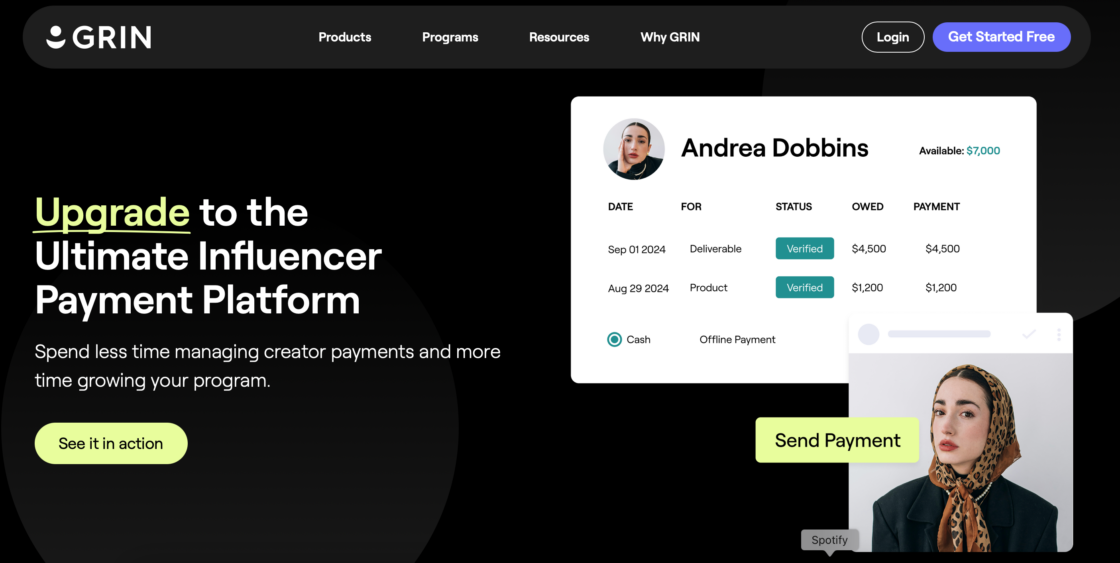
GRIN combines influencer relationship and campaign management with creator payment functionality. It’s a good fit for teams that want payments to sit within their broader influencer marketing workflow. Social media managers who already track campaign performance in GRIN may prefer keeping payment status visible in the same dashboard.
Key features include:
- creator payment management,
- payment tracking,
- PayPal-based payouts,
- tax documentation support,
- campaign and creator reporting,
- performance and ROI tracking.
Consider it if: your marketing team wants to manage creator relationships, campaigns, and payments through the same ecosystem.
3. Modash
Best for: global creator payments and streamlined invoicing.
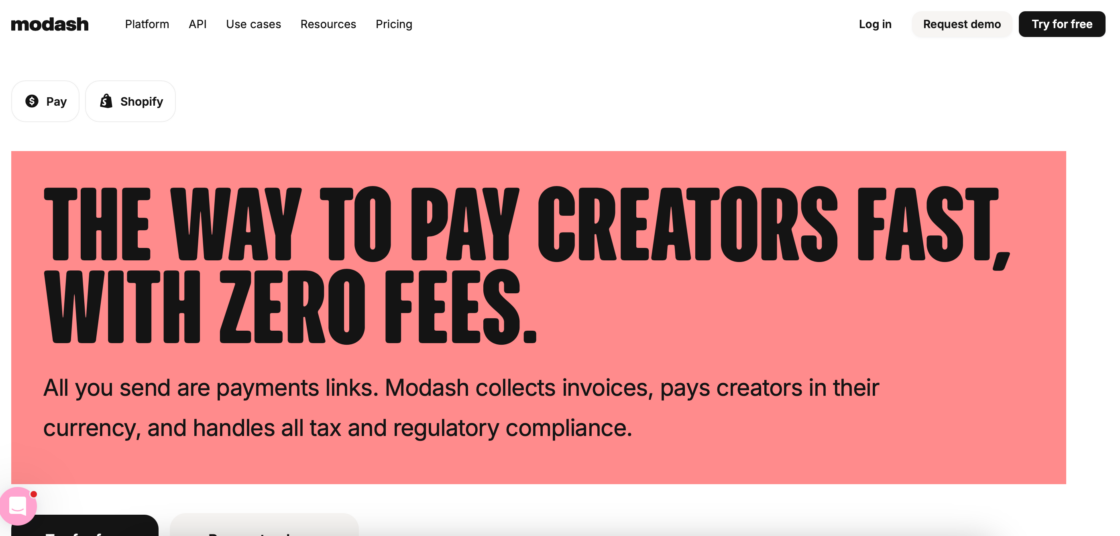
Modash puts particular emphasis on simplifying international creator payouts. Its current payment solution supports creators in 180+ countries and 36 currencies, with payments sent in the creator’s local currency. It also supports creator onboarding, invoice generation or uploads, payment tracking, and compliance workflows.
Key features include:
- international creator payments,
- local-currency payouts,
- creator self-service onboarding,
- invoice collection and generation,
- payment status tracking,
- tax and compliance handling.
Consider it if: you work with creators across multiple countries and want to consolidate payments and invoices into one workflow.
4. impact.com
Best for: performance-based creator partnerships.
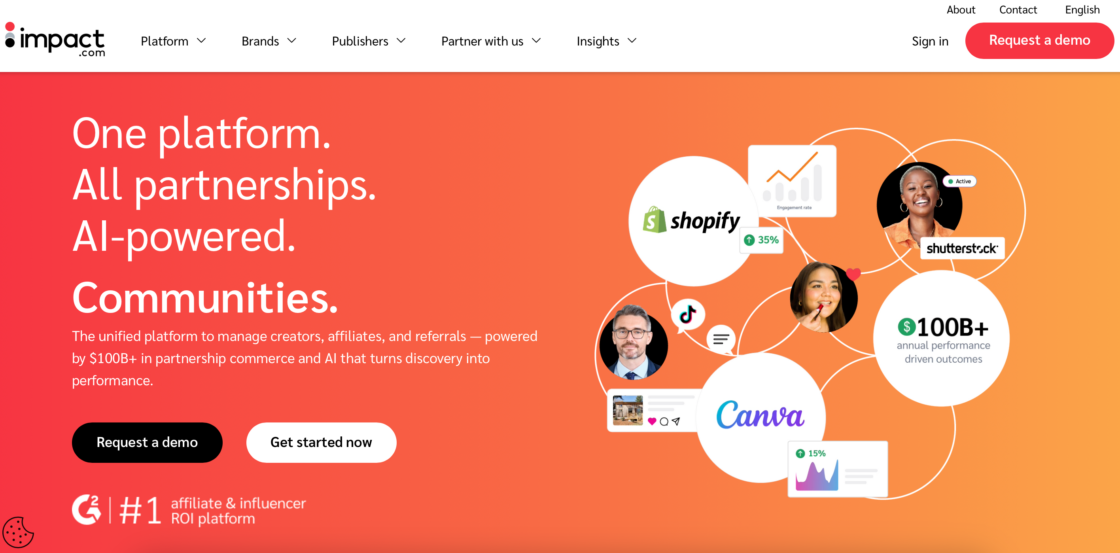
impact.com is especially relevant if you combine influencer marketing with affiliate and performance-based partnerships. Its approach supports compensation tied to measurable outcomes, rather than relying only on fixed creator fees.
Key features include:
- CPA-based compensation,
- fixed and performance-based payment models,
- automated payouts,
- partnership tracking,
- performance reporting.
Consider it if: you want creator compensation to connect closely with sales, conversions, or other measurable campaign outcomes.
5. Influencer Hero
Best for: businesses looking for combined influencer campaigns and payment management.
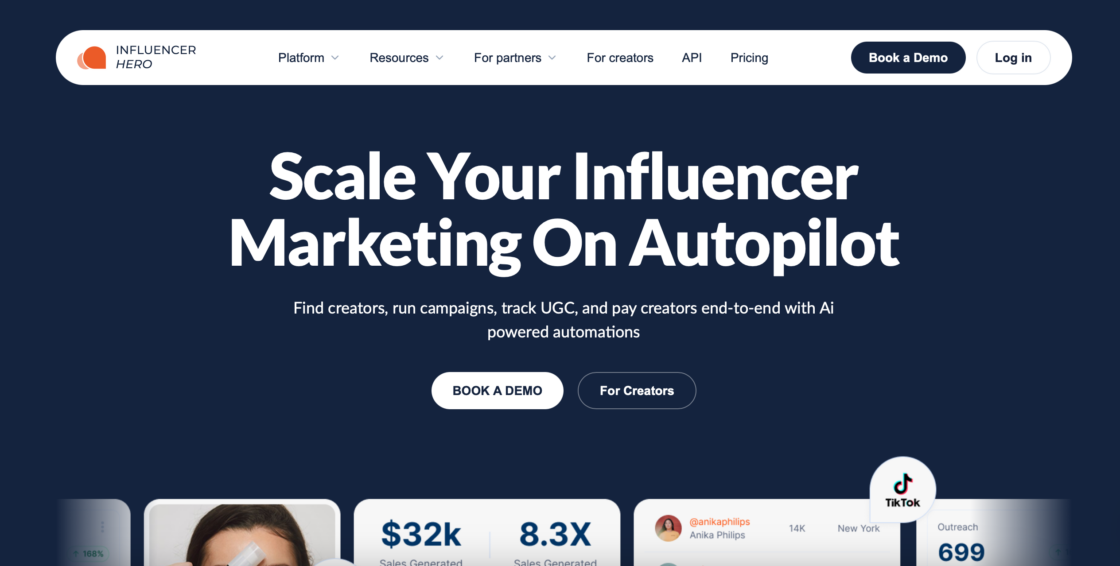
Influencer Hero brings creator management and payment workflows together. This can help if you want to manage creator relationships, campaigns, and compensation in one system.
Key features include:
- payment automation,
- campaign management,
- international payment capabilities,
- creator dashboards,
- payment tracking.
Consider it if: you want an influencer marketing platform that covers more than the payment stage of a creator partnership.
6. Aspire
Best for: creator marketing and performance-based campaigns.
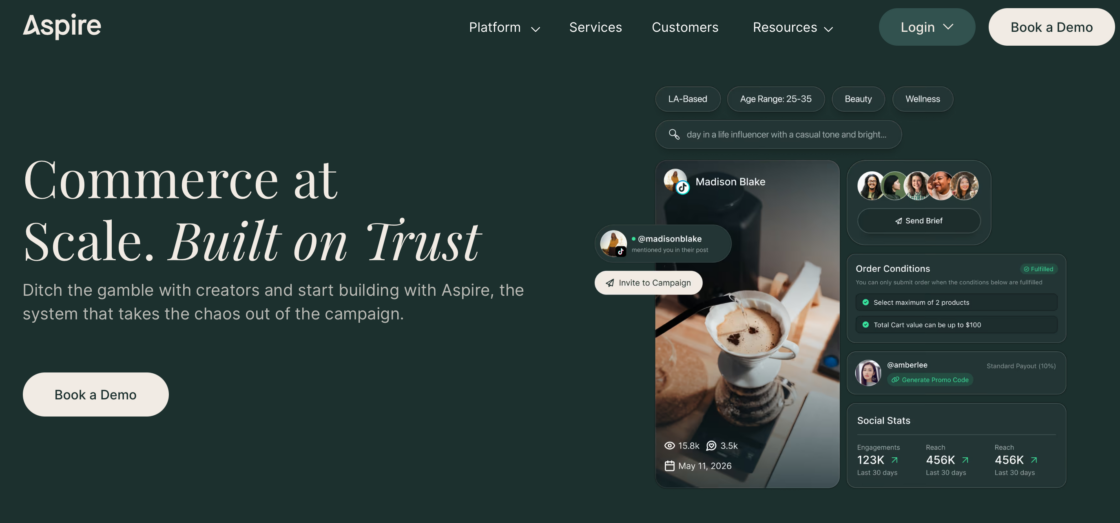
Aspire combines influencer relationship management with campaign and commerce capabilities. It suits businesses that want to manage creator partnerships while also tracking campaign activity and performance.
Key features include:
- a creator marketplace for discovery and inbound applications,
- campaign management covering planning, product shipping, content review, and payment tracking in one place,
- flat, percentage, or tiered commission structures per creator,
- payments through PayPal,
- performance dashboards and ROI reporting.
Consider it if: you need a broader creator marketing platform rather than a payment-only solution.
7. Creator.co
Best for: creator campaign management and payments.
Creator.co combines creator discovery and campaign management with tools for handling creator collaborations and compensation.
Key features include:
- AI-powered creator discovery across Instagram, TikTok, and YouTube,
- a centralized campaign dashboard for outreach, content approval, and payments,
- Shopify integration for product gifting and coupon codes,
- campaign and creator performance analytics.
Consider it if: you want to manage the wider creator campaign workflow, including the financial side of partnerships.
8. Traackr
Best for: enterprise influencer programs.
Traackr is designed for larger influencer marketing programs that need structured creator relationship management and reporting. Its current terms also cover an integrated payment service that lets approved customers fund a payment account and initiate payments to influencers.
Consider it if: your organization runs a larger, structured influencer program and needs payment capabilities alongside enterprise-level influencer management.
9. Shopify Collabs
Best for: Shopify businesses running creator affiliate programs.
Shopify Collabs works well when influencer relationships tie to an online store and affiliate sales. Creators can earn commissions through tracked affiliate links or discount codes, with commissions processed through Shopify’s billing system.
One important thing to note: Shopify says it isn’t accepting new creator signups right now, though merchants can still directly invite creators and continue using existing creator relationships.
Consider it if: your main goal is connecting creator partnerships with Shopify sales and affiliate commissions.
10. Lumanu
Best for: centralized influencer payments and financial operations.
Lumanu is built around managing creator payments and the financial processes that support them. Its platform supports global payouts, consolidated invoicing, compliance workflows, and financial visibility. You can fund accounts in multiple currencies and send payments through local payment rails in supported markets.
Key features include:
- global creator payouts,
- multi-currency support,
- consolidated invoicing,
- tax and compliance workflows,
- payment tracking,
- financial controls and reporting,
- integrations with business and finance systems.
Consider it if: your company manages a high volume of creator payments and wants a centralized financial workflow rather than a basic payout tool.
Signs your business has outgrown manual payments
You may need a more scalable payment process if:
- you rely on multiple spreadsheets, and creator details, invoices, payment status, and campaign budgets spread across different files;
- creators frequently ask about payment status, and your team spends time checking whether payouts have been approved or processed;
- finance spends too much time processing payouts, since routine creator payments need repeated manual checks and approvals;
- tax documentation is hard to track, and your team has to chase creators for missing forms or search through emails for records;
- international payments need extra manual work, since different currencies, payment methods, and banking requirements make each transaction harder to process;
- you can’t easily calculate total campaign spending, because payment information sits disconnected from campaign or accounting data;
- payment errors are getting more common, as incorrect details, duplicate payments, missed deadlines, or calculation mistakes get harder to prevent as volume increases.
Common mistakes when using influencer payment platforms
An influencer payment platform can simplify your workflow, but choosing or using the wrong solution can create new problems. Before you commit to a provider, consider how well it fits your payment process, creator network, and financial setup.
Choosing a platform based only on price
The cheapest option isn’t always the most cost-effective. A low subscription fee may come with transaction charges, currency-conversion costs, limited features, or fees paid by creators.
Look at the total cost of the platform and compare it with the time and administrative work it can save your team.
Ignoring international payment requirements
If you work with creators outside the US, check international capabilities before you sign up. A platform may support influencer payments but have limited country coverage or payment options. International creators often expect timely payouts regardless of currency or country, so confirm processing times before you sign on.
Consider the countries you work with, available currencies, local payment methods, processing times, and foreign-exchange costs.
Not checking transaction fees
Payment costs can vary depending on the payment method, country, currency, and transaction size. Find out exactly what you’ll pay and whether any fees get deducted from the creator’s payout. Currency conversion and FX fees are two of the most overlooked costs when businesses first compare providers.
This matters especially when you make frequent or international payments.
Failing to collect tax information
Tax documentation should be part of creator onboarding, not something your team scrambles to collect at the end of the year.
For US businesses, the appropriate documentation may include W-9 or W-8 forms depending on the creator’s circumstances. Make sure your chosen platform supports the documentation and reporting workflows your business needs.
Not defining payment terms in contracts
A payment platform can’t resolve an agreement that was never clearly defined.
Before work starts, establish the creator’s compensation, payment schedule, currency, payment method, deliverables, approval requirements, and any performance conditions in the contract.
Assuming every platform supports the same currencies
Multi-currency support varies a lot between providers. Some platforms may support many currencies but use different payment methods depending on the creator’s location.
Check the exact countries and currencies you need rather than relying on a general claim about global coverage.
Not checking accounting integrations
If your finance team has to manually transfer payment information from the influencer platform into accounting or accounts payable software, you may lose some of the efficiency the platform is supposed to provide.
Check whether the solution integrates with your existing financial systems or offers an API for custom workflows.
Paying creators late
Even an efficient platform can’t compensate for a poorly managed approval process. Set clear internal deadlines so your team can review and release payments on time.
Reliable payments can also strengthen relationships with creators and make them more willing to work with your brand again.
Failing to reconcile campaign spending
Processing a payment isn’t the final step. Your team should also confirm the transaction matches the relevant invoice, contract, campaign budget, and accounting records.
Regular reconciliation helps you catch errors and gives you a more accurate view of creator marketing costs.
Choosing an overly complex platform for a small creator program
More features don’t automatically mean a better solution. If you’re a small business working with a handful of US-based creators, you may not need an enterprise platform with extensive integrations, advanced permissions, and complex reporting.
Choose a solution that matches your current needs while leaving room to grow. The right platform should simplify your workflow, not add another layer of complexity.
Influencer payment platform checklist
Before you choose an influencer payment platform, make sure it can support your current workflow and scale with your creator program.
Use this checklist to compare your options. Does the platform:

Conclusion on influencer payments
Influencer payment platforms can simplify this process by bringing creator onboarding, documentation, payouts, tracking, and reporting into a more structured workflow. The right solution can also make international payments easier and give you better control over creator spending.
There’s no one platform that works for every business. When you compare options, consider your creator volume, payment methods, geographic reach, compliance requirements, integrations, and total costs. Most importantly, choose a platform that solves your current payment challenges without creating unnecessary complexity.
With the right system in place, you can spend less time managing transactions and more time building productive, long-term relationships with the creators who drive your campaigns.
Curious how bulk settlements work? Book a free demo call and we’ll walk you through paying and settling accounts with your creators in Useme.
FAQs on influencer payments
What’s the best influencer payment platform?
There’s no single best option for every business. The right platform depends on factors such as creator volume, payment methods, international coverage, compensation models, integrations, compliance needs, and budget. Compare platforms against your specific requirements rather than choosing based on popularity alone.
How do influencer payment platforms work?
A typical workflow starts with creator onboarding and collecting payment and tax information. After the creator completes the agreed work and you approve it, the platform processes the payout and records the transaction. Some platforms automate several of these steps.
How do businesses pay influencers?
You can pay influencers using methods such as ACH, bank transfers, PayPal, and other local payment options. The best method depends on the creator’s location, the agreed payment terms, processing costs, and the capabilities of your chosen platform.
How much do influencer payment platforms cost?
Pricing varies widely. Depending on the provider, costs may include subscriptions, transaction fees, payment-processing charges, currency-conversion costs, or international transfer fees. Some platforms also use custom enterprise pricing. Compare the complete cost of the service rather than looking only at the monthly subscription.
When should a business use an influencer payment platform?
A dedicated platform becomes more useful when manual payments start taking too much time or get hard to track. Signs include managing many creators, making international payments, dealing with large numbers of invoices, collecting tax documents, or needing better visibility into campaign spending. If you run a small creator program with only a few straightforward payments, you may not need a dedicated platform.
This article was created with the assistance of AI technology.
| Author: Ela Binkowska |