

Hiring remote workers from abroad opens the door to global talent, qualified professionals, and new markets – but also to unfamiliar employment regulations, complex tax systems, and the risk of misclassifying international contractors. Whether you’re building a global team or bringing on a single remote foreign employee, this guide walks U.S. companies through the international hiring process step by step.
It doesn’t replace professional legal advice, but it gives you a strong foundation to ensure compliance and make smart decisions as you hire internationally.
Key takeaways
- International hiring is strategic, not just tactical. Building a global team drives innovation, market adaptability, and business continuity across regions.
- Compliance comes first. Each country has unique labor laws, tax obligations, work visa requirements, and payroll regulations that you must follow.
- Choose the right employment model. Options include local entities, Employer of Record services, intermediary platforms, independent contractors, or relocation – each fits different business needs.
- Partner with experts. Global payroll providers, immigration attorneys, and recruitment agencies simplify compliance and reduce risk across jurisdictions.
- Plan for hidden costs. Beyond salary, budget for mandatory employer contributions (often 20–40% of gross pay), equipment, visa fees, and provider service fees.
- Tax obligations follow the worker’s location. Even without a U.S. tax burden, you’ll face local withholding requirements, social contributions, and potential permanent establishment risk.
Why you should hire international employees – strategic impact of cross-border hires
Nowadays, hiring international employees is a strategic decision that shapes your company’s future. When you build a global team, you gain access to diverse perspectives that drive innovation and problem-solving.
According to multiple studies, companies with diverse international teams are significantly more likely to outperform competitors in innovation metrics. Cross-border hires strengthen your business through enhanced innovation, greater market adaptability, and business continuity across different regions. These benefits support broader global expansion goals. So when you hire internationally, you’re building infrastructure for sustainable growth in multiple markets.
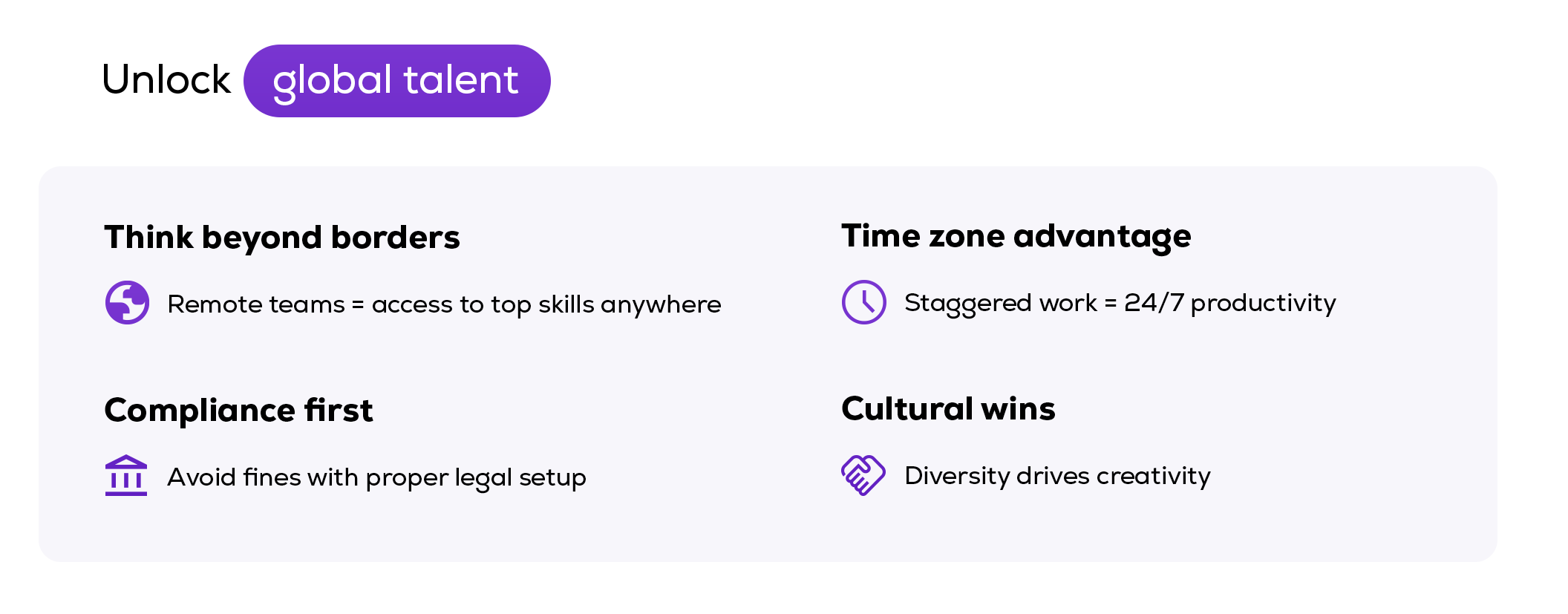
Despite the complexities of international hiring and navigating cross-border employment laws, the advantages of building a global workforce far outweigh the challenges. Here’s why smart companies are expanding their hiring process to include international talent:
Access to a global talent pool
When you hire internationally, you tap into a vast global talent pool filled with skilled and qualified professionals. International hiring gives you access to specialized skills that may be scarce among domestic employees. Foreign workers often bring unique expertise, language abilities, and cultural insights that strengthen your international teams.
Global hiring allows you to recruit from emerging tech hubs and established markets. Whether you need software developers, marketing specialists for new markets, or professionals with a proven track record in international markets, the global workforce offers unparalleled diversity.
Significant cost savings
Hiring international employees delivers substantial cost savings compared to domestic employees, especially when you hire employees in countries with lower living costs. Remote foreign employees and international workers provide quality work at competitive rates, optimizing your budget while maintaining high standards.
International contractors and remote workers also reduce overhead costs for office space and equipment.
Enhanced company culture
International employees bring diverse perspectives that enrich your company culture and decision-making. Foreign employees contribute different problem-solving approaches and business practices that strengthen global team dynamics. This diversity is valuable when expanding into international markets or serving global customers.
Operational flexibility
International hiring provides operational flexibility that domestic-only hiring cannot match. Remote international workers and international contractors offer 24/7 coverage, faster project turnaround, and the ability to scale your workforce based on business needs.
Foreign workers provide business continuity advantages. Diversifying your international workforce across different countries reduces dependency on single markets and provides resilience against local economic downturns or regulatory changes.
Competitive advantage in recruitment
Companies that successfully hire internationally demonstrate sophisticated employer responsibilities and global business acumen. This reputation attracts top international candidates and positions your company as a forward-thinking employer in the global employment landscape.
Working with experienced professionals in international recruitment and maintaining compliance with employment regulations across multiple jurisdictions shows your commitment to building a truly global team. This approach opens doors to international offices, new markets, and sustained global growth.
5 steps for hiring foreign workers
You’ll need a plan that balances global reach with local compliance. Here are five essential steps to help you hire international employees smoothly and legally:
1. Build a clear candidate profile
Before you launch your search, define exactly who you’re looking for. Think beyond the job title. What technical skills, soft skills, or certifications are non-negotiable? What languages should the candidate speak? Do they need experience working in a remote or multicultural environment?
Also, consider how your brand looks from a global perspective. Candidates in other countries may respond to different messaging or job perks. Adjust your job descriptions and application process to reflect the expectations of the region you’re hiring from. That includes highlighting values like flexibility, respect for time zones, and inclusion.
2. Choose your hiring location strategically
Decide where you want to hire – and learn the rules of the road. Employment laws vary widely across countries. Some governments enforce strict regulations on employee rights, benefits, and payroll taxes. Others may offer more relaxed rules for hiring remote foreign employees.
You’ll also want to factor in:
- cost of living (to set a fair salary),
- time zone compatibility,
- cultural differences that affect teamwork,
- visa or work permit requirements (if relocation is involved).
💡 Before you hire your next freelancer, see the clear financial and operational advantages waiting in the European market — 2025/2026 Business Report that your competitors are already reading – click here to download the report.
3. Pick the right employment model
Hiring someone abroad doesn’t always mean creating a full-time job with full benefits. If your needs are more flexible, you have options:
- local legal entity,
- relocation,
- independent contractors,
- Employer of Record (EOR),
- agency.
Choosing the right model helps reduce costs and ensures compliance with local labor laws. We’ll cover each of them in the further sections of the article.
Use global payroll providers for compliance
Regardless of which employment model you choose, consider partnering with a global payroll provider to handle payroll management end-to-end. These providers ensure you meet all tax obligations, file reports correctly, and pay employees on time according to local requirements.
Global payroll partners are especially valuable when you’re managing employees across multiple countries. They reduce administrative overhead and minimize compliance risks that could lead to penalties or legal challenges.
For smaller projects or when working with international contractors instead of full-time employees, a lighter solution may be more practical. Platforms like Useme offer a pay-as-you-go model that allows you to legally settle cross-border contractor deals without building a full payroll structure.
Useme issues a compliant invoice to your business (including consolidated invoices if needed), handles the formal agreement with the contractor, and manages secure international payments. However, the freelancer remains responsible for reporting and paying taxes in their own country in accordance with local regulations.
4. Tap into international talent channels
Once you’re ready to hire, it’s time to promote your opening. Use global job boards, local hiring platforms, and professional networks like LinkedIn to spread the word. You can also work with international recruitment agencies that specialize in hiring foreign workers.
Look for candidates who show adaptability, cultural awareness, and a track record of working with international teams.
5. Run thoughtful, remote-friendly interviews
When hiring remote employees from other countries, video interviews are a must. They allow you to assess communication skills, fluency in your company’s working language, and overall compatibility.
Go beyond technical questions. Ask about real-world scenarios:
- How would they handle a deadline that spans time zones?
- What would they do if a cultural misunderstanding slowed down a project?
- How do they stay motivated while working remotely?
These types of questions help you find candidates who aren’t just qualified, but who can thrive on a global team.
Seamless onboarding for remote international staff
An insightful interview is a good start, but the strong onboarding (and pre-onboarding) process helps international employees feel connected to your company from day one – even when they’re thousands of miles away. Poor onboarding, on the other hand, leads to confusion, delays, and early turnover.
Pre-onboarding checklist (before day one)
✓ Finalize work visa and permits
Confirm all immigration documents are approved and filed. Don’t allow your new hire to start work until their visa status is legally clear.
✓ Prepare employment contracts
Ensure contracts comply with local labor laws. In many countries, contracts must include specific clauses about:
- Probation periods
- Notice periods for termination
- Mandatory benefits
- Working hours and overtime rules
- Data protection and confidentiality
✓ Set up payroll
If you’re using a global payroll provider, submit all employee information at least 2 weeks before their start date. This prevents payment delays.
✓ Order and ship equipment
International shipping can take 2-4 weeks. Order laptops, monitors, and other hardware early. Consider using local vendors in the employee’s country to speed up delivery.
✓ Grant system access
Set up email accounts, communication tools (Slack, Teams), project management software, and any role-specific applications. Test access before day one.
✓ Assign an onboarding buddy
Pair new hires with a colleague in a similar time zone who can answer questions and provide informal support.
A thoughtful onboarding process shows international employees that you value them. It reduces early turnover and helps remote workers integrate quickly into your team.
Work permit requirements and legal compliance
As you may know, navigating work permits and visas is one of the most complex parts of international hiring. Requirements vary dramatically by country, and mistakes can delay hiring or create legal problems.
Here are some of the common work visa types by region:
- European Union: EU Blue Card for highly skilled workers; salary threshold: 1-1.6 x the annual gross salary; processing time: a few months, depending on the country. (European Commission, 2021, European Comission 2025)
- United Kingdom: Skilled Worker Visa requiring a licensed sponsor; minimum salary £38,700; processing time: 3 weeks to 3 months (UK Government, 2024).
- Canada: Temporary Foreign Worker Program (requires LMIA) or Global Talent Stream for tech roles; processing time: 2 weeks (Government of Canada, 2024).
Singapore: Employment Pass for professionals; salary threshold: S$5,600/month minimum; processing time: around 3 weeks (Ministry of Manpower, Singapore, 2024).
Essential compliance steps:
- Confirm visa eligibility before making job offers.
- Review contract language requirements: some countries mandate bilingual contracts (Germany, France, Japan).
- Plan for visa processing times (weeks to months) and communicate realistic start dates.
- Register with local tax authorities, even when using an Employer of Record.
- Keep documentation of all visa applications and approvals for audits.
Pro tip: Partner with immigration law firms in your target countries to handle applications and ensure compliance. Missing deadlines can delay hiring by months.
Common challenges U.S. companies face when hiring international employees
U.S.-based companies hiring international employees need to navigate more than just time zones. Below are the most common challenges businesses face when hiring foreign employees and international contractors, and what you can do to avoid costly mistakes.
When we started hiring outside the US, the first pain was paperwork. Every country has its own rules on contracts, termination, holidays, and what counts as an employee versus a contractor. Misclassify once and you get back taxes and angry regulators. Labor law updates can force a contract rewrite overnight. Payment is another trap. FX swings, local bank rails, and odd invoice requirements can slow onboarding even when the candidate is ready.
All our teams work remotely. We are hiring a lot of people from Latin America. Time zones help, but the hard parts are benefits, data access, and training. A good engineer still needs clean equipment shipping, background checks that work cross border, and clear IP terms. Then comes management. Feedback styles differ, and written English can hide confusion. I learned to standardize docs, record demos, and run frequent QA on funnel signals.
– Ihor Lavrenenko, Search Engine Optimization Manager, Pesty Marketing
Understanding and following local employment laws
Every country has its own employment regulations, and they often differ drastically from U.S. standards. What’s standard in California might be illegal in Germany or Brazil.
For example:
- Some countries require employment contracts to be written in the local language.
- Others mandate notice periods, paid vacation minimums, or specific health benefits.
- Many enforce strict protections around overtime, termination, and severance.
Before hiring international workers, make sure your contracts and HR policies meet local employment regulations.
Payroll and benefits compliance
International payroll isn’t just about sending money. You’ll need to follow the correct payroll cycle, make the right employer contributions (like social security or pension), and comply with local reporting rules.
Key issues to plan for:
- contributions to country-specific social programs,
- local insurance requirements,
- currency exchange and conversion fees,
- legal restrictions on how and when workers are paid,
If you fail to meet payroll obligations, it can affect both your legal standing and your employees’ take-home pay.
Streamline with global payroll partners or intermediary platforms
Many U.S. companies simplify these challenges by working with global payroll providers. These partners handle cross-border payments, ensure compliance with local tax obligations, and manage currency conversions automatically. This reduces errors and frees your team to focus on strategic growth rather than administrative tasks.
Another option is to use an intermediary platform like Useme – especially if you work with independent contractors instead of full-time employees. In this model, you don’t need to set up a foreign entity or manage complex international payroll. All your payments are project-based.
Useme acts as a legal intermediary between you and the contractor. You agree on the project terms directly with the freelancer, and Useme formalizes the cooperation. You receive one invoice from Useme, and after payment, the platform handles the contractor payout.
Risk of employee misclassification
Misclassifying employees as independent contractors is one of the most serious mistakes U.S. employers can make. Just because someone works remotely or part-time doesn’t mean they qualify as an independent contractor under foreign labor laws.
If you:
- set a regular work schedule,
- pay a flat salary,
- control how the work is done,
- provide company tools or software,
then local authorities may view the worker as a full employee, even if you don’t. This opens you up to retroactive taxes, back pay, penalties, and reputational harm. Some countries may reclassify long-term dependent contractors as employees.
Managing international payments
Once you’ve hired your international employee, you need to pay them correctly and on time. But international payroll raises a lot of questions:
- Which currency should you use?
- Is it legal to pay in U.S. dollars?
- How do you handle currency fluctuations?
- What’s the best payment method: bank transfer, fintech platform, or local payroll?
If your international employee is based in a region with financial instability or limited banking infrastructure, payments may be delayed or blocked.
Permanent establishment risk
If your company earns income or builds a long-term presence in another country, you could trigger what’s known as permanent establishment (PE). This means you may become subject to local corporate taxes – even if you don’t have an office there.
PE risk often applies if:
- you generate revenue through foreign employees;
- you have a fixed place of business abroad;
- your workers make sales or contracts in another country.
This is a serious issue with financial consequences, including double taxation or legal action. PE risk doesn’t disappear if you work through a payroll provider or EOR. Always consult with a tax expert to evaluate your exposure.
Tax authorities are more actively pursuing PE cases involving remote employees. Even home offices of key employees may contribute to PE risk in some jurisdictions, so companies should conduct regular risk assessments, especially when expanding remote teams.
Protecting your intellectual property
Hiring employees in other countries may expose your intellectual property (IP) to local laws. In some jurisdictions, the rights to anything created during employment belong to the worker – unless your contract says otherwise.
To protect your innovations:
- Include IP assignment clauses in every employment agreement.
- Understand which local laws apply to copyrights, trademarks, and patents.
- Be especially cautious in high-risk sectors like tech, energy, and finance.
Without clear protections, you may lose control of your codebase, product designs, or trade secrets.
What are your options for hiring international workers?
Choosing how to hire internationally is a strategic decision that impacts your global expansion plans. Each employment model offers different levels of control, compliance support, and scalability. Select the option that aligns with your growth goals and risk tolerance.
Here’s a breakdown of the most common models for hiring foreign employees and contractors, so you can choose what fits your goals and budget.
Set up a local legal entity
If you plan to build a lasting presence in a specific country, opening a foreign subsidiary may be the right move. This allows you to hire employees directly, run local payroll, offer country-specific benefits, and operate under your own name.
A local entity makes sense if you’re expanding into a key market, hiring a large team, or setting up a local office or manufacturing facility. But if you only need a few hires or want to test a new market, this route may be overkill.
Pros:
- Full control over hiring and operations.
- Better brand recognition and market credibility.
- Ability to offer long-term career paths to local employees.
Cons:
- High initial costs and legal complexity.
- Long setup timelines (often months).
- Ongoing obligations for tax, payroll, benefits, and compliance.
Use an Employer of Record (EOR)
Don’t want to deal with setting up a legal entity? An EOR simplifies the process of hiring international employees by handling them on your behalf. They become the legal employer and handle all the admin – payroll, taxes, benefits, and local compliance – while you manage your global team’s day-to-day work. EORs manage payroll management and ensure all local tax obligations are met, removing the burden of navigating complex foreign tax systems from your internal team.
EORs are ideal for companies testing international markets, running distributed teams, or hiring in countries where they don’t plan to establish a long-term presence.
Pros:
- Hire quickly without a local office.
- Stay compliant with local labor laws.
- Reduce admin and HR overhead.
- Scale your global team without major investment.
Cons:
- Less control over contracts and benefits structures.
- Varies in quality – choose a provider with strong country coverage.
- Reduced flexibility for complex employment needs.
- Costly service fees.
Pay through an intermediary platform
If you’re outsourcing work to freelancers, paying them through a trusted intermediary platform can simplify the process. Services like Useme allow you to legally pay international contractors without needing to set up a local entity or navigate foreign tax systems yourself.
Intermediary platforms are especially useful if you’re working with remote foreign employees or freelancers in countries where local compliance is complex. They help reduce administrative overhead, speed up international transactions, and reduce risk – especially around worker classification and cross-border payments.
Pros:
- No need to open a legal entity in a foreign country.
- Helps structure compliant contractor relationships and reduce administrative burden.
- Project-based flexibility.
- The same payment process for all foreign workers, without having to understand every region’s employment regulations.
Cons:
- Not suitable for full-time employees.
- Platform fees.
- Less control over contractor management.
Hire independent contractors
You can hire independent contractors – self-employed professionals who invoice you for their services. You don’t provide benefits or manage their work directly, which gives you flexibility – especially for project-based roles.
Always use compliant contracts and document how the relationship works in practice.
Pros:
- Fast onboarding and low overhead.
- Access to specialized skills in any country.
- No need for a local entity or EOR.
Cons:
- Higher risk of misclassification even with remote employees.
- Limited legal protections around IP and confidentiality.
- Less long-term loyalty or availability.
Relocate the employee to your home country
In some cases, it may make more sense to bring your international candidate to the U.S. or another country where you already operate. This typically involves visa sponsorship and navigating immigration rules.
Relocation is a good fit when remote work isn’t possible or when the employee actively wants to move for long-term career development.
Pros:
- Full legal control and easier onboarding.
- Face-to-face collaboration and in-office integration.
- Ideal for roles requiring physical presence.
Cons:
- Complex, expensive immigration processes.
- Long wait times for visa approval.
- Risk of relocation not working out.
Work with a recruitment agency
If you’re new to hiring internationally or need to fill a role quickly, partnering with a recruitment agency that specializes in global workforce can be a smart move.
The agency then sources candidates from their network, screens them for fit, and presents the top contenders for your review. Many international recruiters also assist with interview scheduling, contract negotiations, and onboarding support.
Pros:
- Access to a wider global talent pool.
- Faster hiring process, especially in unfamiliar markets.
- Local market knowledge, including salary benchmarks and cultural expectations.
- Time savings for your internal HR team.
Cons:
- Agency fees can be high, especially for senior roles.
- You may have less control over the sourcing and screening process.
- Not all agencies are experienced with remote-first or fully distributed teams – choose carefully.
- Agencies don’t usually handle employment compliance (like taxes or payroll).
Which hiring method is right for you?
It depends on your goals. If you need full control and long-term commitment, setting up a local entity may be worth the effort. If you want a fast, low-risk entry into a new market, an Employer of Record is often the best option. For short-term or specialized projects, independent contractors can give you the flexibility you need – if managed correctly through an intermediary platform like Useme.
What’s the total cost of hiring international employees?
Calculating the true cost of hiring international employees requires thinking strategically. These costs are investments in innovation and growth – not just expenses. When you hire the right international talent, you gain capabilities that drive revenue and competitive advantage. Plan your budget accordingly.
Before you make your first offer, it’s important to understand the true cost of hiring workers in a foreign country. It goes far beyond just paying a salary. Here’s what U.S. employers should factor in when calculating the total cost of hiring international employees:
Salary and base compensation
The biggest cost is, of course, the salary. But salaries aren’t one-size-fits-all. You’ll need to adjust based on:
- local wage laws and salary benchmarks,
- experience level and job complexity,
- cost of living in the employee’s country.
In some countries, employers are required to pay bonuses like a 13th-month salary or holiday pay on top of base wages. These extras can significantly raise your total payroll expenses.
Mandatory employer contributions
Each country has its own rules about what employers must contribute to government-backed programs. These typically include:
- social security or pension funds
- unemployment insurance
- workers’ compensation
- public healthcare or disability coverage
These contributions are legally required and vary widely from country to country. In some regions, mandatory costs can add 20%–40% (or more) on top of the employee’s gross salary.
Provider fees for payroll management
If you work with a global payroll provider, budget for their service fees. These typically range from $5-$50 per employee per month, depending on the countries covered and services included. Many providers bundle tax obligations management, compliance reporting, and payment processing into their fees, which can be more cost-effective than managing these functions in-house.
Employee benefits
In many countries, offering health insurance, paid time off, and retirement plans isn’t optional – it’s required by law. Even when not mandatory, providing competitive employee benefits is essential for attracting and retaining top international talent.
You may also need to offer:
- supplemental private insurance,
- meal vouchers, transportation stipends, or wellness programs,
- extended parental or sick leave.
Equipment and setup
If your international employee needs a computer, software licenses, or specific tools to do their job, you’ll likely be expected to cover the cost, especially for a full-time employee.
For independent contractors, the situation is different – they typically use their own tools and manage their own expenses. But for employees, supplying the right equipment is part of your employer’s responsibilities.
Immigration and relocation costs
If you plan to relocate a foreign employee to your home country or another market, be prepared for:
- visa application and sponsorship fees,
- legal and compliance costs,
- travel and relocation expenses,
- tax equalization for expats with obligations in multiple countries.
While not all international workers require visas (especially if they’re working remotely from their home country), immigration costs can quickly add up when relocation is involved.
Currency and payment considerations
Paying international employees means dealing with foreign exchange rates, banking fees, and local tax rules. Key questions to ask:
- Will you pay in USD or local currency?
- Do local laws require salary payments in the national currency?
- How will you handle exchange rate fluctuations?
Hiring process
Hiring international employees comes with additional recruitment and onboarding expenses. Whether you’re working with a recruiter, an employer of record, or another third-party provider, there are service fees involved.
Even if you handle everything in-house, adapting your hiring process to meet local employment regulations – from contracts to compliance – takes time and resources. These early-stage costs should always be factored into your international hiring budget.
Pay models for international contractors and employees
When hiring internationally, it’s essential to choose a pay model that supports fairness, transparency, and long-term growth. Here are three common approaches global companies use.
Tailored compensation
This case-by-case model involves creating a custom salary and benefits package for each international hire. It works well for startups or teams with only a few foreign employees, offering flexibility to adjust for local conditions or relocation needs. However, it becomes difficult to scale and can lead to inconsistent pay across your team. Employees may also expect to negotiate every time they change roles or locations.
Flat global pay
Some companies set the same salary for everyone in the same role, no matter where they live. This is simple to manage and promotes equality, especially in fully remote teams. But without adjusting for local costs of living, it may be hard to retain employees in expensive cities – or you risk overpaying in lower-cost regions.
Location-based pay
With this model, salaries are set based on each employee’s location, using local market data and cost-of-living indexes. It offers fair purchasing power and competitive pay across regions, helping you attract talent globally while managing costs. The trade-off is that it requires regular updates and clear communication, especially if pay changes after relocation.
Don’t forget about currency fluctuations and inflation
Managing compensation in unstable currencies or regions with high inflation can affect your international workforce’s financial well-being. Consider paying salaries to a stable currency (like USD or EUR) or offering partial indexing to inflation if you hire in countries with weak economies.
Hiring international employees – basic taxation rules
In most cases, if the employee is a non-U.S. resident performing services entirely outside the U.S., U.S. payroll tax withholding and W-2 reporting do not apply. Their income is considered foreign-source and is taxed only in their home country.
However, you may still have tax obligations abroad. Some countries require foreign employers to follow local tax and labor rules. You might need to:
- withhold income taxes locally,
- pay employer contributions,
- handle VAT or other compliance tasks.
If you hire a U.S. citizen living abroad, they still have to file U.S. taxes. You may need to issue a W-2 and withhold accordingly, depending on how they’re classified.
Key tax forms:
- W-8BEN – for foreign contractors (no U.S. tax withholding),
- 1099 – for U.S.-based contractors only,
- W-2 / I-9 – required for all employees working in the U.S., including those on work visas.
Taxes follow the worker’s location. While U.S. tax obligations may not apply, you still need to comply with local laws in your employee’s country. To avoid risks, work with a global tax advisor.
In most cases, payroll tax follows the worker’s location. While U.S. tax obligations may not apply, you still need to comply with local laws in your employee’s country. To avoid risks, work with a global tax advisor.
International hiring – 2026 compliance checklist
- Strategic planning: develop a comprehensive strategy for hiring international employees that aligns with your business goals and compliance requirements.
- Worker classification: confirm whether the person qualifies as an employee or an independent contractor under local laws, not just your contract terms.
- Local employment laws. research labor regulations in the worker’s country, including contract requirements, working hours, leave entitlements, and termination rules.
- Tax and social contributions: understand who is responsible for withholding income taxes, paying social security, and making any mandatory employer contributions.
- Payroll setup: decide how you’ll manage payroll – whether through a local entity, an Employer of Record, or a payroll partner.
- IP and data protection: ensure employment or service agreements cover intellectual property rights and comply with local data privacy laws.
- Permanent establishment risk: evaluate whether your activities in a foreign country could trigger corporate tax obligations.
- Global compensation strategy: choose a consistent approach to international pay – such as flat rates, location-based salaries, or custom offers – and document it clearly.
- Benefits and perks: provide all mandatory benefits under local law, and consider optional benefits to stay competitive in the market.
- Immigration and visa requirements: if relocating employees, follow all rules related to visa sponsorship, work permits, and residency status.
- Contracts and documentation: use locally compliant contracts reviewed by legal experts familiar with the country’s employment laws.
Final thoughts on hiring international employees
Hiring international employees opens your company to world-class talent, competitive advantages, and new market opportunities. While the process involves navigating complex labor laws, tax systems, and compliance requirements, the strategic benefits far outweigh the challenges.
Success comes down to three priorities: understanding local regulations before you hire, partnering with experts who handle compliance and payroll, and treating international hiring as a long-term investment in innovation and growth, not just a cost-cutting measure.
Whether you’re making your first international hire or scaling a global team, start with clear planning. Define your employment model, budget for true costs including mandatory contributions and service fees, and build systems that support remote workers across time zones and cultures.
With the right approach, international hiring becomes a competitive advantage that drives sustainable growth for years to come.