

NanoInflu gives brands a platform to run their whole creator campaign, from finding creators and writing the brief to getting the final report. Useme handles the last step: bulk payments. The two platforms are connected through an API.
NanoInflu processes an average of 30–40 paid collaborations a month through Useme, and none of them need manual work. This number grows as more paid campaigns run on the platform.
See how a NanoInflu campaign works step by step, when Useme takes over payments, and what the API integration changed.
| → Want to connect Useme to your system through an API? Book a meeting |
About NanoInflu: a whole creator campaign on one platform
NanoInflu is a platform where companies create and run influencer campaigns on their own. In one place, they find creators, choose offers, approve content, pay for collaborations, and get a results report.
The idea came from a simple observation. Influencer marketing has grown into one of the main channels brands use to reach customers. But many companies still run it the same way they did years ago. They search for creators by hand, collect prices via email and in Excel, prepare contracts, and check posts and payments. At the end, they put all the results into a single report.
When you work with a few creators, running a campaign by hand is inconvenient. With dozens of creators, it becomes a separate, very time-consuming process, says NanoInflu’s founder.
Why brands come to NanoInflu
- Choosing creators. The number of followers alone isn’t enough anymore. Brands look for people who fit their product and target group perfectly.
- Scale. Writing to 5 influencers is easy. But with 30 or 100 creators, the number of messages, arrangements, and documents grows.
- Operations and payments. One campaign can include creators with and without a registered business, barter and paid collaborations, and different deadlines and terms. Brands don’t want to build a separate admin process for each person.
That’s why the founders see NanoInflu as infrastructure for running influencer marketing, not just a database of influencers. Their goal is to make a campaign with dozens of creators simpler than a campaign in a traditional ad system.
Who uses NanoInflu
More than 700 companies already use the platform, and its database has more than 70,000 creator profiles. Brands like Eurosport, Tour de Pologne, Lancerto, Mohito, Pasibus, Sony Music Poland, and AliExpress have used NanoInflu. The platform was also used for a campaign around the Drift Masters final, organized by Red Bull at the National Stadium in Warsaw.
Most campaigns are about cosmetics, fashion, and lifestyle. More and more campaigns are also about events and product launches. The platform works well for:
- Online stores and small and medium-sized businesses that want to work with creators regularly.
- Large organizations that want to scale influencer marketing without building a process from scratch.
- Agencies that run many campaigns at the same time.
- Companies that are planning their first creator campaign and don’t have a specialist team.

The challenge: a campaign with 100 creators and separate payments
Influencer marketing is quickly becoming more professional. But the tools many companies use to run it aren’t keeping up: Excel, emails, and manual bank transfers are still common.
At the same time, brands are focusing more on scale. Instead of one big influencer, they choose many smaller creators and prefer UGC content.
This model makes sense. With 30 posts, the product appears in many places and contexts. People see recommendations that don’t look like typical ads. The brand also gets content it can use in its future marketing.
But each collaboration means extra work for the company. The brand has to:
- Collect details from each creator.
- Check if the creator has a registered business and which contract to prepare.
- Make sure contracts are signed and deadlines are met.
- Collect invoices from creators who have a business, often from different places and in different formats.
- Make a separate transfer to each person.
With 15 creators, for example, the company has to manage 15 separate processes. HR, accounting, and a manager all work on this. And each creator still has to send back their details and documents.
Paperwork is a problem for creators too. For many nano- and micro-influencers, brand collaborations are extra income, so they rarely have their own business. If they had to arrange contracts themselves for every campaign and find a legal way to get paid, some would simply stop working with brands.
NanoInflu quickly saw where the process slowed down:
You can scale the campaign itself with technology. But if you have to pay for each collaboration by hand at the end, prepare separate documents, and track payments, the whole process slows down at the last step, explains NanoInflu’s founder.
The solution: NanoInflu and Useme working together
NanoInflu designed the process so a brand can run a campaign from start to finish in one place. The process has 7 steps:
1. The brand creates a campaign.
It pastes a link to a product, service, or event. The system analyzes the offer and prepares a first draft of the brief. The brand then edits it as needed: creator requirements, scope of posts, deadlines, budget, and collaboration model.
2. NanoInflu helps choose creators.
Creators apply to the campaign themselves. At the same time, the system searches more than 70,000 profiles and suggests the people who best fit the product and target group. The brand always makes the final decision.
3. The creator prepares content.
In the app, they receive the brief, content scope, publishing date, and the brand’s requirements.
The simpler and more predictable the collaboration is, the less likely a creator is to quit because of paperwork, says NanoInflu’s founder.
4. The creator submits finished content for approval.
The creator gets an email from Useme with a link to upload the finished work. They don’t need to create a Useme account or log in. The brand then approves the payment.
5. Data goes to Useme automatically.
NanoInflu sends the payment data to Useme automatically, in the background. The brand doesn’t have to enter creators’ personal data, such as their ID number or address.
6. Useme handles bulk payment for the whole campaign.
Useme takes care of contracts and creator payouts. The brand makes one payment and gets one invoice for the whole campaign, instead of 15 transfers and 15 invoices. If needed, it can also pay for each collaboration separately and get separate invoices. In the dashboard, the brand can see the status of each collaboration and how much each creator will get.
7. Results report. After the campaign, the brand automatically gets a report with reach, views, engagement, and results for each creator. NanoInflu uses integrations with official data sources, so brands can also run campaigns on a performance-based model.
Thanks to the integration, the brand can focus on the campaign itself, while the payment side happens in the background, says NanoInflu’s founder.
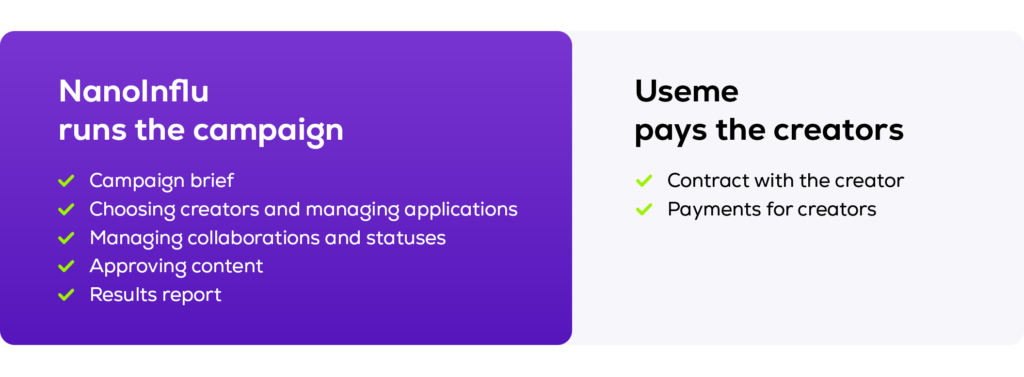
For the brand, it’s one smooth process. It doesn’t need one tool for influencer marketing, another for paperwork, and a third for payouts.
| → Want to connect Useme to your system through an API? Book a meeting |
How the API integration changed payments
At first, NanoInflu paid creators through Useme. Each payment needed a separate form. This worked, but as the number of paid campaigns grew, it took more and more time.

Before the integration:
- The NanoInflu team started each payment in Useme themselves.
- Payments waited until someone had a free moment between other tasks.
After the API integration:
- The payment process starts automatically when the brand approves the content.
- It starts as soon as the condition in the system is met, so the team’s daily workload doesn’t cause delays.
- More creators to pay doesn’t mean more work for the NanoInflu team or its clients.
With the API, payments are no longer a separate task someone has to remember. They’re simply a natural, automatic step in the campaign, says NanoInflu’s founder.
The option to integrate through an API was one of NanoInflu’s key reasons for choosing Useme. Both the brand and the creator stay on the NanoInflu platform and don’t need to switch to another tool. Like every freelancer paid through the Useme API, the creator doesn’t create a Useme account or need to log in.
Results: more creators paid with no extra work
Today, NanoInflu processes an average of 30–40 collaborations a month through Useme. Most campaigns on the platform are still barter collaborations, but the share of paid ones keeps growing. The number of payments goes up with it.
- The brand approves the content, and that’s the end of its part in the payment process. Paperwork and payouts happen automatically through NanoInflu and Useme.
- One invoice instead of a dozen or more. Someone from marketing sends just one document to accounting for payment.
- Creators get paid legally. The brand doesn’t have to check who has a business or which contract to prepare.
- Faster, more predictable payouts. Creators don’t wait weeks for their money, so they’re more likely to join the next campaign.
- Growth without hiring. More creators don’t mean more work for the team at the same rate.
What paying 15 creators for a campaign looks like
| Without Useme | With NanoInflu and Useme | |
| Time | Payments can take many days. | Payments happen in the background. |
| Who’s involved | HR, accounting, a manager, the team, and creators. | One person who gets the invoice. |
| The brand’s tasks | Collecting data, choosing how to pay, contracts, invoices, tracking deadlines. | Approving content – NanoInflu and Useme handle the rest of the payment process. |
| Payments | A separate transfer to each creator and different payment setups. | One payment for the whole campaign, or separate ones – whatever works best. |
| Organization | With 15 creators – 15 separate processes to track. | One process and one platform. |
| Admin cost | Grow with every new collaboration. | More creators don’t add work for the team. |
A company can work with more creators and run more campaigns without needing more people to manage them at the same rate, says NanoInflu’s founder.

Summary: creator campaigns from brief to payout in one place
The NanoInflu case study shows that without automation, the end of a campaign often means the start of more work: contracts, invoices, and transfers for every creator. The platform automated briefs, creator selection, content approval, and reports. The Useme API integration completed the process: payments start on their own when the brand approves the content.
This lets marketers focus on ideas, creators, and campaign results. The paperwork happens in the background.
Advice for brands that still pay creators manually
First, calculate how much time manual creator payments really cost you today. With a few collaborations, the traditional model still works. The problem starts when an agency runs dozens or hundreds of collaborations at the same time. Then every contract, document, invoice, and transfer becomes a separate task, advises NanoInflu’s founder.
Who NanoInflu and Useme are for
This solution is worth considering if you:
- Run campaigns with many creators, especially nano- and micro-influencers.
- Work with creators and freelancers who don’t have a business.
- Want to grow your influencer marketing without growing your team.
- Run an agency and manage several campaigns at the same time.
→ Running campaigns with creators? Check out NanoInflu and run your whole campaign in one dashboard, including payments through Useme.
→ Do you have your own platform or marketplace? Connect it to Useme through our API and pay your contractors automatically. Book a meeting with our team.


