

At the same time, more businesses and consumers now expect real-time payments and greater efficiency from financial partners. As a result, cross-border payment systems have become the backbone of international trade and global cooperation.
To understand them fully, let’s look at how they work, their main benefits, the challenges they create, and the different cross-border payment methods available today.
What are cross-border payments?
A cross-border payment is any financial transaction between parties in different countries. Cross-border payment systems go beyond business trade or freelancing. Students use them to pay tuition fees abroad, travelers pay for hotels and flights in foreign currencies, and nonprofits rely on them to collect global donations. Even international investors depend on these systems to move funds across markets.
Examples of cross-border payments:
- Enterprise procurement – e.g., a German car manufacturer paying a parts supplier in South Korea.
- Contractor compensation – e.g., a U.S. marketing agency paying a freelance designer in Mexico.
- Personal remittances – e.g., a worker in the UK sending money to their family in Poland.
- International investment transfers – e.g., a Canadian investor moving funds into a real estate project in Spain.
These transactions link domestic payments with the global payment system, helping businesses and individuals take part in international trade.
👉 Do you know an easy, fast, and secure way to pay international contractors? Try Useme – an intermediary platform that simplifies freelance payments and invoicing.
How cross-border payments work
Most international payments move through a correspondent banking model. In this system, banking institutions use correspondent banks involved in the transfer. A payment message with all the payment data travels between banks until the money reaches the final bank accounts.
Some regional or alternative channels – like SEPA in Europe, instant payment schemes, or fintech solutions (Wise, Revolut, etc.) – bypass parts of the correspondent model to make transfers faster and cheaper.
Why efficient international payments matter for companies
Smooth cross-border payments are key for companies that want to expand abroad. To manage costs, pay global teams, and build partnerships, businesses must move money quickly and safely. Sending money internationally also supports international trade and helps businesses hire talent anywhere in the world.
Enhancing cross-border payments helps organizations gain:
- better return on investment,
- easier use of resources,
- clearer control of transactions,
- better financial reports,
- stronger security.
Domestic payments vs. cross-border payments
Domestic payments happen inside one country. Cross-border payments are more complex. They involve banking institutions, payment service providers, correspondent banks, and sometimes extra regulations. The payment process depends on the countries involved, the payment methods, and the currencies used.
Several actors enable cross-border payments. Banks, card networks like Visa and Mastercard, payment gateways, and fintech providers connect local payment systems, handle compliance, and provide fraud protection. Together, they create the infrastructure that allows money to move across borders.
🔎Practical example: retail cross-border payments
A retailer selling products online to customers in different countries needs flexible cross-border payment options. By offering multiple payment methods – such as card payments, mobile payments, or local payment methods – the company can accept payments smoothly. This reduces failed transactions, speeds up cash flow, and enhances customer trust
5 categories of cross-border payment methods
| Method | Examples | Pros | Cons |
| Bank transfers |
|
|
|
| Payment platforms |
|
|
|
| Digital wallets |
|
|
|
| Card-based solutions |
|
|
|
| Traditional instruments |
|
|
|
| Cryptocurrencies |
|
|
|
Key challenges of cross-border payment services
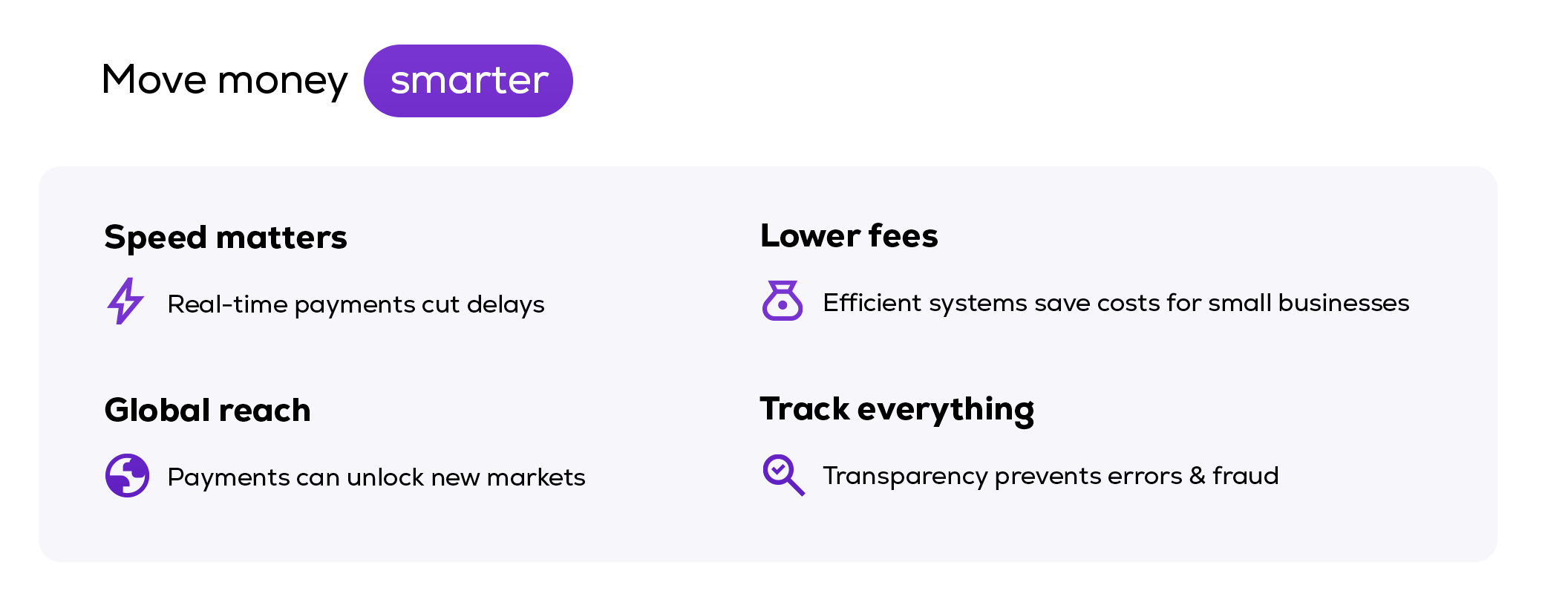
Cross-border transactions happen through both traditional and modern channels. Wire transfers and international money orders are older options that can be slow and costly. In contrast, card payments, online platforms, and even cryptocurrencies provide faster settlement and more flexibility. Each comes with a trade-off between speed, cost, and security.
This model is slow, costly, and not always transparent. Multiple financial institutions add more transaction fees and foreign exchange costs. Businesses often face delays, hidden currency conversion fees, and problems with cash flow.
- High costs. Cross-border payments can be several times more expensive than domestic ones. Transaction fees, exchange margins, and conversion costs quickly add up and reduce profits for businesses and individuals.
- Lack of transparency. Payments often pass through multiple intermediaries, making it difficult to track where the money is or when it will arrive. It can lead to uncertainty and cash flow problems.
- Legal and regulatory complexity. International transfers must meet different tax laws, anti-money laundering rules, and reporting standards. Uneven sanctions screening across countries adds further delays and extra compliance costs.
- Anti-fraud requirements. Cross-border payments are becoming increasingly complex because of stricter regulations and advanced fraud detection. While these safeguards are necessary, they often increase costs and slow down processing.
- Data standards. Payment data formats differ widely across jurisdictions. These inconsistencies cause errors, delays, and higher costs when transactions pass between different banking systems.
- Slow processing times. Limited bank operating hours and outdated legacy technology delay settlement. When multiple intermediaries are involved, a payment that should take minutes can instead take several days.
- Weak competition. In many markets, only a few providers dominate cross-border payment services. This lack of competition keeps prices high and discourages innovation.
- Security risks. Fraud and money laundering remain major threats. Providers must run strict compliance checks, which help protect transactions but can also extend processing times.
Choosing the right payment methods for your business
When sending or receiving cross-border payments, consider these factors before deciding on the right method.
Countries involved
Every country has its own financial regulations and compliance requirements. Some regions support faster systems like SEPA in Europe, while others rely on slower traditional networks. Always check if the payment method you plan to use is supported in both the sending and receiving countries.
Payment provider
Not all providers offer the same balance of cost, speed, and security. Compare fees, settlement times, and compliance features before you choose. A reliable provider should also have clear processes for fraud protection and dispute resolution.
Multiple payment options
Offering your customers or contractors more than one way to pay reduces the risk of failed cross-border transactions. For example, providing both card payments and local bank transfers can improve convenience and build trust with international partners.
Foreign exchange
Currency conversion can add hidden costs. Exchange rate margins, conversion fees, and fluctuating rates all affect the final amount. Make sure you know what your provider charges and, if possible, lock in rates to avoid surprises.
Checklist – steps before sending money abroad
- Compare available payment methods – compare their speed, cost, and security.
- Check the latest exchange rate – keep in mind the final amount the recipient will get.
- Confirm the recipient’s details – even small errors can delay transfers.
- Review provider fees – look for hidden costs like conversion margins.
- Complete required verification – follow your provider’s security checks.
- Keep transaction records – store receipts for accounting and compliance.
Cross-border payments for work and services
Global business growth depends not only on trade between companies but also on smooth payments between employers and employees, and between clients and contractors. Companies increasingly hire international talent, while freelancers and contractors work with clients abroad. These work relationships require reliable, fast, and secure ways to move money across borders.
Traditional systems often create challenges: high transfer fees, long settlement times, and complex paperwork. Newer digital solutions aim to solve these problems by simplifying the flow of money between businesses and individual professionals.
Useme: a cross-border payments platform for freelancers
The freelance economy needs reliable international payments. Useme is a dedicated cross-border payments platform that helps employers send and accept payments from freelancers in different countries. It acts as a legal employer for freelancers, reducing paperwork and ensuring financial stability.
Key benefits:
- A clear and secure payment process.
- Protection against fraud and money laundering.
- Multiple payment options, including bank transfers, cards, and direct debit.
- One summary invoice that saves money and time.
Useme makes it easy for companies to manage business-to-business payments on a global scale.
Global initiatives to enhance cross-border payments
Global initiatives are pushing for transparent cross-border payments. The World Bank, the Financial Stability Board, and other relevant international organizations want international payments to be faster, cheaper, and safer. These efforts improve financial inclusion and support economic growth in the global economy.
The private sector is also driving innovation. New market infrastructures and technology reduce costs and simplify payment flows. From retail cross-border payments to business-to-business deals, the payments industry is building a fairer, more efficient global payment system.
FAQ: cross-border payments
1. How do cross-border payments work?
Cross-border payments are financial transactions where money is sent from a payer in one country to a payee in another. Most of these transfers move through the correspondent banking model, where banks use intermediary banks to complete the transaction.
2. What’s the difference between domestic payments and cross-border payments?
Domestic payments happen inside one country. A cross-border payment connects different countries through international money transfers.
3. What are the main cross-border payment methods?
Options include wire transfers, global ACH, credit cards, money orders, digital wallets, prepaid debit cards, and checks. Cryptocurrencies like Bitcoin and Ethereum can also be used, though they carry volatility risks.
4. Are certain cross-border payment methods more common in specific regions?
Yes. For example, credit cards are most popular in North America, while mobile wallets are widely used in Southeast Asia.
5. Are real-time payments possible across borders?
Yes. Many financial institutions now use real-time payment systems and private blockchains, which make cross-border transfers faster and more reliable compared to traditional correspondent banking.
6. How do cross-border payment systems support the global economy?
They allow financial transactions between different countries, improve financial stability, and drive international trade and economic growth.