

Hiring across borders is no longer a niche strategy. It’s becoming standard for U.S. companies that want to tap into global talent. Expanding internationally offers access to diverse skills, potential cost savings, and faster innovation. But managing employees or contractors in multiple countries comes with challenges. Local labor laws, payroll complexity, benefits administration, and tax compliance can quickly become overwhelming.
This guide highlights the top Papaya Global alternatives for 2026. We’ll compare pricing, global coverage, compliance features, and platform capabilities. You’ll also learn which solutions are most-fitting for startups, mid-size businesses, and U.S. companies managing remote freelancers – so you can choose a platform that supports growth without adding administrative headaches.
But, as always, the best Papaya Global alternative depends on what you need. Whether you’re hiring your first international contractor or scaling a distributed team, this guide will help you find a solution that fits your business model, workforce, and budget.
Papaya Global alternatives: key takeaways
- Papaya Global works well for large enterprises, but it’s often too expensive or inflexible for small businesses, startups, and companies that work primarily with contractors.
- Some companies report concerns about pricing transparency, customer support responsiveness, and reliance on local partners for compliance.
- The right platform when it comes to Papaya Global alternatives depends on three things: your hiring model (employees vs. contractors), your compliance risk level, and your total budget – not just the monthly subscription.
- For full EOR services with strong compliance, Deel, Remote, and WorkMotion are among the top-rated Papaya Global alternatives in 2026.
- For fast, low-cost contractor payments, Useme is one of the most cost-effective options with no subscription and service fees starting at 4.99% per transaction.
What is Papaya Global?
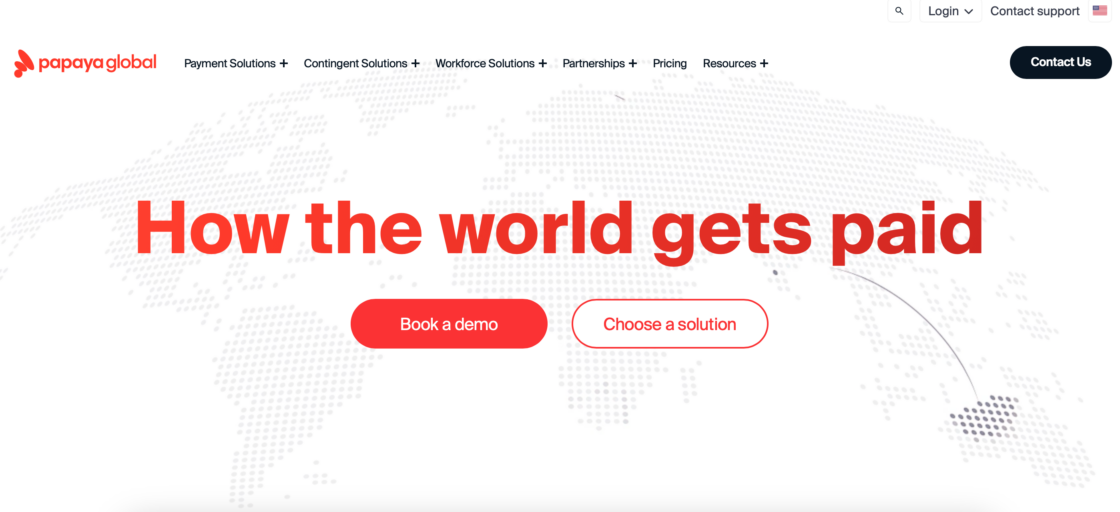
Papaya Global is a cloud-based platform designed to help companies manage employees and contractors across multiple countries. It combines payroll automation, contractor management, and Employer of Record (EOR) services. This makes it possible for businesses to hire internationally without setting up legal entities in every country.
The platform supports global operations in more than 160 countries. Its services cover onboarding, contracts, payroll processing, benefits management, and local compliance. HR and finance teams rely on Papaya Global to reduce manual data entry, ensure legal compliance, and centralize global workforce management.
Strengths of Papaya Global
- Volume-based pricing lowers the per-person cost as headcount grows – appealing for large enterprises.
- Contractor management is available at a lower entry price, making it accessible for small remote teams.
- Strong global coverage across 160+ countries.
- Solid HR analytics for workforce reporting.
Challenges of Papaya Global
- Less cost-effective for smaller teams and startups at lower headcounts.
- Limited flexibility in custom reporting.
- Fewer deep integration capabilities compared to larger HR ecosystems.
- Occasional invoice errors reported by some users.
- Inconsistent regional support due to reliance on local partners rather than owned entities.
Why companies look for Papaya Global alternatives
While Papaya Global is a well-established platform for global payroll and workforce management, it doesn’t meet every company’s needs. Many businesses explore alternatives – including Papaya Global competitors – for reasons that go beyond features, focusing on cost, compliance, usability, and flexibility. Let’s go through them.
Reason 1: Cost transparency and predictable billing
Some businesses find Papaya Global’s pricing difficult to forecast, especially smaller teams. Although its volume-based model can reduce costs for larger workforces, startups or mid-sized businesses may face high entry-level fees.
A recurring frustration among users is that hidden fees – such as implementation fees, multi-currency conversion charges, and offboarding costs – sometimes appear unexpectedly during onboarding, making true costs hard to estimate upfront. Companies often seek platforms that offer transparent pricing or simpler billing structures to make budgeting easier.
Reason 2: Compliance and risk management
Global hiring comes with legal complexity. Businesses want strong safeguards against misclassifying workers and expect platforms to keep up with local labor laws across countries. While Papaya Global provides compliance management tools, some companies look for alternatives with more proactive reporting, automated audits, or local compliance expertise in specific regions.
Legal experts consistently warn that contractor classification rules vary dramatically across countries – what’s compliant in the U.S. may not be compliant in Germany, Brazil, or India.
Reason 3: Flexibility in hiring models
Not all teams have the same workforce needs. Some require full EOR services, others focus on direct international hires, and many work primarily with contractors. Companies often look for platforms that can support multiple hiring models – managing both employees and contractors – or switch between them as their workforce evolves.
Reason 4: Expanded country coverage and local expertise
Growing businesses may enter key markets where the platform relies on third-party partners for local compliance. This can lead to variations in service quality and response times. Papaya Global alternatives with broader entity ownership or deeper local expertise can provide faster, more reliable support for companies operating in multiple countries.
Reason 5: Platform usability and integration
A smooth, intuitive unified platform is critical for HR and finance teams. Companies often report that bulk updates, custom reporting, or field-level permissions are limited in Papaya Global – and that the platform isn’t as streamlined as newer alternatives built with modern UX in mind.
They also seek solutions with stronger integration capabilities into their HR, finance, and IT management systems to reduce manual data entry and improve automation. Integration capabilities vary significantly among EOR platforms, and that gap directly affects how well a tool fits your existing workflow. Many of today’s leading Papaya Global alternatives also emphasize employee experience alongside compliance, offering mobile apps and self-service portals that give international employees more visibility and control over their own onboarding and payroll information.
Reason 6: Customer support experience
Consistent, responsive customer support is essential when managing global teams across borders. Some users of Papaya Global note that support quality can vary depending on the region, making it harder to resolve urgent issues quickly. Alternatives with dedicated regional support teams or AI-powered assistance can improve the experience significantly.
This is where Papaya Global falls short for many users – not in features, but in the day-to-day experience of getting help when it’s needed. Compliance failures remain one of the biggest threats to global teams, and slow or inconsistent support makes those risks harder to manage in real time.
What happens if you choose the wrong platform?
Choosing the wrong platform for Papaya Global alternatives doesn’t just waste money. It can create real legal and operational problems:
- Misclassified workers can trigger audits, back taxes, and fines.
- Slow onboarding can delay key hires by weeks or months.
- Poor integration with your existing tools can force your HR team into manual workarounds.
- Locked-in contracts with high exit fees can make switching difficult later.
That’s why it pays to do the evaluation properly before you commit – not after.
EOR vs contractor management vs payroll platforms – what you actually need
Before we cover Papaya Global alternatives, let’s talk a bit more about your needs. When you expand your team internationally, you have three main ways to bring people on board:
- hiring employees through an Employer of Record (EOR);
- working with contractors through a contractor management platform;
- using a payroll platform.
Each approach has very different implications for cost, compliance, and control. Choosing the wrong one can lead to unexpected expenses, legal penalties, or administrative headaches.
Here’s how they differ and when each makes sense.
Employer of Record (EOR)
What it is: An Employer of Record becomes the legal employer for your international hires. The EOR handles contracts, payroll, taxes, statutory benefits, and compliance with local labor laws in each country. Your company directs the employee’s work, but the EOR carries the legal and administrative burden.
Best for:
- Hiring full-time employees abroad without creating a local entity.
- Growing teams that need stable employment arrangements.
- Companies that want full compliance handled for them.
Pros:
- You don’t need a local company in every country.
- EOR handles payroll, taxes, and benefits administration.
- It significantly reduces legal risk.
Cons:
- Higher cost per employee compared to other models.
- Less flexibility for short-term or project-only roles.
- Typically designed for long-term employment rather than temporary work.
Use case example: A U.S. tech company wants to hire a full-time engineer in Germany without setting up a German subsidiary. An EOR enables compliant global employment in weeks rather than months.
Contractor management
What it is: Contractor management tools help you engage freelancers and independent contractors. These platforms simplify invoicing, multi-currency payments, and, in some cases, classification compliance, but the worker remains legally independent.
Best for:
- Project-based work with a clear deliverable.
- Specialized short-term or one-off hires.
- Teams that need flexibility without long-term employment commitments.
- Cross-border collaborations.
Pros:
- Fast setup – contractors can issue their first invoice in minutes, and employers don’t even need to sign up.
- Lower cost – no benefits, payroll taxes, or employer contributions.
- Access to specialized skills for specific tasks without ongoing overhead.
- Great for scaling up or down quickly across multiple markets.
Cons:
- No employer benefits or insurance apply – which suits independent workers, but may not be the best model for long-term full-time roles.
- You set the terms, but contractors work independently – that’s by design, not a limitation.
Use case example: A U.S. startup needs cost-effective freelance services. They choose a designer from Poland for a 3-month campaign. A contractor management platform lets you pay, manage contracts, and transfer copyright – all without employment commitments or ongoing subscription costs.
Payroll platforms
What it is: Traditional payroll solutions focus on paying employees accurately and calculating taxes. They may handle statutory withholdings and reporting but don’t assume employer liability or legal compliance in foreign jurisdictions.
Best for:
- Companies that already have a legal entity abroad.
- Managing international payroll for local hires within existing markets.
Pros:
- Lower cost for payroll processing than an EOR.
- Good for internal HR management teams in countries where you operate.
Cons:
- Requires you to have a local business presence.
- Doesn’t handle contracts, benefits, or global compliance.
- Not designed for cross-border hiring without existing infrastructure.
Use case example: A U.S. company already has an entity in Mexico and just needs to run payroll for employees there. A global payroll provider helps manage local tax and pay cycles.
- EOR is best when you want low legal risk and long-term hiring abroad without setting up legal entities.
- Contractor management is ideal for flexible, project-based work where speed and cost matter more than employment benefits.
- Payroll platforms are useful if you already operate locally in a country and simply need better pay runs.
For many U.S. businesses, a hybrid strategy works well – use contractors for short-term specialist tasks, while relying on an EOR for key hires and sustained global operations.
How we evaluated Papaya Global alternatives
Finding the right platform to manage a global workforce isn’t just about features – it’s about fit. We tested each platform against seven criteria that matter most when hiring internationally. Here’s what we looked at when it comes to Papaya Global alternatives.
1. Pricing and cost transparency
We compared pricing tiers from budget to enterprise, including hidden costs like implementation, currency conversion, and offboarding fees.
2. Global coverage and local expertise
We prioritized platforms operating in 80+ countries, and checked whether they own local entities or rely on third-party partners.
3. User satisfaction and reliability
We reviewed verified user feedback, focusing on payroll accuracy, support quality, and ease of use.
4. Compliance and legal support
We assessed how each platform handles local labor laws, tax regulations, and misclassification risk across countries.
5. Integration and automation
When evaluating Papaya Global alternatives, we favored platforms that connect with HR, finance, and IT tools – and reduce manual work through automation.
6. Customer support and onboarding
We assessed support availability, onboarding assistance, and regional coverage in key hiring markets.
11 best Papaya Global alternatives (2026)
If Papaya Global isn’t the right fit for your business, there are plenty of alternatives to help you hire, pay, and manage global teams efficiently. We’ve grouped the top Papaya Global alternatives based on target audience, use case, and unique strengths so you can quickly identify the best fit.
| Platform | Best for | Type | EOR price | Contractor price | Countries |
| Useme | Fast contractor payments | Contractor management | – | From 4.99% per transaction | 170+ |
| Deel | Startups needing speed | EOR + contractor | $599/mo per employee | $49/mo per person | 150+ |
| Remote | Compliance and IP protection | EOR + contractor | $699/mo per employee | $29/mo per person | 170+ |
| Rippling | Unified HR, IT, and finance | EOR + contractor + HR | Custom | Custom | 80+ (EOR), 185+ (contractors) |
| Oyster HR | Cost-conscious expansion | EOR + contractor | $599/mo per employee | $29/mo per person | 180+ |
| Pebl | Enterprise with complex needs | EOR + contractor | ~$599/mo per employee | Custom | 185+ |
| WorkMotion | Compliance transparency | EOR + contractor | From $499/mo per employee | From $29/mo per person | 160+ |
| Globalization Partners | Long-term enterprise stability | EOR | Custom | – | 180+ |
| Skuad | Emerging markets | EOR + contractor | From $199/mo per employee | From $19/mo | 160+ |
| RemoFirst | Cost-effective global hiring | EOR + contractor | From $199/mo per employee | $25/mo per person | 180+ |
| Borderless AI | AI-powered onboarding speed | EOR + contractor | $579/mo per employee | $49/mo per person | 170+ |
1. Useme – best for fast contractor payments without subscriptions
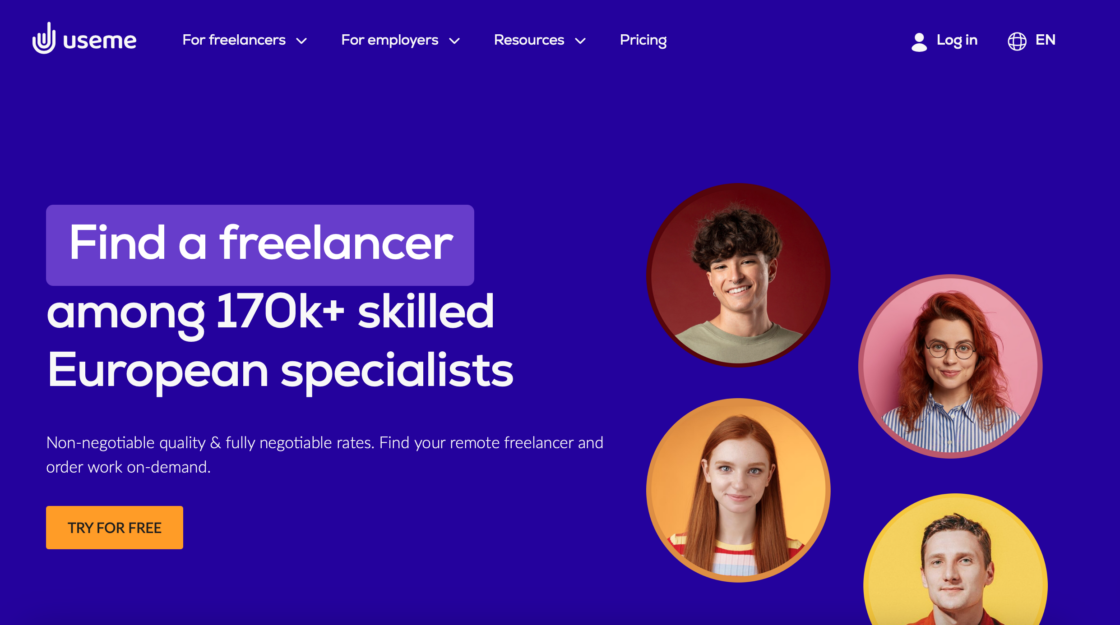
Why it stands out: Useme is a European-based contractor management platform focused on freelancers and short-term international contractors. It lets companies pay international contractors quickly without the overhead of subscriptions, complex international payroll, or EOR record services. This makes it one of the best Papaya Global alternatives.
Key features:
- Pay international freelancers securely within 1–3 days via multiple payment methods.
- Freelancers can invoice clients without registering a business.
- Bulk invoicing and payments are included.
- No setup or monthly subscription fees – pay only per transaction.
- Self-service options for fast, independent onboarding.
Pricing:
- Service fee of 4.99% of the invoice amount, with a maximum of $99 per transaction.
- No subscription or setup costs.
Pros for freelancers:
- Invoice clients without registering a business.
- Get paid usually within 1–3 days.
- Can choose their local currency, even if the client pays in dollars or euros.
- Transfer copyright fully automated.
Cons for freelancers:
- No mobile app.
- Mostly suited for payments from clients you already have, as Useme has smaller job volume compared to platforms like Upwork.
Pros for clients:
- No subscription – pay only when you use it.
- Pay all contractors in one transfer and receive one monthly summary invoice.
- Simple onboarding – deals can even be completed from email.
- Highly-rated customer support.
- Access to European contractors with competitive rates.

Cons for clients:
- Not suitable for hiring full-time employees or EOR.
- Limited project management features.
Best for: Companies that hire short-term contractors or freelancers and want a simple, cost-effective platform for international payments without hidden fees.
2. Deel – best for startups needing speed and automation
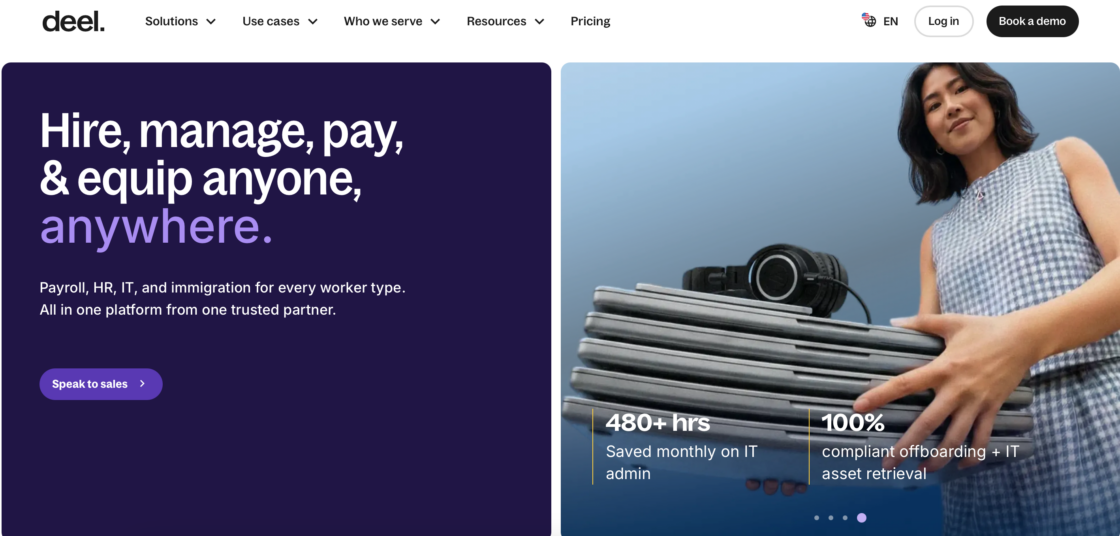
Why it stands out: Deel combines EOR and contractor management with a fast, SaaS-first experience. It’s widely recognized for its modern interface and rapid deployment – two qualities that make it a popular first choice for startups that need to get international hires up and running quickly. Deel uses modular pricing for Payroll, HR, and IT, so you only pay for what your team actually needs. Startups hiring globally and mid-sized businesses benefit from easy onboarding, automated compliance, and AI-powered HR management tools.
Key features:
- Global payroll in 150+ countries.
- Contractor management with automated invoicing.
- Built-in equity administration.
- HRIS and compliance management automation.
Pricing:
- EOR: $599/month per employee.
- Contractors: $49/month per person.
Pros for freelancers:
- Fast contract setup and automated invoicing.
- Multiple currency and payment options.
- Clear visibility of payment status through the contractor dashboard.
Cons for freelancers:
- $49/month fee is paid by the client, but some clients pass costs on through lower rates.
- Less useful for very short, one-off projects.
Pros for clients:
- Fast onboarding – international hires can be set up in days.
- Modular pricing means you only pay for what you need.
- Strong compliance automation across 150+ countries.
Cons for clients:
- $49/month per contractor adds up quickly for larger teams.
- Full EOR at $599/month is expensive for small businesses.
Best for: Startups and growing teams needing quick setup, multi-currency payroll, and flexible contractor workflows across multiple countries.
👉 Looking for something similar to Deel? Check out our comparison: 11 best Deel alternatives in 2026.
3. Remote – best for compliance and IP protection
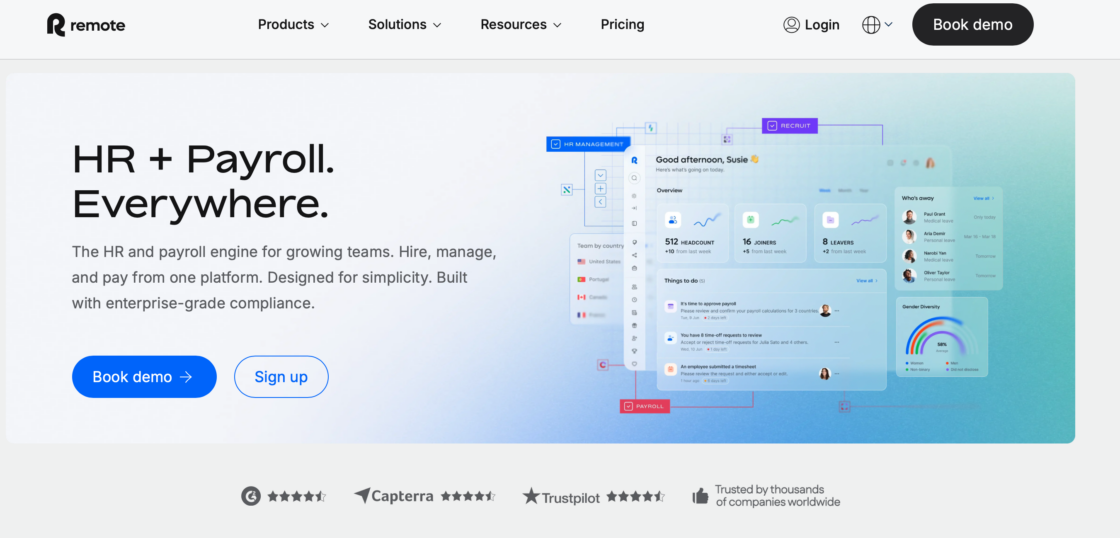
Why it stands out: Remote owns legal entities in all operating countries. This gives companies stronger local compliance expertise and IP protection than Papaya’s partner-based model. It’s also widely favored for its user-friendly design, which makes full-service EOR capabilities accessible to HR teams that don’t have dedicated operations staff. This makes it one of the leading Papaya Global alternatives for compliance-focused businesses.
Key features:
- Full EOR, payroll platform, and contractor management in 170+ countries.
- Built-in benefits administration.
- Visa and work permit support.
- Proprietary IP protection and unlimited indemnity coverage.
Pricing:
- EOR: $699/month per employee.
- Contractors: $29/month per person.
Pros for freelancers:
- Low monthly fee of $29 for contractor access.
- Clear, timely payments through an easy-to-use contractor portal.
- IP ownership handled cleanly and compliantly.
Cons for freelancers:
- Platform is primarily client-facing – freelancer experience is secondary.
- Limited tools for self-promotion or finding new clients.
Pros for clients:
- Owned legal entities in every country – no third-party partner risk.
- Strong IP and indemnity protection built in.
- User-friendly interface, even for non-HR teams.
Cons for clients:
- EOR at $699/month is among the higher-priced options.
- Less suitable for companies that only need occasional contractor payments.
Best for: Startups or companies with sensitive intellectual property, strict compliance needs, or distributed global teams requiring compliant global employment.
👉 Want to explore the platform? See the 9 best Remote alternatives for hiring global talent in 2026.
4. Rippling – best unified HR, IT, and finance platform
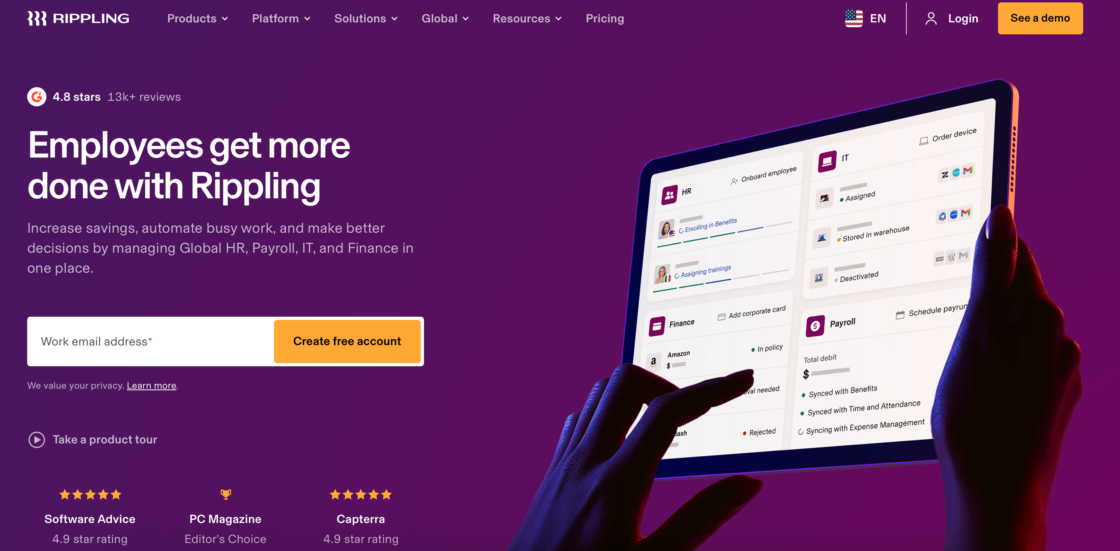
Why it stands out: Rippling combines HR, IT, finance, and global payroll into a single system – one of the few platforms that genuinely unifies workforce operations end to end. Its extensive app marketplace gives HR and IT teams an unusually broad set of integration options. Its device and application management features go well beyond what most EOR platforms offer. This reduces the need for multiple tools and manual data entry.
Key features:
- EOR and global payroll in 80+ countries, contractors in 185+.
- 500+ integration capabilities with HR, finance, and IT systems.
- Automated workflows and compliance management.
- Device and application management for international employees.
Pricing: Custom pricing based on services and headcount.
Pros for clients:
- Single platform for HR, IT, and payroll – fewer tools to manage.
- 500+ integrations reduce manual data entry significantly.
- Scales well from small teams to enterprise.
Cons for clients:
- Custom pricing makes it hard to budget without a sales call.
- Can be more than most small businesses need.
- No transparent pricing published.
This is an employer-facing platform. Contractors don’t interact with it directly, so a freelancer perspective doesn’t apply here.
Best for: Mid-market companies and enterprise clients wanting a single platform for HR, IT management, payroll, and compliance automation across key markets.
5. Oyster HR – best for cost-conscious global expansion
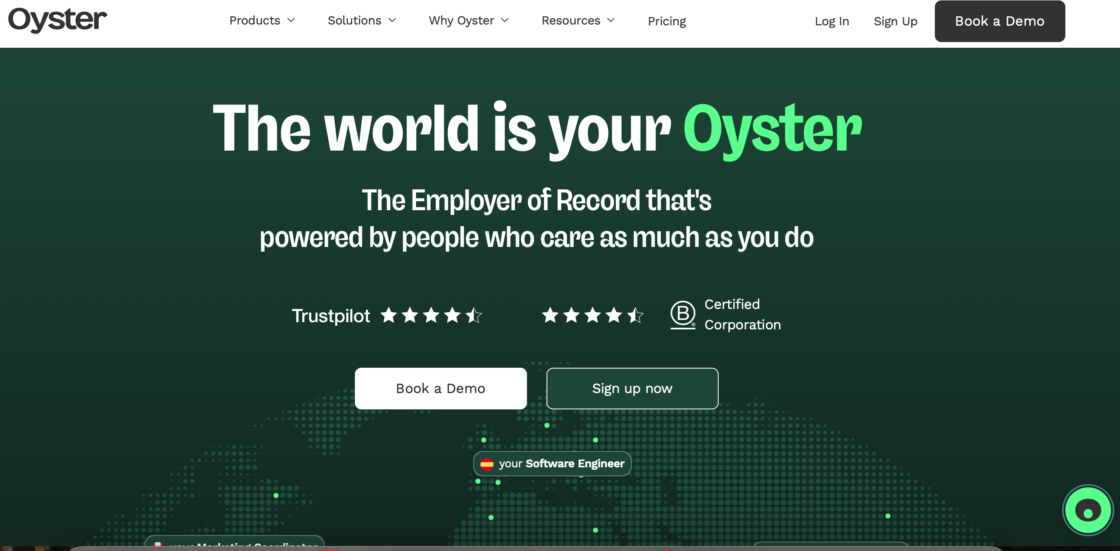
Why it stands out: Oyster HR takes a mission-driven approach to global employment, pairing simplicity with a genuine commitment to ethical hiring practices. It’s a top choice for budget-conscious companies focused on compliant, full-time international employment. It offers tools for hiring, payroll, benefits, and compliance in over 180 countries – all with transparent, all-inclusive pricing.
Key features:
- EOR and contractor payroll.
- Automated compliance management and monitoring.
- Local currency multi-currency payroll and global benefits.
- Educational resources and employee development tools.
Pricing:
- EOR: $599/month per employee (annual billing).
- Contractors: $29/month per person.
Pros for clients:
- Transparent, all-inclusive pricing with no hidden fees.
- Strong compliance tools across 180+ countries.
- Mission-driven platform with a focus on ethical global hiring.
Cons for clients:
- Annual billing required for the lowest EOR rate.
- Fewer integration options than platforms like Rippling.
- Less suitable for enterprise-scale complexity.
Best for: Small businesses and startups looking for simple, affordable global employment solutions without hidden fees.
6. Pebl – best for enterprises with complex needs
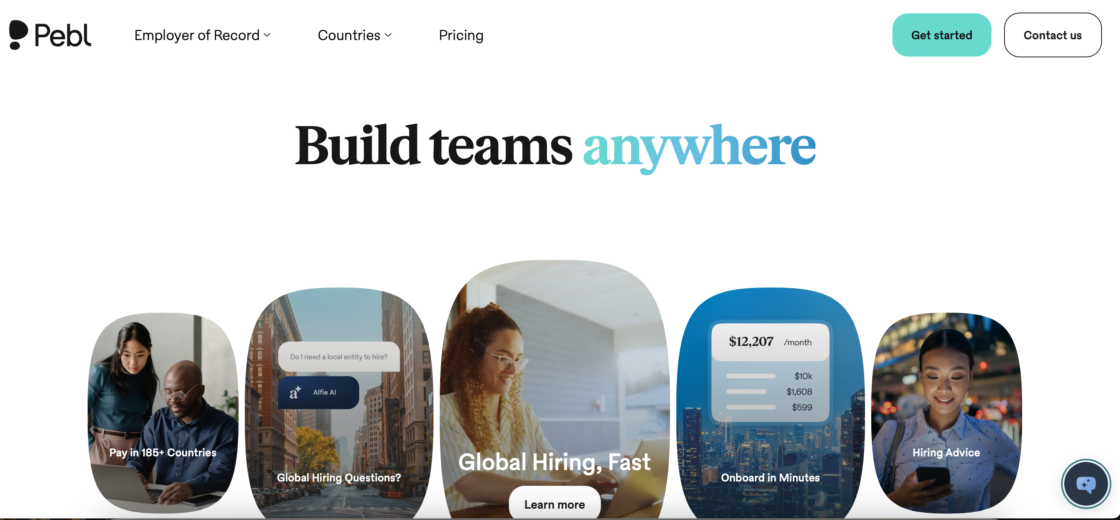
Why it stands out: Pebl (formerly Velocity Global) is built specifically for enterprises that require complex, long-term, and compliant global employment at scale. It specializes in large-scale global expansion with deep legal expertise and proprietary infrastructure in 185+ countries – making it one of the few platforms genuinely suited to organizations managing hundreds of international employees across multiple regions simultaneously.
Key features:
- Full EOR services for employees and contractors.
- Immigration, visa, and relocation support.
- Multi-currency payroll and benefits management.
- AI-powered HR compliance tools.
Pricing: Varies based on services and headcount; approximately $599/month per employee typical.
Pros for clients:
- Deep legal expertise and owned infrastructure in 185+ countries.
- Strong immigration and relocation support.
- Consistent service quality at enterprise scale.
Cons for clients:
- Pricing is not transparent and requires a custom quote.
- Overkill for small teams or contractor-only use cases.
- Recently rebranded from Velocity Global – some instability during transition.
This is an employer-facing platform designed for enterprise HR and legal teams. Contractors don’t interact with it directly, so a freelancer perspective doesn’t apply here.
Best for: Large corporations and enterprise clients expanding rapidly across multiple regions and requiring consistent service quality at scale.
7. WorkMotion – best for compliance transparency and predictable pricing
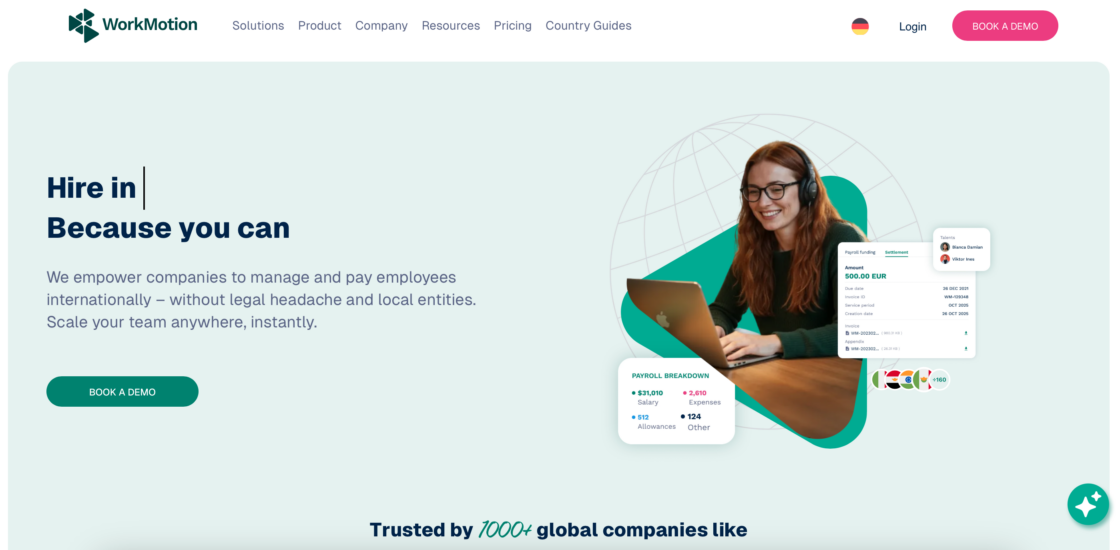
Why it stands out: WorkMotion is one of the strong Papaya Global alternatives for businesses that want clarity upfront. It offers a more transparent cost structure than Papaya Global, which means you can scale headcount without worrying about surprise markups. WorkMotion simplifies onboarding, payroll accuracy, contract generation, and compliance updates across multiple markets – all from an intuitive platform designed to reduce administrative load.
Key features:
- Automated compliance checks and legal-grade risk mitigation.
- Transparent, predictable pricing with no hidden fees.
- Contract generation and onboarding workflows across multiple countries.
- Compliance monitoring with automated updates as local laws change.
Pricing:
- EOR: starting at $499/month per talent.
- Contractors: starting at $29/month per person.
Pros for clients:
- Transparent pricing from day one – no surprise costs.
- Strong automated compliance across multiple markets.
- Intuitive platform with low administrative overhead.
Cons for clients:
- Smaller country coverage than some competitors.
- Less brand recognition than Deel or Remote.
- Fewer integrations with third-party HR tools.
Best for: Companies that prioritize compliance transparency and want a clear, reliable cost structure from day one – particularly those frustrated by Papaya Global’s fluctuating pricing.
8. Globalization Partners – best for long-term enterprise stability
Why it stands out: Globalization Partners is one of the earliest EOR providers, G-P offers stable infrastructure, AI-assisted onboarding, and flexible benefits administration in 180+ countries.

Key features:
- Global EOR covering international payroll, compliance, and HR management.
- AI-assisted contract generation and onboarding.
- Visa and work permit support.
- Flexible health insurance and benefit options for international employees.
Pricing: Custom pricing based on headcount and regions.
Pros for clients:
- One of the most established EOR providers in the market.
- AI-assisted onboarding speeds up international hiring.
- Strong benefits and insurance options for employees.
Cons for clients:
- No published pricing – requires a custom quote.
- Can be expensive for smaller teams.
- Less suited to contractor-only use cases.
This is an employer-facing EOR platform. Contractors and freelancers don’t interact with it directly, so a freelancer perspective doesn’t apply here.
Best for: Enterprises seeking long-term reliability and established local compliance expertise.
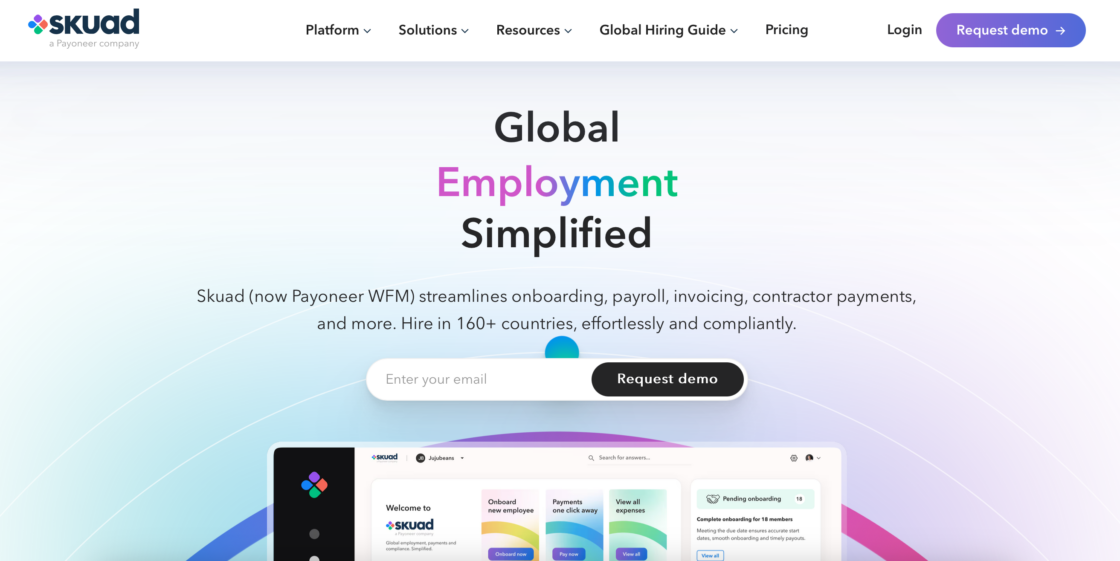
9. Skuad (Payoneer Workforce Management) – best for emerging markets
Why it stands out: Skuad – now operating as part of Payoneer Workforce Management – focuses on emerging markets with competitive pricing and tools for managing employees and contractors in 160+ countries.
Key features:
- Multi-currency payroll and local tax optimization.
- Contractor management with automated workflows.
- Built-in productivity tools for remote global teams.
Pricing:
- EOR: starting from $199/month per employee.
- Contractors: starting from $19/month.
Pros for freelancers:
- Low contractor fee starting at $19/month.
- Multi-currency payment support.
- Straightforward onboarding process.
Cons for freelancers:
- Platform is primarily employer-facing.
- Limited visibility tools for finding new clients.
Pros for clients:
- Very competitive pricing, especially for emerging markets.
- Strong local tax optimization in India, LATAM, and Southeast Asia.
- Backed by Payoneer’s payment infrastructure.
Cons for clients:
- Less established than Deel or Remote for enterprise use.
- Coverage gaps in some regions outside core emerging markets.
Best for: Companies expanding in India, LATAM, or other emerging markets needing cost-effective compliance and international payroll management.
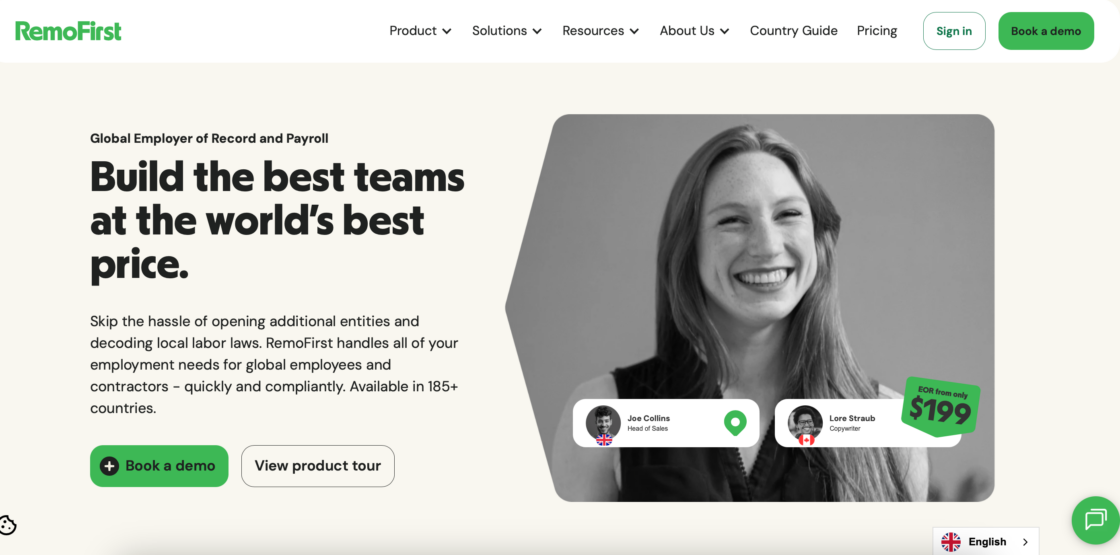
10. RemoFirst – best for fast, cost-effective global hiring
Why it stands out: RemoFirst is one of the most cost-effective EOR options and Papaya Global alternatives available in 2026. With plans starting as low as $199 per employee per month, it’s a compelling choice for small and mid-sized companies that want compliant global employment without the enterprise price tag. It offers fast onboarding, transparent pricing, and dedicated migration support for global teams in 180+ countries.
Key features:
- EOR and contractor services.
- Visa and work permit support.
- Global employee health insurance and benefits, with payroll in local currencies.
Pricing:
- EOR: starts at $199/month per employee.
- Contractors: $25/month per person.
Pros for clients:
- One of the lowest EOR prices on the market.
- Fast onboarding with dedicated migration support.
- Transparent, flat-rate pricing with no hidden fees.
Cons for clients:
- Smaller team and less established than Deel or Remote.
- Fewer integrations with HR and finance systems.
- Less suitable for complex enterprise needs.
This is primarily an employer-facing platform. While contractors receive payments through it, they don’t manage their own experience on the platform, so a freelancer perspective doesn’t apply here.
Best for: Small and mid-sized companies looking for affordability, quick setup, and hands-on customer support.
11. Borderless AI – best for AI-powered onboarding speed
Why it stands out: Borderless AI takes a fundamentally different approach to global hiring. Its AI-native platform, HRGPT, can reduce onboarding times from weeks to just minutes. For teams that need to move fast – whether hiring in a new country or scaling a distributed workforce quickly – this is a significant differentiator. The platform also provides fast, 24/7 compliance answers, reducing the need to wait on support tickets for time-sensitive questions.

Key features:
- AI-native platform (HRGPT) with 24/7 compliance guidance.
- Onboarding that can be completed in minutes, not weeks.
- EOR services with automated compliance checks.
Pricing:
- EOR: $579/month per employee.
- Contractors: $49/month per person.
Pros for clients:
- Fastest onboarding of any platform on this list.
- 24/7 AI compliance support reduces reliance on account managers.
- Good fit for tech-forward teams that want automation over hand-holding.
Cons for clients:
- AI-first approach may feel impersonal for teams that prefer human support.
- Less track record than established EOR providers.
- Contractor fee at $49/month is on the higher end.
This is primarily an employer-facing platform. Contractors don’t manage their own experience within it, so a freelancer perspective doesn’t apply here.
Best for: Tech-forward companies or fast-scaling teams where onboarding speed and AI-driven compliance support are top priorities.
✅ Pro tip for choosing Papaya Global alternatives: Useme is ideal if your focus is short-term freelancers and simple contractor payments. WorkMotion is a strong pick if compliance transparency and predictable pricing are your top priorities. For full EOR services and scaling teams, platforms like Deel, Remote, and Rippling provide the most comprehensive coverage.
Common mistakes when choosing a global payroll platform
Now that you know Papaya Global alternatives, we can cover what not to do when choosing your platform. Because even experienced HR teams make avoidable errors when selecting a global workforce platform. Here are the most common ones – and how to avoid them.
1. Choosing based on price alone
A lower monthly fee doesn’t mean lower total cost. Many platforms charge extra for onboarding, multi-currency conversions, offboarding, and compliance updates. When looking at Papaya Global alternatives, always calculate the full cost of ownership before you decide.
2. Not checking country-specific compliance
A platform might operate in 180 countries, but that doesn’t mean it handles compliance equally well in all of them. Ask specifically about the countries where you plan to hire.
3. Using a contractor platform when you need an EOR
If your workers are working full-time, following your schedule, and using your tools, they may legally be employees – even if you call them contractors. Using the wrong platform won’t protect you.
4. Ignoring integration with your existing tools
A great EOR platform that doesn’t connect to your payroll software, HR system, or accounting tools will create manual work. Check integrations before you sign.
5. Skipping the support evaluation
Support quality varies enormously. Test response times and regional coverage before you commit to one of the Papaya Global alternatives – especially if you’re hiring in countries where you don’t have local expertise.
Papaya Global alternatives – compliance risks (U.S. perspective)
In the second point of common mistakes when picking a Papaya Global alternative, we talked about compliance. When you expand your workforce across borders or hire international contractors globally, compliance isn’t just a nice-to-have – it’s a legal requirement. Missteps can lead to fines, back taxes, legal liability, and damage to your reputation.
Below are the most important compliance risk areas U.S. businesses should understand when evaluating Papaya Global alternatives.
1. Worker misclassification risks (IRS + global equivalents)
What it is: Worker misclassification happens when you treat someone as an independent contractor when local laws consider them an employee – even if you intended otherwise.
Why it matters (U.S.): In the United States, the Internal Revenue Service (IRS) and state labor departments use strict criteria to determine whether a worker is an employee or contractor. If someone is misclassified:
- You may owe back payroll taxes (Social Security, Medicare, FUTA).
- You may owe wages, overtime, or benefits under state law.
- You could be liable for penalties and interest.
This risk isn’t limited to the U.S. Many other countries have similar tests, often with even stricter thresholds – meaning that an arrangement that looks like a contractor relationship from a U.S. standpoint might still be an employment relationship overseas.
Real-world example: misclassification fine in Spain
In 2021 and then, again in 2023, Glovo – a delivery platform – was ordered to pay €57 million in social security fines by Spanish authorities after regulators determined its delivery workers were employees, not independent contractors. This is one of the most cited examples of cross-border misclassification risk for companies operating with a contractor model. (Forbes, Jan 24, 2023)
This type of ruling can happen in any country with strict labor laws – including Germany, France, Brazil, and India.
How this risk plays out with global providers:
- Some global hiring platforms focus primarily on payments, not legal classification support. Without strong classification safeguards, you could be responsible for misclassification penalties.
- Platforms with built-in misclassification risk assessments, document management support, or legal review help reduce this exposure.
2. Permanent establishment (PE) risk
What it is: Permanent establishment refers to the risk that a foreign tax authority might conclude your business has a taxable presence in their country – simply because you have workers operating there regularly.
Why it matters: In many countries, having personnel perform work from within borders – even remotely – can create a taxable nexus. If your company is deemed to have a PE:
- You may be required to register a local legal entity.
- You could owe corporate tax, VAT/GST, or local reporting obligations.
- You may be subject to audits and penalties.
PE rules vary by jurisdiction, and treaties between countries (such as U.S. tax treaties) may change how the test applies.
How compliance platforms help:
- A solid EOR provider can significantly reduce permanent establishment risk by acting as the legal employer, though PE exposure depends on local laws and business activity.
- Providers that only handle payroll solutions or payments without a legal entity may leave you exposed.
Questions to evaluate:
- Does the provider own legal entities in the countries where you hire?
- Will the provider help you understand PE thresholds by jurisdiction?
- Do they assist with VAT/GST registration and corporate tax compliance if triggered?
3. Tax withholding responsibilities
What it is: When you pay workers – international employees or contractors – various taxes may apply. You must properly withhold and remit those taxes to the correct authorities.
U.S. context: In the U.S., employers must withhold federal income tax, Social Security, Medicare, and possibly state and local taxes for employees. Contractors typically don’t have tax withheld (unless backup withholding applies), but you still need to report payments on Form 1099.
💡 Read more about 1099-NEC Form: what it is, who needs it, and how to use it
Global context – international workers often trigger:
- withholding tax on wages;
- tax on contractor payments (and sometimes VAT);
- social security contributions under local schemes.
Failing to withhold and remit correctly can result in interest and penalties, employer liability, and audit exposure.
Where providers differ:
- EOR providers typically withhold and remit on your behalf, ensuring compliance with local regulations.
- Contractor-only platforms may not handle withholding. This may be compliant depending on local tax law and the contractor’s registration status.
- Some platforms lack clear multi-currency payroll tax handling or don’t automatically update withholding rates, creating risk.
4. Contractor vs employee tests internationally
What it is: Every country has criteria to define whether a worker is an independent contractor or a legally employed worker. These criteria differ widely and are often stricter than U.S. standards.
Examples of international test differences:
- Some countries assume a worker is an employee unless very specific conditions are met.
- Others treat contractors as employees if they work more than a certain number of hours or have too much integration with your organization.
- Countries like Germany, France, Brazil, India, Japan, and many in Europe and LATAM have strict tests that focus on control and dependency, not just contract wording.
Why this matters: If a worker is misclassified overseas, local authorities can impose back wages, taxes, contributions, and fines. You may be required to enroll the worker in benefits that only employees receive. Penalties are often much higher than in the U.S. due to statutory benefits and social insurance schemes.
How providers help: Strong global workforce platforms provide country-specific classification frameworks, compliance documentation templates, and automated alerts when worker status may trigger an employment relationship.
👉 Dive deeper into the subject with our article: Independent contractor vs employee: what’s best for your business.
Global employment: why these risks matter for U.S. businesses
U.S. companies expanding abroad or hiring international contractors often underestimate how different compliance frameworks can be. What qualifies as a contractor in America might be an employee under Spanish, Brazilian, or Indian law. Misunderstanding these risks can lead to large financial liabilities, forced entity formation, loss of tax treaty benefits, and a damaged employer reputation.
The best Papaya Global alternatives aren’t just about payroll or pricing – they must help you navigate international compliance with confidence.
Reducing compliance risk – what to look for
To protect your business, prioritize providers that offer:
✅ Strong classification safeguards tailored by jurisdiction.
✅ Owned entities with legal entity presence (not just local partners).
✅ Automated withholding and remittance.
✅ Regular compliance management updates and alerts.
✅ Contract templates aligned with local regulations.
✅ Clear document management and documentation of tax and PE exposure.
Choosing Papaya Global alternatives – checklist
Use the questions in this checklist to compare platforms side-by-side before committing to a platform.
- Pick the platforms you’re considering.
- Go through each section and mark what each platform supports.
- Focus on the areas that matter most to your company.
Hiring model
- Does it support my worker type – contractors, employees, or both?
- Can it handle hybrid teams?
Compliance & legal
- Does it provide local worker classification checks?
- Does it own legal entities in my target countries?
- Does it handle tax withholding and remittance?
- Does it reduce permanent establishment risk?
Pricing & total cost
- Is pricing transparent and predictable?
- Have I accounted for onboarding, offboarding, and FX fees?
- Are there any hidden fees?
Scalability
- Can it expand into new countries as I grow?
- Does pricing stay reasonable at my current and projected headcount?
Workflow & automation
- Does it automate contracts and compliance alerts?
- Does it support bulk payments and multiple payment methods?
Support
- Is there reliable customer support in my key markets?
- Does it offer onboarding assistance?
Integrations
- Does it connect with my HR and finance systems?
- Is there API access for custom workflows?
Conclusion on best Papaya Global alternatives
Papaya Global is a capable platform, but cost, compliance complexity, and usability gaps push many businesses to look elsewhere. The alternatives in this guide cover the full range of needs – from fast contractor payments with Useme to full EOR services with Deel, Remote, and RemoFirst, to unified HR and IT management with Rippling. Specialized options like WorkMotion add compliance transparency, while Borderless AI cuts onboarding time significantly.
By applying a structured decision framework – defining your hiring model, assessing compliance risk, estimating workforce scale, calculating total cost, and evaluating onboarding speed – businesses can select the platform that aligns with both their operational needs and strategic vision.
FAQs on Papaya Global alternatives
What is the best Papaya Global alternative?
The best Papaya Global alternative depends on your business needs. For contractor management and fast payments, Useme is a strong choice with no subscription fees. For full EOR services, Deel and Remote are top Papaya Global alternatives worth evaluating. For AI-powered onboarding speed, Borderless AI is worth considering. For mid-market companies and enterprise clients needing a unified platform, Rippling and Pebl lead the field.
Do I need an EOR for freelancers?
No. If you’re working with genuine independent contractors, a contractor management platform is usually sufficient. EOR services are designed for full-time international employees, not freelancers. Using an EOR for contractors adds unnecessary cost.
What’s the cheapest way to pay international contractors?
Useme is one of the most cost-effective options – charging a service fee starting at 4.99% per transaction with no monthly subscription. It supports multiple payment methods and simplifies invoicing, making it ideal for small businesses paying international contractors regularly.
How do companies avoid misclassification?
To avoid misclassification, use platforms with built-in classification checks aligned with local labor laws. EOR providers offer compliant global employment for workers who should be employees. For contractors, strong contract templates and regular compliance management reviews reduce risk significantly.
What should I assess before evaluating Papaya Global alternatives?
Start by defining your specific requirements: what types of workers you’re hiring, which countries you’re operating in, and how quickly you need to scale. From there, evaluate each platform on its integration capabilities with your existing HR and finance systems, its compliance strength in your target markets, and whether its pricing model matches your growth pace. The goal is to find a platform that fits how you actually work – not one you have to adapt to.
Is Papaya Global good for small businesses?
It can be, but it’s not the most cost-effective option for small teams. The platform’s pricing model works best at scale. Small businesses with fewer than 10–20 international hires often find contractor-focused tools like Useme (no subscription, 4.99% fee) more affordable and easier to manage. This is one of the best Papaya Global alternatives for small businesses.
Disclaimer: This article is for informational purposes only and does not constitute legal, financial, or employment advice. Employment laws and platform features change regularly. Always consult with qualified professionals before making hiring decisions.
This article was created with the assistance of AI technology.
| Author: Ela Binkowska |