

Write good prompts. But don’t forget the human touch.
Use AI for ideas. But decide for yourself which are the good ones.
Make more content faster. But don’t lose your brand’s personality.
Working with AI in content is a balancing act. Done right, it can save time and spark ideas. Done wrong, it can make your message sound cold or generic. That’s why many businesses face the same challenge: how do you use AI tools without losing what makes your brand special?
Shortcut: Your 4 keys to AI and brand voice
You can speed up content with AI without losing brand voice by:
- Documenting a specific, example-driven voice & tone,
- Giving role-based prompts with goals, audience, format, and boundaries,
- Running an edit loop where AI self-checks against your brand checklist and a human does the final pass.
- Use a shared prompt library, evolve guidelines, and audit outputs at scale.
Why AI content often sounds generic
Even the best AI tools can create content that sounds fake and robotic – no matter how much you train your AI model. This happens because AI learns patterns from millions of texts, but it doesn’t understand your specific business story, your customers’ inside jokes, or the cultural context that makes your brand special.
The problem isn’t that AI can’t write well. Modern AI tools can create good copy, come up with creative ideas, and copy different writing styles very well.
But your brand voice isn’t just about writing style. It’s about who you are as a company. AI can simulate personality, but it can’t genuinely understand the experiences and insights that make your brand unique.
You can spot off-brand AI content easily. It sounds too formal or too casual for your brand, uses the same phrases over and over, and feels flat without showing your brand’s soul. The good news is that this doesn’t mean AI is useless for brand content. It just means you need to approach it right.
“When I first started using AI, I was honestly a bit disappointed. The content was grammatically correct, but it was generic. It had no personality; it didn’t sound like me or my brand. My breakthrough came when I stopped thinking of AI as a writer and started seeing it as a very fast, very capable assistant. Its job is to build the basic structure and give me a solid first draft, saving me from the ‘blank page’ problem.
Now, my process is completely different. I spend maybe 20% of my time creating a detailed prompt, sometimes even giving the AI a mini-style guide with key phrases and tone. But the other 80% of the time is mine. That’s when I do the real work: I rewrite sentences, add personal anecdotes, and inject my brand’s unique voice into the text.
AI gives you speed, but it’s the human touch that creates connection. That’s our job, and that’s what keeps our brand authentic.”
– Patrycja Zawadka, copywriter and storyteller at patrycjazawadka.pl
What keeping the brand voice actually means
Before a musician plays their instrument, they have to tune it. The same goes for a copywriter and brand voice. Before you start writing or prompting AI – and expect the result to sound like your brand – you need to know what that voice actually says and how it sounds.
New to brand voice and tone? You don’t have to do it alone! Marketing professionals can help you shape your brand personality and connect with your target audience.
When talking about brand personality and style guides, the terms voice and tone usually come together. Brand voice is the way a company “speaks” in every message. It’s made of its values, personality, and writing style. Brand tone is how that voice adapts to different situations and readers’ emotional states.
- Voice = stable personality & values (always-on)
- Tone = situational adjustment (channel, audience mood)
💡If you’re just starting to create your company’s brand voice rules, get inspired by big names’ style guides like:
When you have a clearly defined voice and tone, it’s easier to make sure that even if AI helps create the content, the result still sounds true to the brand. Without this base, you’re asking AI to hit a target you haven’t even defined yet.
If you don’t have a brand voice and tone written down, you can do it with AI. Try uploading a few examples of your best content and prompt the tool, for example:
Analyze the tone, style, and personality in these text samples. Summarize the main traits in short, clear bullet points. Include examples from the text that show each trait. Suggest 3–5 personality words that best describe this voice. If something is unclear or inconsistent between samples, point it out.
Adjust your voice and tone guidelines to AI
Traditional brand voice guidelines often describe the brand in broad terms: “We’re genuine, confident, and friendly. We understand our customers’ challenges and speak in a warm, easy-to-understand way.” While this is helpful for human writers, it’s often too vague for AI.
Creating an AI-friendly brand voice guide starts with being specific about your personality. Instead of saying your brand is “friendly,” be clearer. Is it “warm and supportive” or “casual and playful”? AI understands words differently than humans do, so the more exact you are, the better results you’ll get.
To show AI what your brand voice means in practice, give it real examples. You need to provide clear text samples of both what you want and what you don’t want. Include good ones that show “This is how we sound” alongside bad ones that demonstrate “This is not how we sound.” The more examples you give, the better AI will understand your style.
💡 When you set up your brand voice rules, make sure to include these points:
- 3–5 personality words (from your own analysis step)
- Do/Don’t vocab (approved & banned phrases)
- Good vs. not-our-voice fragments (10–20 words each)
- Channel modifiers (e.g., “IG captions = warmer; docs = neutral”)
Copywriting prompts: getting the results you want
AI performs better when you give role-based instructions and specific steps to follow. Instead of only listing personality traits, tell the AI who it is for this task, what it needs to do, and what to avoid.
You should also give complete background information every time you create a prompt. Tell the AI who your target audience is, what the goal of this content is, where it will be published, and how people will use this information.
Compare the traditional brand voice example with the version changed for AI:
| Approach | Audience | Example |
| Traditional | For humans | We are confident and friendly, not afraid of humor. We keep things informal, but clarity comes first. |
| AI-Ready | For models | You are a social media copywriter for (COMPANY NAME). Create an Instagram caption that is informal, warm, and familiar to small business owners. The post should highlight a quick tip for improving productivity, in under 80 words, and end with a light, friendly question to invite comments. Avoid technical jargon, hashtags over three words long, and overly formal language. |
Why this works:
- Role assignment tells AI exactly how to “think” for the task.
- Content format (Instagram caption, length limit) keeps output consistent.
- Tone and audience make the post match the brand personality.
- Boundaries prevent off-brand elements from slipping in.
🔎 For practical inspiration, check David Precht’s article about crafting tone-of-voice (TOV) guides specifically for AI tools, not just for human writers: Teaching the AI how to sound better (AKA Building an AI voice and tone guide)
Create a central prompt library
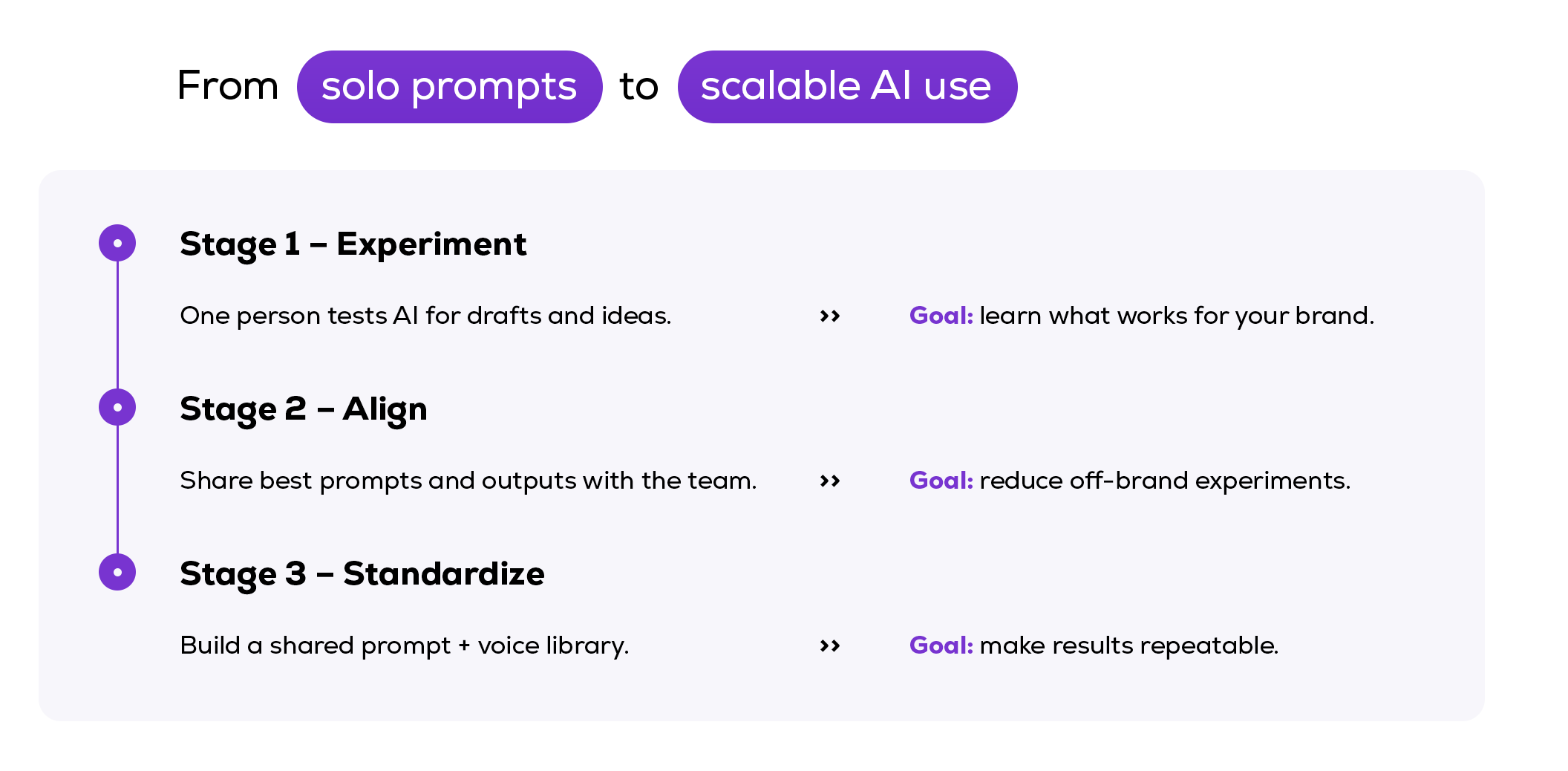
Don’t let good prompts get lost in emails or private notes. Store them in one shared place – a simple document, internal wiki, or project management tool – where the whole team can access them. Include your most successful prompts, brand voice checklist, style rules, and examples of on-brand content. Add short notes on when and how to use each prompt, and update the repository regularly based on new tests and results.
A shared prompt library saves time, keeps your AI output consistent, and helps new team members get up to speed faster. It also turns AI use into a repeatable process instead of starting from scratch every time.
The human-AI collaboration process
Always let a person check the content before you publish.
The best results come when humans and AI work together, not when one replaces the other. Think of AI as your first-draft writer, and you are the editor and quality controller. AI can quickly create content that’s 70-80% of what you need, then you add the final 20-30% that makes it truly yours.
What AI handles well:
- Creating first drafts quickly
- Coming up with content outlines
- Writing summaries of longer content
- Checking large amounts of content for consistency
What humans should handle:
- Final editing and polish
- Understanding cultural context and emotions
- Very important content like crisis communication
- Adding personal stories and experiences that only your team knows
Use iteration to improve step by step
Instead of taking AI’s first attempt and editing it by hand, give AI feedback and ask it to improve. Read AI’s first draft, identify what needs to change, and then ask for specific improvements like “Make this section more conversational” or “Add more specific examples.”
You can also run the draft through a second prompt as a checking step. In this round, give the AI your brand voice checklist (more on that later) and ask it to check the content against it. This way, the tool corrects itself and ensures the final version matches your tone, style, and audience needs before you make any last human edits.
Based on that, a simple workflow would go like this:
- Read the AI’s first draft.
- Identify what needs to change.
- Ask the AI to make specific improvements.
- Run the revised draft through a second prompt with your brand voice checklist.
- Repeat until you’re happy with the result.
Brand voice checklist
A self-check prompt for AI used in the 4th step could go like this:
Review this text against our brand voice checklist. Spot any issues and suggest specific changes so it:
- Matches our brand personality
- Uses the right tone for the audience and context
- Includes approved words and phrases
- Avoids banned words and phrases
- Keeps sentences short and simple for global readers
- Avoids jargon and cultural references that may confuse non-native speakers
- Keeps clarity over humor or cleverness
- Sounds natural and human, even if AI generated it
- Ends with a call to action that fits our style.
💡Create feedback loops: Keep track of what feedback works best with your AI tools. Over time, you’ll get better at asking for what you want, and the AI will get better at delivering it.
Use AI to see if content follows brand guidelines
When you give AI the right role, context, and limits, it doesn’t just avoid breaking your brand voice – it also makes it stronger and helps you follow your brand guidelines.
You can use AI to help maintain consistency across all your content, not just create it. Use AI to check large amounts of content at once and flag anything that doesn’t match your brand voice.
You might start your prompt by “Look at these 20 blog posts and tell me which ones don’t match our brand tone” and then feed your AI with previously prepared voice guidelines.
💡 Tools like Grammarly’s tone detector or Jasper’s brand voice checker can catch problems you might miss.
Continuous prompt improvement
Your brand voice isn’t fixed forever, so your approach to AI content shouldn’t be either. As your business grows and your audience changes, your voice might need to evolve too.
Review your brand voice guide every few months and ask yourself: Is it still accurate? Do you need to add new examples or change any rules? When you update your brand voice, make sure to update the instructions and examples you give to your AI tools. Pay attention to which content performs best with your audience and use these insights to improve both your brand voice guidelines and your AI prompts.
🔎 Check 3 more ways AI can improve your content strategy described by Nick Parish.
Experience with AI-supported tools
Not all AI tools work the same way, and some are better at understanding and keeping your brand voice tan others. Look for tools that let you pick specific tones like “professional,” “casual,” or “convincing,” offer custom templates that match your content style, and have brand voice memory that remembers your preferences.
For example:
- Klaviyo (email marketing platform) lets you set brand voice descriptors and writing rules directly in its Email AI, so every draft starts in your preferred tone. You can customize these settings, preview changes, and apply them across all future content without re-entering instructions.
- HubSpot (CRM and marketing automation software) analyzes your existing content to build a brand voice profile you can apply to blog posts, emails, SMS, and social media. It also allows fixing details for each channel and supports tone corrections while keeping your voice consistent.
🔎 Check out how Elodie Veysseyre, a content designer at PayFit, built an AI assistant for UX writing.
FAQ
Q: Can AI write in our brand voice without examples?
A: No. AI needs clear samples. Show it both good and bad text, give it a checklist, and let a person do the final check.
Q: What’s the easiest way to begin?
A: Start small. Make one clear AI prompt for your main channel. Add a simple “self-check” prompt, then always have a human review before publishing.
Q: How often should we update our voice rules?
A: About every three months, or when your audience or product changes.
Q: What should go on the “don’t use” list?
A: Words that are too formal, too casual, or hard for your audience. Also cut jargon and culture-specific terms that may confuse readers.
Wrap-up: keeping your brand voice with AI
To sum it up, here’s a short list of dos and don’ts to keep in mind when working with AI
✅ Do
- Define your voice and tone before using AI.
- Give clear prompts with role, audience, and tone.
- Show examples of on-brand and off-brand writing.
- Save prompts in one shared place.
- Iterate with AI instead of editing by hand.
- Check outputs with a brand voice checklist.
❌ Don’t
- Don’t rely only on AI without human review.
- Don’t use vague prompts like “make it friendly.”
- Don’t skip examples in your instructions.
- Don’t forget cultural context in key messages.
⚠️ Common mistakes:
- Vague traits (e.g., “be friendly”) without examples.
- No approved/banned vocab.
- Skipping audience/context in prompts.
- Treating AI’s first draft as final.
- No self-check prompt stage.
- No shared prompt library.